Showing posts with label Omnichannel. Show all posts

April 18, 2017

A Five-Year Forecast Methodology To Determine Which Stores To Close

Below is a brief presentation (23 slides) outlining the methodology I use to determine which stores should be closed.

If you are reading this via email and cannot navigate the presentation, click this link to view the presentation.

And when you need help determining which stores should remain open or be closed, please contact me (kevinh@minethatdata.com) for assistance.

June 11, 2015

Kohl's - I Cannot Ever Recall Seeing This Happen


Here's the quote you need to remember:
  • "It became more clear everyday that these two things, customer engagement and product, are linked completely," he said in an interview.
The article describes two movements, happening at the same time.
  1. The omnichannel theory is validated - props to the omnichannel folks. E-commerce and store ops are fused, seen now as one thing, reporting to a Chief Operations Officer. But this is not the central story - and that's an important realization. Omnichannel, as we know it, is part of Operations.
  2. Priority is clearly assigned to a fusion of merchandise + customer experience. Think about that one for a moment.
In 2015, I've workd on 2.5 Merchandise Forensics projects for every 1.0 Customer Optimization project. There is a fundamental change happening across my client base (three years ago, I sold zero merchandise-centric projects, period), and it is not a change that is channel-centric. There is a realization that Merchandise, yes, Merchandise, is what fuels the customer experience.

I do not every recall an instance where a person without merchandising experience moved into the Chief Merchandising Officer position at a $100,000,000+ sized company. I've seen marketing gurus move into Executive Merchandising positions - but never the top of the pyramid.

I'm not saying this move is right/wrong - it's dangerous to predict the future, simply because it is nearly impossible to ever be right.

I am saying that there is an obvious trend that is shaping the future, and it is time that we pay attention to the trend - it is time to give the trend proportional attention:
  • Merchandise fuels the customer experience.
  • If we don't focus on merchandise, there is no customer experience, and there are no channels to integrate.

October 29, 2013

14 Shocking Images That Breakthrough Omnichannel And Social Strategies Cannot Fix

Yes, that's a headline test - I am measuring how use of the word "shocking" impacts readership. This is the only time I'll ever use silly headlines to capture eyeballs - I just want to see what I'm missing. Thanks for helping! The title will make more sense in a moment or two.

And if you like headlines - read this (click here).

But there truly is meaty content for you to digest today.

You probably had the chance to read through this little ditty about Sears ... go ahead, take a peek, I'll wait for you (click here). These are the images mentioned in the subject line test. This is an important read.

And you probably read this little ditty about the potential spinoff of Lands' End, a company near and dear to my heart (click here).

Now peruse this one, about race and retail (click here).

Finally, Google, of course, removed all your organic search keywords (click here), and people are upset. Turns out that maybe we shouldn't have been building businesses from the free digital exhaust of an algorithmic giant. By the way, how many of you believe you lost any business at all with the disappearance of organic keywords? Discuss. You don't hear many folks telling horror stories - if you have one, use the comments section.

A decade of absolute unfettered nonsense caused businesses to fall into a series of camps.
  1. Merchandise + Presentation + Service + Fair Pricing.
  2. Pseudo-Strategy, Including Omichannel, Social, Engagement, Big Data, Optimization, Relevancy, SEO, Attribution, and Minimizing E-Mail Opt-Outs. I know, I just offended nearly all of you. I'm not saying these things don't work, they do. But they aren't strategies, they are tactics. And tactics pale in comparison to Merchandise + Presentation + Service + Fair Pricing.
  3. Begging, including all discounts and promotions.
The articles illustrate just how far we've moved away from (1) above. Financial management of businesses, pseudo-strategy, and 30% off the first item and 15% off the second item plus free shipping on all orders and free expedited shipping on orders of $100+ are magic - they have nothing to do with Merchandise + Presentation + Service + Fair Pricing.

Be honest - how much time do you spend focusing on Merchandise + Presentation + Service + Fair Pricing in your current job? Now, how much time you do spend focusing on magic?

What would it take to re-establish the focus on these aspects of strategy, boring aspects no doubt, but the real reasons customers buy stuff from us?

Use the comments section to discuss. Go!!

P.S.: The title of this blog falls squarely in pseudo-strategy, doesn't it? We're optimizing engagement. And you sure get clicks. But you don't move the sales needle. And the sales needle is what matters, right?

October 01, 2013

MineThatData Radio - #Omnichannel / #shoporg13 Edition

Loyal MineThatData followers - here's something new for you - it's the first episode of MineThatData Radio!

In this first episode, I talk about one of the themes at this year's Shop.org conference - Omnichannel! It's just me, sharing a lot of information about omnichannel, based on an awful lot of project work conducted over the past few years.


Today's episode is all business, and for good reason - omnichannel is a big topic. In future episodes, you may find a little business humor sprinkled in as well.


VENDORS - CONSULTANTS - POTENTIAL INTERVIEWEES

I'm going to do something different with MineThatData Radio. I am repeatedly hounded by folks who want free access to this blog ... "your readers would love to learn how we helped a brand increase engagement by 943%, please publish this guest post immediately, and thanks for your help."

Within the radio show, and only within the radio show, I am willing to conduct interviews, as long as they are beneficial to the audience who chooses to listen to MineThatData Radio. And I am willing to interview anybody - CEOs, EVPs, Vendors, Web Analysts at Williams Sonoma, Independent Consultants, Trade Journalists.

If you would like the opportunity to share what you've learned about customer behavior, to an audience of 2,500 blog subscribers, 4,900 Twitter followers, and the 325,000 folks who've previously visited the MineThatData Blog (shared only via MineThatData Radio, not through any other content here on this blog), here's the conditions for inclusion - email me (kevinh@minethatdata.com) answers to the following questions:
  1. What is the topic you wish to discuss? The topic must be related to e-commerce, retailing, modern catalog marketing, or analytics. I'm not going accept "Eight Ways Social Media Can Turbocharge Your Business", or "Four Ways To Optimize Your Website For Breakthrough Performance" or "Six Ways That Mobile Changes Everything Forever" or "Twenty-Nine Ways That Gen-Y Engages With Content". That stuff is nonsense. You must bring your A-game to MineThatData Radio.
  2. What is the case study or information you will point to, in order to prove that whatever you want to talk about is important and will generate an increase in profitability? If you are a printer, and you have a new format for direct mail, and a client got an 11% increase in response over a control, you're well on your way to being on the show. If you are a web analyst, and you have a new way of analyzing data that my clients can benefit from, you are well on your way to being on the show. If you are an e-commerce vendor, and you increased conversion rates for a large client by 9%, and you are willing to share specific, in-the-weeds details, you'll be considered.
  3. How might you promote the podcast and MineThatData services, where appropriate?
Answers to the three questions listed above are mandatory for consideration. Following consideration, I promise to be respectful, honest, kind, to not demean you, and to give your thoughts a fair hearing. Hopefully, you will enjoy the experience.

Let's give this a try, folks!

August 19, 2013

Macy's: America's #Omnichannel Store

Click here to read this ditty about Macy's, a brand who self-labels themselves as "America's Omnichannel Store".  Second quarter results were not good, with a comp store sales decrease.

Were we not told that omnichannel is the path to riches? 

Here's what is happening folks.  We've got two camps.
  1. Digitize Retail.
  2. Add Warmth To Online (read this story about Zappos, click here).
It's fascinating, isn't it?

I get emails and calls from the online camp - they want to know the "secrets" to offline marketing success - they want to know how to add warmth to a cold, sterile, search-centric shopping function that, by and large, has not been rescued by social media (and could quite possibly be obliterated by mobile in several years) - seeking to get the right offer in front of the right customer at the right time.

I get emails and calls from the retail side of the world - they want to know the "secrets" behind digitizing a business via big data - seeking to get the right offer in front of the right customer at the right time.

I don't think there's any such thing as omnichannel. It's a confection, dreamed up by trade journalists, researchers, bloggers and consultants to explain an overriding concept that is hard to grasp.

The concept?
  • Retailers want to digitize their experience, to enable them to keep doing what they love, which is, of course, in-store commerce.
  • Online folks want to create a much warmer and more social experience, to enable them to keep doing what they love, which is, of course, e-commerce.
In other words, omnichannel is real, but it is not a solution. It's a response to fear.  Both retailers and e-commerce businesses are fearful of mobile (my opinion - I could be 100% wrong).

We went through this 10-15 years ago with catalogers. Fear. It was everywhere. So the experts decided that being multichannel was the key. Everything you read today about omnichannel we read 10-15 years ago about multichannel.

How did multichannel work for catalogers?

How will omnichannel work for retailers or e-commerce folks?

I analyze a lot of data. The data shows that it is hard for older generations to permanently switch to new channels. This traps existing companies in the business model they've always enjoyed. The data also shows that younger customers spend time exploring, then adhere to newer channels. Today, that's a fusion of mobile/social.

Folks - omnichannel = fear. It's fear of what the future holds. It is a logical response, trying in some way to fuse the past to the future, so that we can continue working on the things we loved working on in the past.

If omnichannel was the answer, then Macy's would be outperforming everybody. Instead, they're struggling, again. And they'll fix their problems, again, but omnichannel won't be the solution. Merchandise, that will likely be the solution.

What do you think?

April 24, 2013

Macy's

Click here to read their 2012 annual report.

They now call themselves "America's Omnichannel Store".  You'll have to come up with a different slogan, sorry.  This slogan, however, comes with a price.  Now we're watching.  If you claim you're the best at something, we're going to compare your progress to the progress of others who aren't quite as boastful.  And for being "America's Omnichannel Store", Macy's did not post comp store sales gains as strong as Nordstrom, a company that does not mention the word Omnichannel once in their 2012 10-K.

In fact, the word "omnichannel" appears 30 times in the report.  Thirty.  The word "profit" or "profitability" appears 9 times.  Nine.

Profit should be called out, because EBITDA is closing in on 14% of net sales.  In retail, that's some sweet action.

Comp store sales were +5.3% in 2011, and dropped to +3.7% in 2012.  Oh oh.

Let's think about a key omnichannel strategy - the ability to fulfill items from other stores or the online channel should boost sales, right?  Macy's went from 23 stores in 2011 to 292 stores executing this key omnichannel strategy in 2012. So why are comp store sales falling, when this key omnichannel initiative should cause sales to increase?  Give that some thought.

Macy's 10-K talks about marketing to Millenials ... those age 13-30, suggesting that this is a key marketing initiative.  Pay attention, folks.

Macy's generated $422,000,000 in co-op advertising ... in other words, brands paid Macy's $422,000,000 to advertise their products.  Catalogers - pay attention!!!

Macy's has $6.8 billion ($6,800,000,000) in long-term debt, and paid $425,000,000 in interest payments in 2012.  This is common in retail.  It also illustrates why retailers jump all over omnichannel initiatives ... when sales struggle, it hurts to make $425,000,000 in interest payments, payments that accomplish virtually nothing. 

Think about this ... Macy's has 800ish stores, suggesting that each store generates somewhere in the range of $3,000,000 to $4,000,000 in profit.  It takes 100 stores, generating average levels of profit, just to pay the interest on long-term debt.

Worded differently - the sole purpose of 100 of the 800+ stores is to generate enough profit to only pay interest on long-term debt.  Did anybody tell you how important a heavy debt load was, when thinking about accomplishing a brilliant omnichannel strategy?  Macy's has +/- 30% of annual net sales tied up in long-term debt, and it must be paid off.  We're only talking interest here.  And when you do pay it off at a faster than expected rate, Wall St. hammers your stock price.  So there.  Omichannel.  Fun stuff!  Just don't let sales decrease, you've got interest payments to make.

We're going to pay attention to Macy's, going forward.  If you claim to be "America's Omnichannel Store", we're going to measure you against alternative strategies.

April 23, 2013

Omnichannel: Are #Omnichannel Customers Truly More Valuable?

The most popular meme in retail is "omnichannel".  The theory posits that by aligning all channels around the customer, by creating a consistent experience across all channels, by tearing down silos inside organizations, by integrating a digital experience in-stores and online, by fully integrating mobile into the customer process, retailers get to reap the rewards of a customer demanding a fully holistic purchase experience.

You'll have to look hard to find any researcher or vendor who has proof that this strategy leads to a dramatic increase in profitability.

Here's how the argument begins.  We're told that omnichannel buyers, those who purchase from many, many channels, are much more valuable than single channel buyers.  Researchers cite this table as proof - here's what the data typically looks like:

This is where the research ends.  A simplistic query is run, and of course, there's clear proof that customers who shop many channels spend much more than customers who only shop a small number of channels.  In this query, 0-3 month buyers were chosen.  Then we measure historical channels purchased from, and we measure how much customers spent, historically.

Clearly, omnichannel matters.

Or does it?

Researchers need to go one step further, don't they?  Given that a customer is an omnichannel customer and has the same frequency as a single-channel customer, can we prove that omnichannel leads to increased future spend?

This table measures repurchase rates in the next month, after controlling for historical frequency, and for historical number of channels purchased from.  We're still evaluating 0-3 month buyers.


What do you observe, in this table?

Look at a customer with 6 life-to-date orders.  Read across the table ... these are customers who purchased from 1, 2, 3, 4, and 5 historical channels.  The customer buying from 5 historical channels should be much more valuable than the customer buying from 1 historical channel, correct?

But that's not what we observe.

In fact, you have to get to 10 historical orders, and 5 historical channels, before you start to see an increase in future repurchase rate.

Let's look at future spend, not future repurchase rate.


Average spend (no repurchase = $0, averaged with those who do repurchase) illustrates that there is some incremental value to getting a customer to purchase from multiple channels.  Read across the Life-To-Date Orders = 6 row.  You see that four channels are better than 1-3 channels ... mind you, only 20% better, but it's still better.

But there are quirks, aren't there?  Read across the Life-To-Date Orders = 3 row.  Here, buying from one channel is better than buying from three channels.  Read across the Life-To-Date Orders = 2 row.  Here, buying from one channel is better than buying from two channels.

For this retail brand, when a customer is early in the life cycle, omnichannel behavior is counter-productive.

For this retail brand, when a customer is deep in the life cycle, omnichannel behavior is more productive, but only 15% - 25% more productive, not 7 times more productive as is commonly published.

Run these queries for your business.  Seriously, go run them.  You'll see similar results.  Of course, your mileage will vary.

If your results look something like what I've illustrated above (hint - they will look similar to this), then there are a whole bunch of interesting strategic questions that need to be asked.

Strategic Question:  If most of my customers have 1-3 historical purchases, and the gains promised from omnichannel come from customers with 10+ historical purchases and 3+ historical channels, and the gains are in the 15% - 30% range (not 700% or 800% as promised in omnichannel literature), then of what benefit is an omnichannel strategy?

Strategic Question:  If the gains are in the 15% to 30% range, wouldn't I be better off investing in 1 new customer, so that I have 2 customers, than to re-arrange every process in my company so that I have 1 customer spending 15% to 30% more - only if the customer makes it deep into the life cycle?

Strategic Question:  If the payback of an omnichannel strategy is 15% to 30%, only among the 5% of customers who ever make it deep into the customer life cycle, then why should I tear down all silos in my company and work terribly hard to integrate all of my processes around digital channels?

Strategic Question:  What do Forrester Research, IBM, HP, and any other vendor promoting omnichannel integration have to gain by getting you to reinvent your entire business around a concept that only pays back 15% to 30% among the 5% of your customer audience that is deep into the customer life cycle?

Use the comments section to offer your thoughts.  Provide links to research that complements or refutes the information presented here.

April 11, 2013

#Omnichannel Future - Channel Pairs Part 4

I want to wrap up this series by analyzing four unique channel pairs.

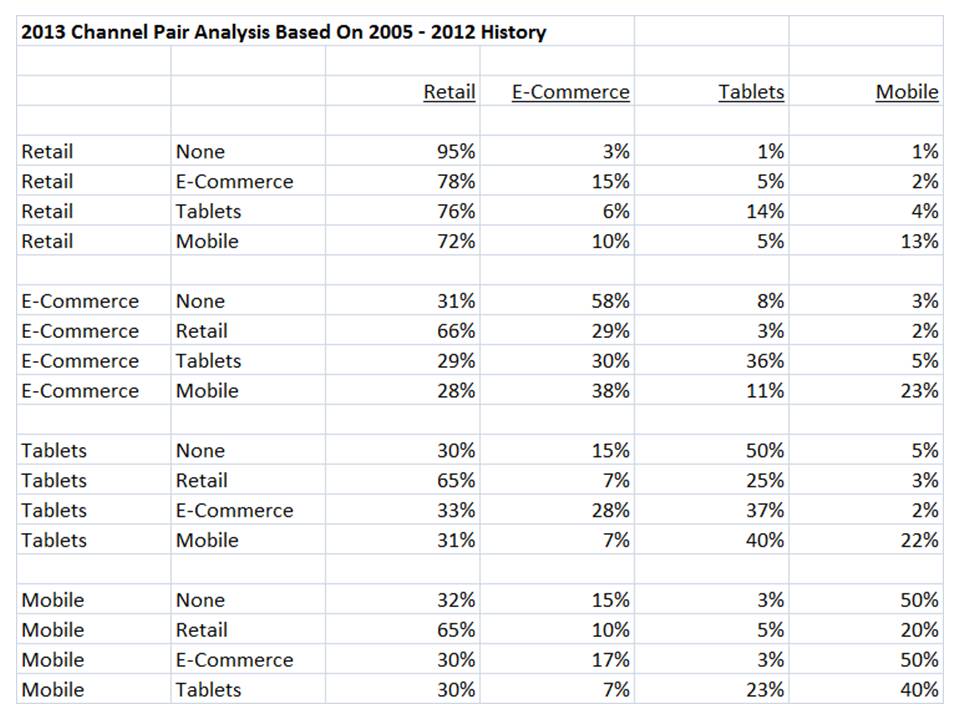
Take a look at any row in the table that has "None" in the second column.  These are customers that only buy from one channel.

By the way, the majority of customers in your database only buy from one channel.  We spend all of our time analyzing omnichannel customers, when in reality, we should be spending a disproportionate amount of time analyzing single-channel customers!

Retail Only Buyers:  95% of future demand is in-store.  This tells us that, for these customers, digital is there to support the in-store experience.  I know, the experts don't want to hear this, but analyze your own data, and you're likely to see a similar outcome.  For retail brands, most of the customers are retail-only, and most of the future sales from this audience are in-store.  The digital experience supports in-store purchasing activity, an important strategic finding.

E-Commerce Only Buyers:  58% of future demand is via e-commerce, while 11% is via tablets/mobile.  About 20% of future online activity is bleeding out of e-commerce, into newer digital channels.  Unless mobile/tablet customers migrate back to e-commerce at the same rate, e-commerce is dying a slow death.  You don't hear the pundits talk about this, because, well, digital advocates just don't want to believe this finding!  Go look at your own data.  What do you observe?

Tablet Only Buyers:  50% of future demand is via tablets, 15% via e-commerce ... ok, this is a very interesting finding.  In reality, tablet customers are switching to e-commerce at FASTER rates than e-commerce buyers are switching to tablets.  We just validated the opposite hypothesis!  Now the new media pundits will get frustrated!  This finding tells us that e-commerce customers want to try tablets/mobile, but may find that experience not fully developed, driving customers back to e-commerce.

Mobile Only Buyers:  50% of future demand is via mobile, 15% via e-commerce ... again, the customer is actually switching back to e-commerce faster than e-commerce customers are switching to tablets/mobile.

So this analysis didn't go where I thought it was going, when I reviewed e-commerce only buyers, did it?  Fascinating!  At this time, customers are switching from tablets/mobile to e-commerce faster than they are switching from e-commerce to tablets/mobile.

By the way ... the relationships in this table (above) are very, VERY similar to the relationships observed when e-commerce broke on the scene in the late 1990s ... customers left the call center to try e-commerce, then shifted back to the call center.  This trend didn't hold - that's why you run this analysis every month/quarter, to understand how customer behavior is shifting.

April 03, 2013

#Omnichannel Future - Channel Pairs Part 3

We're having fun, aren't we?

Sure, I get it.  It's entertaining to hear omnichannel thought leaders describe improbable versions of a gloriously digital future.

It's more appropriate, however, to analyze your own data, and make your own decisions based on how your own customers are behaving.

So let's do more of that.  Take a look at the Mobile / Retail row of the table.  These customers spent more money on mobile phones than any other channel.

Take a look at where these customers migrate, in the future.
  • Retail = 65%.
  • E-Commerce = 10%.
  • Tablets = 5%.
  • Mobile = 20%.
This tells us a lot about how we'll prioritize future strategies.  Retail, clearly, is the driver among this customer audience.  For this business, retail isn't dying.  Retail, instead, is the "sun" of this solar system.

More important, however, is the relationship between mobile and e-commerce.  Notice that, in the future, these customers spend twice as much via mobile as they spend via e-commerce.

For this customer segment, the future aligns with an in-store experience supported with mobile.  The e-commerce channel, surprisingly, is the one that is dying, not the in-store experience.

This data is readily available in your customer database.  Go analyze it!  The secrets of your business lie in your own customer database.

March 28, 2013

#Omnichannel Future - Channel Pairs Part 2

Let's take a look at another channel pair.

Review the E-Commerce / Tablets row.  This is an interesting row, because these customers have spent more, historically, on e-commerce than on tablets.  The key with this row, of course, is what these customers do in the future.

Take a peek at the future.

  • Retail = 29%.
  • E-Commerce = 30%.
  • Tablets = 36%.
  • Mobile = 5%.
Ohhhhh, this result is absolutely delicious, isn't it?

The historical preference is e-commerce.  The future preference is a mix of retail, e-commerce, and tablets, with a skew to tablets.

This illustrates a customer that is in transition ... the customer is slowly switching from e-commerce to tablets.  This tells you that your tablet-based investments are appropriate.  Just as important, the customer spends nearly 30% of future volume in stores, telling you that you must have synergy between retail and tablets.

Next week, we'll analyze additional channel pairs.  It should be obvious to you, by now, that channel pairs help us visualize how our customers are evolving and changing, providing us with the information we need to determine future strategies.

March 27, 2013

#Omnichannel Future - Channel Pairs

If we want to understand what our omnichannel future holds, we should look at our own customer data for clues.

Many of us now categorize physical channels based on a Retail / E-Commerce / Tablets / Mobile Phone framework.  Using this framework, we can see how trends are playing out.

Take a look at the Retail / Mobile channel pair ... the fourth row in the table.  These customers spent more weighted dollars in retail than any other channel, with mobile phones in second place.

  • 72% of future demand happens in retail stores.
  • 10% of future demand happens in e-commerce.
  • 5% of future demand happens in tablets.
  • 13% of future demand happens in mobile.
In this case, the retail/mobile customer spends the vast majority of future demand in stores.  In this case, you'd say that mobile is largely supportive of the retail store experience.  Given this development, you'd build a mobile experience that is highly integrated with your store experience.

Tomorrow, we'll look at another channel pair.

March 26, 2013

Where Is My #Omnichannel Business Headed? Start With Channel Pairs

An awful lot of omnichannel experts seem to know what the future holds.

Fortunately, you don't have to listen to their guesses.  You have actual data, based on how your customers (not generic consumers) perform.

All you have to do is perform a weighted channel pair analysis.

Remember weighted channel pairs?

We sum weighted demand by physical channel ... for example, retail, e-commerce, tablets, and mobile.

  • Transactions 0-12 Months Ago = Demand * 1.00.
  • Transactions 13-24 Months Ago = Demand * 0.50.
  • Transactions 25-36 Months Ago = Demand * 0.25.
  • Transactions 37-48 Months Ago = Demand * 0.15.
  • Transactions 49+ Months Ago = Demand * 0.10.
Then we rank order the pairs, based on the channels that generate the most weighted demand.

Here's an example:
  • Retail 0-12 Months Ago = $100 (weighted = 100*1.00 = 100).
  • Tablets 0-12 Months Ago = $40 (weighted = 40*1.00 = 40).
  • E-Commerce 13-24 Months Ago = $180 (weighted = 180*0.50 = 90).
This customer possesses a Retail / E-Commerce channel pair.

Tomorrow, we'll analyze one specific channel pair.

March 25, 2013

The #Omnichannel Challenge - Forecasting Sales

Here's the challenge that nobody wants to talk about.

We know that mobile is growing, exponentially.  Some businesses (not retailers) generate 30% or more of volume via mobile.  Most businesses, especially those catering to a customer over the age of 45, generate a very small ratio of sales via mobile.

When newer channels "explode", we make an invalid assumption ... we assume that the new channel will result in an increase in total sales.

It is more likely, however, that the new channel will cannibalize existing channels.  Credit cards and 1-800 numbers eliminated the need for customers to mail checks.  E-commerce ended the call center.  And rest assured, mobile will end something.

The only question, then, is this ... "what channel will be cannibalized at the expense of mobile?"
  • E-commerce.
  • Retail.
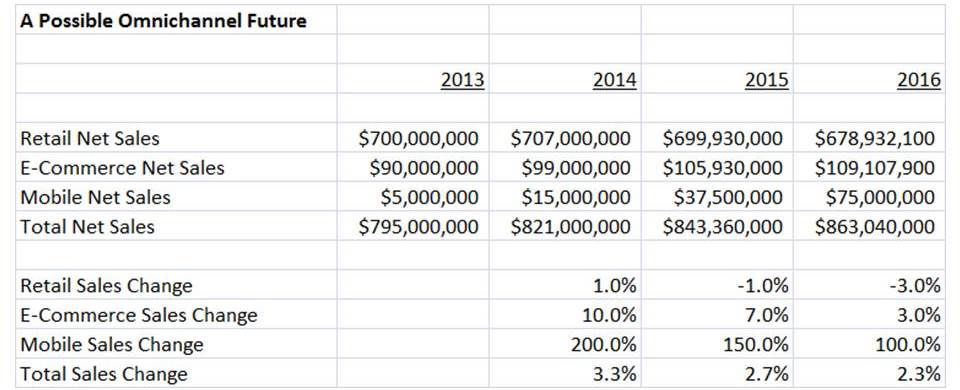
Look at our example, above.  This is a reasonable forecast for a large retailer.  Omnichannel experts tell us that customers will use the retail channel as an "experience channel".  They tell us that retail will not be where sales are generated, in the future.

Ok, let's accept the premise (flawed though it may be).  In our example above, if retail sales begin to drop (see 2015 and then 2016), then we must get a dramatic increase in e-commerce + mobile sales to offset the retail drop --- or the retailer goes out of business due to retail debt obligations.

If the omnichannel experts are right, then mobile is going to explode, e-commerce growth is going to slow (causing e-commerce folks to add mobile to their totals to keep e-commerce relevant when, really, it is being replaced by mobile), and retail is going to shrink.

This will require mobile to really, really explode, in order to keep the total net sales line growing.  You have to project some really big mobile numbers to make this happen.  It will be fun to watch, no doubt.

March 24, 2013

Barnes and Noble: #Omnichannel Struggles

Have you had a chance to read through the most recent 10-Q for Barnes & Noble?  Click here to take a peek.

Barnes and Noble continue to generate a loss - and according to the profit and loss statement, the loss is in the Nook division.

We hear an awful lot about omnichannel, especially from the retail side of the spectrum.  We're told that we have to do the following (at minimum):
  • Align inventory across channels.
  • Align creative strategy across channels.
  • Same promotions in all channels.
  • Price parity, where reasonable, across all channels.
  • Be everywhere your customer is by participating in an explosion of channels.
If businesses do this, then omnichannel experts suggest that profit should be robust - because the business is meeting the needs of the customer.

Does Barnes and Noble meet the needs of the omnichannel customer?  Absolutely!
  • Inventory available via Nook (digital), e-commerce, or in-store.  How do you beat that?
  • Digital device (Nook), or available on iOS and Android devices via an app.  How do you beat that?
  • Similar book-based merchandise assortment to the competition (Amazon).
And yet, Barnes and Noble struggles to generate a profit.  The Nook division appears to be losing hundreds of millions of dollars, and it appears that sales of the Nook device are in decline ... content was +6.8% last quarter.

If omnichannel strategies are so critical to success, then wouldn't Barnes and Noble, with retail, e-commerce, and digital (Nook) have an enormous advantage over Amazon, which doesn't have the bricks 'n mortar advantage?

You can't blame the failure on merchandise (same merchandise as Amazon).

Why does an omnichannel strategy, one that should guarantee success for Barnes and Noble, lead to the opposite outcome?

Discuss.  And discuss what this truly means for the validity of omnichannel strategies.

March 21, 2013

Honest #Omnichannel Assessment From Internet Retailer

Give this little ditty from Jack Love at Internet Retailer a read.
Key Takeaways:
  • He cites growth rates, showing that e-commerce grows faster at pure plays than at retail brands.  I see this in my work, too.
  • Stock prices are tepid.
  • Comp store sales have to be lousy, and are then masked by e-commerce growth rates to report overall totals that sound impressive but truly aren't.  I see this in my work, too.
I've worked on more than 100 projects in the past six years.  When you force e-commerce (and now mobile/social) to be a slave to retail, you do get an omnichannel outcome.  And that's ok.  But you don't achieve the potential of e-commerce (and now mobile).

We need more people to speak the truth.  Just analyze the numbers, the proof is in the pudding.

And I know, most of you will think I'm wrong, here.  You'll quote something from Forrester or Gartner or Shop.org, where 1,143 likely shoppers were surveyed and 43 executives were cited.  You'll show me how "everybody" is talking about omnichannel, so it has to be the right way for retailers to go.

You can help me.  Find non-survey research that shows how a business like Macy's, after subtracting the impact of merchandise strategy and marketing strategy, grew by 10% solely due to multichannel / omnichannel strategies.  Find this information, and I'll happily publish it here on this blog, and I will cite you as well.

February 28, 2013

Barnes and Noble: #Omnichannel Fail?

You probably had an opportunity to review this little ditty from Barnes & Noble (click here).

A few questions for the omnichannel marketing community, a group that tells us that bricks 'n clicks and online and digital is far better than a single channel solution:

  1. Why would Amazon, with no retail, have a growing Kindle business, while B&N, with stores, be struggling?
  2. Why would B&N, with bricks 'n clicks and e-commerce and digital (Nook), be struggling, even after the top competitor (Borders) went out of business?
Barnes & Noble does what omnichannel experts love - bricks 'n clicks, e-commerce, and digital (Nook).  Retail competition was vacated when Borders failed.

And yet, B&N is struggling to compete with Amazon, a single-channel competitor.

On Twitter, I received this comment:
  • "It's not omnichannel's fault.  B&N was a sinking ship.  If anything, omnichannel is slowing down the sinking of the ship."
Why is it that when a business is doing well (say Macy's), we credit omnichannel for the success, but when a business is clearly failing in competition with a single-channel entity, we blame the victim?

Ok, time for your thoughts.  If total sales equate to 100% of a business, what % is caused by omnichannel?

February 21, 2013

Omnichannel and People: Macys and Belk

Experts outline two recent executive announcements as proof that omnichannel is the future.
It's been 18 years (1995) since I first heard an executive (at Eddie Bauer) mention the critical importance of "multichannel" - in a meeting, he discussed how digital and retail needed to align to better serve the customer, while everybody else offered blank stares in response.  This individual might be responsible for the phrase "multichannel customers are worth 8 times as much as single channel customers", and I ran the query (under protest, of course)!

In other words, the experts have been beating retailers up for almost two decades ... two decades of dissatisfaction with how retailers respond to first e-commerce, and now, mobile.

When you appoint an executive to lead an area, you are saying that you have a people problem.  I'm not saying that either company is better off or worse off than others.  I am saying that it is terribly difficult to get 150,000 employees (or 150 employees) to all pull in the same direction.  So you put somebody in charge, and you expect that person to make things happen.

Hiring omnichannel executives isn't proof that omnichannel arrived.

Hiring omnichannel executives is proof that it is terribly difficult to get people, human beings, to all do something deemed important by Sr. Management.

August 14, 2012

Omnichannel Marketing

Yesterday, I asked all of the omnichannel marketing experts to answer hard questions about omnichannel marketing.  Here's the article (click here), for your reference.  I promised to publish any link or documentation that illustrates that omnichannel marketing yields net sales and profit increases, on an annual basis.

Certainly, if omnichannel marketing (and it's cousin, big data) is so effective, somebody would offer a link to a case study proving the effectiveness of the craft, right?

How many links did I get?

Zero.

More than 5,000 marketing experts were exposed to the article.  One person on Twitter bothered to take up the omnichannel torch.  Not one person submitted a link to a case study that proves that omnichannel generates annual sales and profit.

Why, dear readers, is omnichannel marketing being rammed down our throats by the vendor community, consultants, research organizations, and conference leaders?

Maybe it is time to ask more of those who don't work in the trenches with you.  Maybe it is time for research organizations, vendors, consultants, and conference leaders to stop trying to garner eyeballs, and start focusing on ways for you to generate more profit.

August 13, 2012

An Open Letter To Omnichannel Advocates

Dear Omnichannel Advocates:

It's been an amazing couple of years.  In that time, you invented terms like "omnichannel" and "big data".  Both terms require each other, and therefore, require the purchase of research reports, attendance at conferences, and finally, expensive software installations that require consulting services to retrain employees who spent a lifetime dealing with "small data".  All of these purchases and services benefit the omnichannel advocate.

You frequently follow a compelling narrative.  You present a complex array of customer behavior, one that seems almost unmanageable.  You present us with a customer possessing nearly limitless sophistication.  She begins with search, visiting websites, conducting research.  Or maybe she receives a catalog or a personalized and highly relevant email campaign that drives her to a website.  Regardless, our intrepid customer, with considerable time and resources at her disposal, eventually drives to a store to physically look at merchandise.  This is a key inflection point in the purchase process.  In the old days (2010), the customer would buy something in-store.  But in modern times (2012), the customer "showrooms", she pulls out her mobile device, browsing for cheaper prices and social media reviews, dodging retargeting strategies by competing retailers via display ads.  With luck, the customer chooses an omnichannel brand utilizing big data to "be everywhere" the customer is.  At worst case, the customer buys from Amazon, an outcome more devastating than the customer buying nothing.  The narrative ends with a terrifying view of the future, one where "brands" that fail to adopt an omnichannel framework are destined for the scrap heap of history, destined to become the next Montgomery Wards, while Amazon continues an unstoppable rampage through the commerce landscape.

When you mix big data and fear in a marketing blender, you get "omnichannel".

Most important, you put the reader at a knowledge disadvantage.  The poor reader works at Ann Taylor, he certainly isn't leveraging big data, and even though his business is profitable, he is, according to the narrative, failing miserably, and is just a few years from being out of business.  He only possesses a series of legacy reports that are downloaded into Excel, reports that only tell him what sold, and when it sold.  He can't possibly see that his customer is researching alternatives on Facebook.  He has no idea that a competitor is offering a comparable product at 20% off.  His search reporting is terrible.  His direct mail efforts are feckless.  His marketing efforts are in silos across the company, not coordinated, not integrated, not effective.  He's about to lose market share to Zappos, a division of Amazon.  He'll be out of business in three years.  Everything he does has been pronounced "dead".

The reader is told that this problem can be solved by being "omnichannel".

I have a few questions for you, the omnichannel advocate.
  • You promote an omnichannel strategy.  And yet, Amazon is anything but omnichannel.  Amazon is not "social" in the way that Best Buy (Twelpforce) is social. Amazon is not in retail.  Amazon does not leverage offline advertising in a scalable way.  Amazon does not leverage direct mail in an effective way.  But Amazon is systematically crushing companies that leverage various elements of the omnichannel strategies proposed by omnichannel advocates.  How do you explain the fact that Amazon essentially does the opposite of your proposed strategy, and easily defeats companies employing various iterations of your strategy?  And you can't answer "they avoid collection of sales tax", since brands that are forced to collect sales tax after being tax-free rarely see a measurable drop in sales once sales tax is collected.
  • How do you reconcile the fact that you believe customers are "omnichannel", and yet, when you actually mine customer data, the majority of customers have a single-channel preference that doesn't often change? Have you actually done the analysis, or are you reciting survey data from research organizations?  Discuss.
  • What proof do you have, today, that a "brand" that fails to adopt an omnichannel strategy will be out of business in the near future?  Please provide simulation results that demonstrate how Ann Taylor or Chicos will be driven out of business, soon.  In fact, if you provide links to the simulation results in the comments section, I will publish your simulations in a future blog post. 
  • How do you explain companies like One Kings Lane, who go from $0 to hundreds of millions of dollars in annual sales in just a few years, by employing discount-based curation strategies that are largely independent of the omnichannel strategies you demand retailers participate in?  One can make a strong argument that One Kings Lane operates independent of the omnichannel strategies folks are proposing.  Do you have a case study of a business employing an omnichannel strategy, one that yields a sales increase over two years of several hundred million dollars?
  • This year, JCP changed a pricing strategy, and saw sales drop by 15%.  In other words, we know that pricing strategies are critically important to the customer.  If pricing strategies account for a +/- 15% change in net sales, how much do your omnichannel big data simulations suggest that omnichannel strategies impact net sales? 0%?  2%?  12%?  22%?  32%?  Please show the data that illustrates or is used to simulate the sales increase you estimate.
  • You claim that "showrooming" is a huge problem.  Have you stood in a Best Buy store and physically calculated the percentage of customers who pull out a mobile device and actively showroom in the store?  Have you segmented those who actually perform this activity by age cohort?  In the comments section of this post, please publish your findings.
  • You consistently claim that "best customers do everything", and therefore suggest that best customers are omnichannel, and then make the leap of faith that if a retailer becomes "omnichannel", the retailer will cause average customers to become more likely to behave in an omnichannel manner, like best customers behave, thereby causing unfettered sales increases.  Please show the data mining results and/or simulations that demonstrate that a once-a-year buyer will become far more likely to spend more if the retailer advocates an omnichannel strategy that appeals to best customers.  Please provide a link to your research in the comments section of this blog post.
  • If you were going to start a business from scratch, today, would you start a business with a fully integrated omnichannel strategy that includes direct mail and websites and social media and mobile and retail stores and online marketing, or would you start with a merchandising concept employed within limited channels (Amazon, Zappos, One Kings Lane, eBags, Chasing Fireflies)?  If your instinct suggests the latter, why do you advocate the former?
  • Explain how Apple, with no tangible social media strategy, outperforms companies that fully leverage a social media strategy in the spirit of the ominchannel framework you advocate?  If your answer is "product" or "merchandise", then why shouldn't businesses prioritize product over channel strategy?
  • You frequently advocate an integrated marketing/merchandising/creative organization, where all decisions are made by a centralized organization, providing one coherent representation of the brand.  You frequently advocate the elimination of what you call "silos".  Prove that your style of organizational structure leads to a healthy increase in annual sales and profit, and provide links to the case studies or simulations that demonstrate that your ideas lead to a 10% or better annual sales increase.
  • Describe why retailers must integrate all marketing activities within one department via the elimination of silos, but your organization frequently operates within the context of silos (sales, marketing).  Why is your organization allowed to have silos, but the solutions you sell require the client to have full integration of marketing activities?
  • Yes, I understand, there's a lot of data, and when it is braided together across fifty channels, you have the potential for a wonderful CRM-fueled situation where a customer tweets about a problem with an iPad and seconds later a vendor provides a solution to the customer.  But that capability existed four years ago, in real time.  And that capability existed thirteen years ago in email, just not in real time.  Why do you believe the customer demands that this capability exist as part of a seamless experience, and you believe that during the multichannel era the customer also demanded a seamless experience, and yet, for more than a decade, the promise has not been realized?  The technology existed.  The customer allegedly wanted it.  Why didn't it happen, and why do you think it will be different this time?
  • We were told 5-10 years ago that retailers would be out of business if they didn't employ multichannel strategies.  Most retailers did not employ multichannel strategies as advocated by the vendor community, and survived nicely.  And companies that did employ multichannel strategies (Borders, Circuit City) are out of business.  Please reconcile these inconsistencies, and then discuss if similar inconsistencies may exist for retailers who do/do not employ omnichannel strategies.  Furthermore, if there are other reasons that cause businesses to succeed/fail, how important are those reasons in comparison to being "omnichannel"?  Should the retailer focus on other issues instead, if resources are limited and other issues provide a greater return on investment?
  • You demand that email be part of an omnichannel strategy, and advocate that "email relevancy" is a critical step in the success chain.  When was it acceptable for email marketing to not be relevant?
  • We keep hearing that social media is a huge component of big data and omnichannel.  And yet, unless you're a startup catering to an under-30 audience, social media never accounts for more than a couple of percentage points of annual sales, total.  Please explain why social is a critical component of an omnichannel strategy, when 95% of businesses with sales over $20,000,000 generate almost no sales whatsoever from social media, even those who apply all possible best practices to the craft?
  • Catalogers were told they had to become "multichannel" or they would die.  They became multichannel.  They were told that catalogs drove orders to other channels.  However, by keeping the catalog "in the mix", most catalogers maintained their traditional audience and as a consequence, did not relate to a younger audience.  Today, most catalogers have an age discrepancy that disconnects them from the average consumer, now catering to a 55+ rural audience.  Since omnichannel is just an extension of multichannel, are you advocating a circumstance that will cause companies employing an omnichannel strategy to eventually serve an older-than-average customer?  Does your strategy potentially damage the customer files of businesses that employ an omnichannel strategy, given what we already know about the evolution of the catalog multichannel customer?
  • Often, multichannel advocates use campaign results to prove that integrated omnichannel marketing campaigns work.  However, annual results (repurchase rate, orders per buyer, items per order) seldom change.  How do you reconcile the fact that your omnichannel campaigns change weekly customer behavior but do not change annual customer behavior?  And if omnichannel campaigns do not change annual customer behavior, then why employ them?
  • The promise of "big data" in an omnichannel framework is that artificial intelligence will detect customer behavior unseen by humans, thereby eliminating the "gut feel" and "instinct" that historically drove business success.  And yet, the artificial intelligence that is used in a "big data" framework is not fundamentally different from the artificial intelligence used for the past twenty years by "small data" practitioners.  Why do you believe that the same methodologies that have been largely ignored by non-geeky business-focused individuals for twenty years will suddenly be embraced by non-geeky business-focused individuals within a big data framework?
Of course, omnichannel is important.  I am asking you to separate the importance from the facts that prove it is important.  Please provide proof in the comments section.  And by proof, I don't mean a Woodside Research report projecting what the world will look like in 2016, and I don't want the results of a one-off campaign executed over a two-week period of time in late 2011.  I want actual proof, or the simulations that lead to the possibility of proof.  If you're defending omnichannnel/big-data, then you are a data person, so go get the data!!! 

I will publish credible responses on this blog on Wednesday morning.

Thanks,
Kevin

June 17, 2012

Dear Catalog CEOs: Omnichannel Power Rankings

Dear Catalog CEOs:


Maybe you've read those Power Rankings on ESPN or elsewhere ... wins and losses don't actually matter, what matters is how a group of sportswriters ranks teams!  Well, at least it's a good way to generate page views.


We'll do that here, from ten to one.  Let's not take the actual rankings too seriously, ok?!  I mean, it's probably not worth debating whether Social Media should move up or down a notch!


#10 = Multichannel:  A Woodside Research analyst recently stated that "Multichannel is Dead".  This was fun, of course, because for a decade prior, Woodside Research told marketers that they "had" to be Multichannel or they'd be ... wait for it ... Dead!!!!  Multichannel never truly existed.  Multichannel was a concept created by vendors, bloggers, research organizations, and trade journals to tie the online future to the offline past.  Sales did not increase if you linked everything together in a delicious blend of integrated goodness ... if sales did increase because of it, Circuit City's industry leading "buy online, pickup in stores" would have guaranteed their future, right?


#9 = Omnichannel:  It's hard to believe that you can have an Omnichannel Power Ranking and Omnichannel only ranks at #9, but that's the case.  Have you heard all this blather about "Omnichannel" coming out of Woodside Research and other pundits?  Tell me if this sounds familiar to you.  Online is being overtaken by mobile/social/local, so instead of moving to the future, you have to be "Omnichannel" ...  you have to do offline and online and mobile and social and local.  Oh boy!!!  It's the e-commerce folks demanding a seat at the table of the future, trying to link the past (e-commerce) to the future.  We've been there, before (see #10 above).  It doesn't work.  The more you integrate, the harder it is to execute ... and the harder it is to execute, the easier it is for single-channel newbie organizations to own the future.


#8 = Catalogs:  Yes, I know, you're offended that catalogs only come in at number eight.  But have you had a chance to read this little ditty from the DMA via Multichannel Merchant (click here)?  The authors conclude that even though response rates are down 25% over the past decade, direct mail still rocks!!  The author cites that, even with lowered response rates, direct mail will still have an important role well into the future.  Really?  Really?  What happens when response rates drop another 25% this decade?  What happens when costs increase but response drops another 25%?  What happens when direct mail users (55+, rural) become 65+, rural users?  How we can conclude anything other than an unprecedented transformation of an industry is beyond me?!


#7 = Social Media:  Has there ever been a technology that is more hyped than social media?  If you cater to an under-35 audience, social media is built into the fabric of the brand, much like a call center is critical to a catalog brand.  If you cater to customers over the age of 45, social media hype borders on being fraudulent!  If you cater to a customer over the age of 45, you're told you "must" embrace social media or "tempt obsolescence at your own risk".  We have social media all wrong ... we attribute word-of-mouth, an amazing marketing strategy that has been around since Adam and Eve, to social media.  Separate the two, and social media is much less influential.


#6 = Search:  Pundits say that search is dead, lamenting Google's theoretical demise.  Here's the deal with all of this fluff.  I don't know why we assume that every individual in the United States will use every technology at the same rate.  Each channel has unique advantages to specific demographic profiles.  Search matters to Jennifer, it's how she hunts for information.  It's irrelevant that Jasmine trusts friends more than she trusts Google, fine, let her go!  Search is the tool that Gen-X uses to make sense of the internet, just like Facebook is the tool that Jasmine used to make sense of the web.  You don't integrate search into everything, you capitalize on search within the demographic profile that uses it.  Search is just fine with Jennifer's generation.  Figure something else out for Jasmine and Judy.


#5 = Showrooming:  This is the concept that an army of price-sensitive mobile advocates are driving sixteen miles to go to a Best Buy store to research products in-person, then instead of buying the item at Best Buy along with 8% sales tax, the customer either gets in her car and drives another sixteen miles home to buy the item online, or buys the item online, right there in the Best Buy store, while blue-shirted Twelpforce-infused employees offer extended warranties as a competitive advantage.  This is great in theory, except it doesn't pass the smell test in three important ways.  First, if this was truly happening at scale, then we'd see mobile (don't count tablets in mobile, folks, nobody is standing there in a Best Buy store holding a tablet) transactions at more than one or two percent of total e-commerce transactions.  Second, if this was truly happening at scale, Best Buy would be posting -15% or -20% comps, causing a collapse of the entire retail model (the collapse of the entire retail model may well be happening anyway, but that's a discussion for another day).  Third, if this was truly happening at scale, then Best Buy would benefit from "reverse effects" ... meaning that customers would be using Wal-Mart and Target and Frye's and just about any other retailer to showroom for Best Buy, right?  The reality is that we are in the top of the first inning when it comes to figuring out how customers will integrate mobile with retail, but the trend is very important, and will turn out differently than the pundits tell us it will turn out.  Remember, e-commerce pundits told us that retail was destined for the scrapheap ... fifteen years later, retail may be destined for the scrapheap, but e-commerce didn't cause it to happen.  Showrooming won't kill retail, either.  By the way, if you think that showrooming is so darn important, go spend three hours at a Best Buy store, and count how many customers, out of 100, are actually engaged in the process of showrooming.  Seriously, go do it.  Record a video.  The numbers (and behavior) are self-evident.


#4 = Apple:  At some point, we have to classify Apple as a channel of it's own.  They are responsible for tablets.  They are responsible for the iPhone and ultimately for the competition that was caused by the creation of the iPhone, which came from the iPod which transformed the music industry.  An entire industry around apps was created because of Apple.  They integrate across devices, but are self-contained within their own ecosystem ... devices literally speaking to each other ... and you'll soon be controlling you Mac with gestures.  What company, other than maybe Amazon, influences your day-to-day life as much as Apple? 


#3 = Mobile:  Though one can make the argument that mobile, as a channel, is no different than Apple ... mobile / Apple are fundamentally one and the same ... with Android/Google providing mild and directionally similar competition.  If you care about Jasmine, you care about mobile, so you care about Apple.  If you care about Judy, mobile is irrelevant.  And honestly, it's time to toss tablets out of the mobile discussion.  Throw 'em out, folks!  Tablets are a whole 'nuther genre of technology, used differently by people.  When you're walking out in public, maybe at a farmer's market, count how many people are thumbing information into a smartphone vs. a tablet.


#2 = Email:  Sure, email is dead, as the pundits say.  Except, have you noticed that email is the only channel that spans all generations of commerce?  Brands that cater to Judy use email marketing.  Brands that cater to Jennifer thrive on email marketing.  Brands that speak to Jasmine have email as one of the few channels that allows them to push a message to Jasmine. Sure, you only generate $0.10 per email sent to a customer ... but you also send 150 messages a year, so that's $15.00 of incremental demand and $6.00 of incremental profit, per customer, that you wouldn't otherwise generate.  If the channel is dead, go ahead, ignore the volume.  I know of classic direct marketers that generate $10,000,000 of annual profit, but lose sight of the fact that they generate $0.10 of demand per email delivered across a list of 1,000,000 names and 100 campaigns, yielding $10,000,000 of annual demand and $4,000,000 of annual profit ... 40% of total company profit from email!!!  It happens all of the time.  Nobody looks at the data the right way to make the connection.  Those that do look at the data that way have a huge competitive advantage.


#1 = Word of Mouth:  We mistake all channels for the activity that fuels the channel.  Word of mouth matters.  Pinterest, in and of itself, is not new or interesting.  For whatever reason, however, it benefited from word of mouth.  When people talk about things going "viral", they're really talking about word of mouth.  Word of mouth fuels modern online activity, especially among Jasmine's generation.  That being said, word of mouth has always been there.  Catalogers, do you remember when you used to send out two million catalog requests a month?  That happened because of old-school world of mouth!  We spend so much time trying to astroturf "viral" activities, without ever thinking about what causes word of mouth to happen.  Great products with great and sharable stories ... that seems to fuel word of mouth.  Among Jasmine's generation, there seems to be a resurgence in word of mouth.


Terms that did not make the top ten list:  CRM ... Social CRM ... Net Promoter Score ... Optimization ... Purchase Funnels ... Local ... Personalization ... Relevancy ... Engagement ... Social Search ... Branding ... Infographics ... Big Data ... The Cloud ... Big Data Meets The Cloud ... Private Clouds within The Cloud ... Infographics about Big Data Meeting Private Clouds in The Cloud ... Disruption ... Facebook ... Twitter ... Amazon ... Kindle ... Nook ... Viewthroughs ... Viewable Impressions ... Open-Source ... Virtual Anything ... Pinterest ... Blackberry ... Microsoft ... Yammer ... Content Marketing ... Yahoo ... Digital Analytics, Digital Marketers, and anything else Digital ... Square ... Video on Demand ... Co-Ops ... Social Commerce ... Facebook Commerce ... Instagram ... and an infinite number of topics that render anything that currently exists "dead".

Package And A Snack

I ordered a cable ( from Bloom Audio ) that connects my Qudelix Q5k bluetooth dac/amp to my Apos Gremlin hybrid tube amp (2.5mm balanced t...