April 02, 2013

Smartphone Contract: Your Decide The Right Omnichannel Offer!

Here's one for you omnichannel fans out there.

My smartphone contract runs out on April 23.  While visiting a Best Buy store, the rep tells me that he can get me a new phone on April 16, just stop by and see him and he'll get me a new phone one week early.

So I email my smartphone provider, communicating the situation.  Here's the response I received (after being told that I was a valued, loyal subscriber).
  1. I can upgrade my phone, in-store, on April 23.
  2. I can upgrade my phone at Best Buy on April 16.
  3. I can upgrade my phone over the internet today.
Ok, omnichannel gurus.  Time for your input:
  1. We're told that, in order to be an outstanding omnichannel retailer, we have to tear down silos and align our business equally, across all channels.  This implies that each channel should adhere to an April 23 phone upgrade schedule, correct?  Because 4/23 is the date that my contract runs out.  You can't get a phone ahead of schedule, or you'd have chaos.
  2. We're also told that we're supposed to personalize our experience and reward our best customers, reacting in real time where possible.  This implies that I should feel honored to be eligible for an upgrade, because my smartphone provider is treating me better than the April 23 deadline they impose for average customers.  The personalization / CRM community would likely laud this kind customer service initiative, while omnichannel experts would pan it as another example of silo-based channel nonsense.
Now, I suppose both parties might be happy if the upgrade date were today, in any channel, and all systems between retailers linked data together properly (Big Data advocates are heard cheering from near and far).

But given an imperfect world, wouldn't you rather that my smartphone provider approach the problem in a silo-based manner than in an integrated, but less customer friendly omnichannel manner?

Discuss.

April 01, 2013

Important Project Links

I get a lot of requests for links to the project work I provide for clients.  Let's get you those links, right here, right now!  Click on the link next to each bullet point.

Recent Projects:
  • Private Equity business evaluation.
  • Optimal price point analysis.
  • Seasonal customer buying behavior analysis.
  • Optimal targeted catalog assortment analysis.
  • Merchandise Forensics (multiple projects).
  • Catalog PhD (multiple, multiple projects).
  • Catalog Startup - merchandising and contact strategy development.
  • Online Startup - customer behavior evaluation and future sales potential via five-year forecast.
  • Advisory Board (I am accepting, on a limited basis, Board of Directors opportunities).
  • Marketing Attribution across All Marketing Channels.
  • New Store forecast model by Geography.
  • B2B optimal housefile and acquisition contact strategy.
  • Judy / Jennifer / Jasmine customer analysis and five year demand forecast.
Once I get into mid-April, projects really ramp up, through Labor Day.  Please get in the queue now, don't wait until your competitors snatch all of the project bandwidth from you!

March 31, 2013

Dear Catalog CEOs: Cannibalization

Dear Catalog CEOs:

One of the most interesting aspects of marketing, unique largely to catalog and email marketing, is the concept of cannibalization.

Simply put, when you fail to market during one timeframe, you lose sales, but sales also shift into other timeframes.

Take a look at this:

The second test group did not receive a catalog in the second month.  When this happened, demand moved out of the second month, and moved into the third month.

Similarly, when catalogs are not mailed at all, customers still spend 50% of the demand they would have spent otherwise (this is known as the "organic percentage").

Look at the last row ... send 0 catalogs, get $0 of catalog-attributed demand.  Send 2 catalogs, and you don't get $12 (as one might expect), instead, you get $14.  This is a classic case of catalogs cannibalizing each other.

Twenty or more years ago, when I worked at Lands' End, we measured the living daylights out of cannibalization.  Twenty years later, you're hard-pressed to find a cataloger who understands cannibalization.

Execute a test and measure it for yourself.  You'll be fascinated by what you learn.

Want to implement cannibalization findings into your business?  Contact me (click here) for your Catalog/Email PhD Project.

March 28, 2013

#Omnichannel Future - Channel Pairs Part 2

Let's take a look at another channel pair.

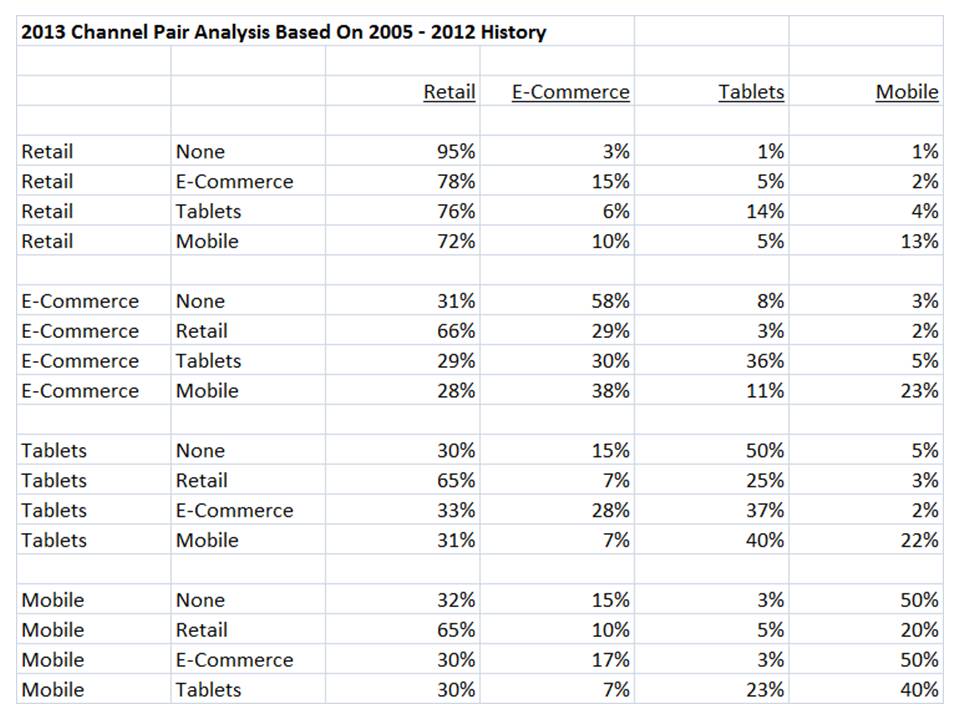
Review the E-Commerce / Tablets row.  This is an interesting row, because these customers have spent more, historically, on e-commerce than on tablets.  The key with this row, of course, is what these customers do in the future.

Take a peek at the future.

  • Retail = 29%.
  • E-Commerce = 30%.
  • Tablets = 36%.
  • Mobile = 5%.
Ohhhhh, this result is absolutely delicious, isn't it?

The historical preference is e-commerce.  The future preference is a mix of retail, e-commerce, and tablets, with a skew to tablets.

This illustrates a customer that is in transition ... the customer is slowly switching from e-commerce to tablets.  This tells you that your tablet-based investments are appropriate.  Just as important, the customer spends nearly 30% of future volume in stores, telling you that you must have synergy between retail and tablets.

Next week, we'll analyze additional channel pairs.  It should be obvious to you, by now, that channel pairs help us visualize how our customers are evolving and changing, providing us with the information we need to determine future strategies.

March 27, 2013

Merchandise Forensics Project Cost

If you're wondering how a Merchandise Forensics project is configured (and you want to know what a project costs), please click here.  

The Merchandise Forensics project is the second most popular project of the spring season, and is, to be honest, exceptionally inexpensive.  Few vendors offer this service, so contact me (click here) for your own Merchandise Forensics project, before my calendar fills up.

#Omnichannel Future - Channel Pairs

If we want to understand what our omnichannel future holds, we should look at our own customer data for clues.

Many of us now categorize physical channels based on a Retail / E-Commerce / Tablets / Mobile Phone framework.  Using this framework, we can see how trends are playing out.

Take a look at the Retail / Mobile channel pair ... the fourth row in the table.  These customers spent more weighted dollars in retail than any other channel, with mobile phones in second place.

  • 72% of future demand happens in retail stores.
  • 10% of future demand happens in e-commerce.
  • 5% of future demand happens in tablets.
  • 13% of future demand happens in mobile.
In this case, the retail/mobile customer spends the vast majority of future demand in stores.  In this case, you'd say that mobile is largely supportive of the retail store experience.  Given this development, you'd build a mobile experience that is highly integrated with your store experience.

Tomorrow, we'll look at another channel pair.

March 26, 2013

Where Is My #Omnichannel Business Headed? Start With Channel Pairs

An awful lot of omnichannel experts seem to know what the future holds.

Fortunately, you don't have to listen to their guesses.  You have actual data, based on how your customers (not generic consumers) perform.

All you have to do is perform a weighted channel pair analysis.

Remember weighted channel pairs?

We sum weighted demand by physical channel ... for example, retail, e-commerce, tablets, and mobile.

  • Transactions 0-12 Months Ago = Demand * 1.00.
  • Transactions 13-24 Months Ago = Demand * 0.50.
  • Transactions 25-36 Months Ago = Demand * 0.25.
  • Transactions 37-48 Months Ago = Demand * 0.15.
  • Transactions 49+ Months Ago = Demand * 0.10.
Then we rank order the pairs, based on the channels that generate the most weighted demand.

Here's an example:
  • Retail 0-12 Months Ago = $100 (weighted = 100*1.00 = 100).
  • Tablets 0-12 Months Ago = $40 (weighted = 40*1.00 = 40).
  • E-Commerce 13-24 Months Ago = $180 (weighted = 180*0.50 = 90).
This customer possesses a Retail / E-Commerce channel pair.

Tomorrow, we'll analyze one specific channel pair.

It's Forecast Season!

Somebody at your company sounded the alarm bells about November/December. Is that person right? Are you going to be below plan/budget? Or is...