January 28, 2014

And It You Are Discounting, Fewer Emails Become Necessary

Yesterday, I shared the concept of diminishing returns in email marketing. We predict how much a customer will spend in email marketing, annually, and then we apply costs and profitability estimates.

Here's the fundamental problem with email marketing.

Email marketing is synonymous with discounts and promotions. Email marketers ruined the discipline between 1997 - 2001, when, in a mad dash for monetized eyeballs, email marketers gave away the farm to get orders. 20% off, 30% off, free shipping, gift with purchase, 70% off clearance items, you name it, email marketers have done it.

When I analyze client data, it is terribly common to observe profit factors that are seven or eight points lower for email than for other channels. This happens, of course, because email orders are disproportionately skewed to discounts/promos, and therefore, convert less demand to profit.

In the example above, 40% of demand flows-through to profit. Let's assume that is the company average.

Now, let's assume that the email average is 30% - because of heavy discounting and promotions, only 30% of demand flows-through to profit. What happens to the profit and loss statement?


Optimal profit now happens at 50 contacts a year, not at 100 contacts a year.

Once again, discounting and promoting yields a bunch of unanticipated side effects.

Are you performing this style of analysis?

Do you use this style of analysis to determine how many emails to send to a customer, annually?

If not - contact me now (kevinh@minethatdata.com). Profit is laying on the ground, waiting to be picked up!

Or buy the book (print click here, Kindle version click here).

January 27, 2014

Marginal Email Subscribers - Less Is More!

There's a secret to email marketing that most folks don't know.

I'm here to tell you this secret.

Step 1: Create a model that predicts how much a customer will spend, on an annual basis, on your email marketing campaigns.

Step 2: Using a law of diminishing returns equation, predict what happens when you go from no email contacts to one per week, to two per week, to three per week, all the way up to six per week. Now, granted, these aren't cart abandonment programs, these are your typical mass-blast-style campaigns. Still, run through the exercise.

Step 3: Calculate the incremental cost to deliver an email message to a customer, on a variable basis. For many folks, this averages to about $0.003 per contact. That sounds like nothing ... until you extrapolate it to an annual basis. If you send an email message per weekday, then you're spending $0.75 per customer per year to send email campaigns ... and at that point, email marketing becomes identical to catalog marketing ... all of a sudden, you are required to make smart circulation decisions ... something the vast majority of email marketers have not been trained to do.

Step 4: Create the profit table illustrated above. The customer above is predicted to spend $4.00, on an annual basis, via email marketing. The customer is currently forecasted to receive 250 campaigns per year, 5 per week. At that level of contact, the customer will generate $0.78 profit on an annual basis. However, the most profitable strategy is to mail the customer 100 campaigns per year, generating $0.92 profit on an annual basis.

Step 5: Run the table in Step 4 for each customer in your database. Calculate the optimal number of email contacts to send to the customer, annually.

Step 6: Repeat / Rescore the file weekly.

You will find that email prospects and those with recency > 12 months are typically over-contacted. You can be more profitable by not contacting these customers as often.

Contact me (kevinh@minethatdata.com) for your own, customized, contact strategy analysis.

Or buy the booklet - $29 via Amazon (Print - Click Here) - or $10 via Kindle (Click Here).


January 26, 2014

Monday Mailbag

It's time for our new Monday tradition - real and imagined questions from real and imagined readers. Send me your questions (kevinh@minethatdata.com) and I'll answer them!

Our first question comes from Cynthia: "How do I take care of customers who return a lot of merchandise? Can I convince these customers to stop returning merchandise?"
  • Maybe.
  • Some items are pre-destined to have systemic returns issues, while other items will seldom be returned, if ever. Use the Merchandise Forensics framework to identify high-returns items, and work with your merchandising team to understand if high-returns items are still profitable.
  • Just as interesting, however, is how we manage high-returns customers. Once customers get in the habit of returning merchandise, customers will continue to return merchandise. This greatly lowers overall profitability. You can minimize how these customers ruin profitability by not emailing them. Seriously. Stop emailing these customers. Stop mailing catalogs to these customers. Stop retargeting to these customers. Just stop. There are millions of dollars of profit to be had (for larger-sized businesses) by not marketing to high-returns customers.
Our second question comes from Andy: "I work for a large brand. Our CFO told us that our social media efforts are meaningless - she said this in a large meeting, in front of my co-workers. My CFO is wrong. How do I prove she is wrong?"
  • This doesn't have to be a long, complicated, difficult analysis, Andy.
  • Social media, for 97% of the companies I work with, contributes +/- 1% of total volume, on an annual basis. To your CFO, that sounds like a tiny number, no doubt.
  • Let's say that you work for a billion dollar, mall-based retail brand. 1% of a billion dollars is a whopping $10,000,000 of annual sales. 
  • Sit down with your CFO, and ask your CFO to tell you how much of annual net sales flows-through to profit. For most businesses, this percentage is somewhere between 20% and 50% - I find that the average is +/- 40% for most businesses, depending on what the business sells. If it is 40%, then calculate 40% of the annual sales total generated by social media ... 40% of $10,000,000 is $4,000,000 profit.
  • Do you think your CFO will ignore $4,000,000 of annual profit?
  • Stop communicating via "engagement". Communicate using metrics that resonate with Senior Management. Profit resonates with Senior Management.
Our final question comes from Larry: "My email vendor told me to mail fewer emails to customers who don't care about email marketing. My CFO told me that my email vendor is crazy, and should be fired. Who is right?"
  • In most cases, your email vendor is right.
  • I never would have answered that way, until I worked on catalog + email contact strategy projects that proved that the email vendor is "right".
  • Tomorrow, I will demonstrate why your email vendor is right, in a separate blog post.

January 23, 2014

Story: Dimensions of Warmth

The great sadness of the #omnichannel movement involves a complete lack of what I call "Dimensions of Warmth".

Look at this image. This was one of five revolving images from the home page of Patagonia. This has elements of what I call "Dimensions of Warmth". There's a story here, don't you think?

We might grade that a "B" on the "Dimensions of Warmth" scale.

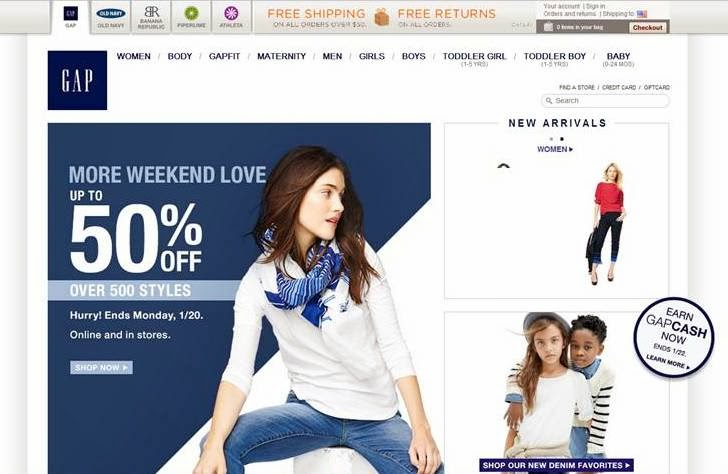
Here's Gap's home page.


This isn't a warm message. What is the story that Gap is communicating to you? Patagonia is encouraging women to participate in fly fishing. Gap is encouraging customers to take up to 50% off and to earn GapCash. I'm not saying this presentation won't work, in fact, it might work great. But it isn't warm.

How about Macy's, the self-proclaimed "America's Omnichannel Store"?


The story goes off the rails here, doesn't it? This is #omnichannel perfection, no doubt about it. Low prices, sale, clearance, free shipping, extra savings, buy one get another at 60% off, aligned across all channels. Cold, sterile, lifeless. Again, I'm not saying this stuff doesn't work. It does work. Macy's posted positive comps last quarter.

But there's nothing warm about Macy's. Or Gap. Amazon has never been accused of being a warm brand, now has it?

So maybe there's a competitive advantage out there, waiting to be snared, by somebody willing to add "Dimensions of Warmth" to their business (or maybe it's best to be "cold", what do I know?).

As you know, I used to work at Nordstrom. Cosmetics was always on the 1st floor of the store. It smelled good on the 1st floor! That's a "Dimension of Warmth". Best Buy's "Geek Squad" represents a "Dimension of Warmth" - a human interjected into a cold, sterile experience. Or the "Genius Bar" at Apple - again, a human being interjected into a cold, sterile experience.

I'm suggesting that there's a hole in the marketing world - the rush to create a perfect #omnichannel experience seems to have sterilized retail and e-commerce ... and that only helps Amazon and the lowest priced "brands". Somebody, please, go fill that hole!

January 22, 2014

It's Here! Hillstrom's Contact Strategy

Here's your chance to see how I determine the optimal number of catalogs and email campaigns.

In "Hillstrom's Contact Strategy", I explain, soup-to-nuts, how I optimize the annual number of catalog mailings, and the optimal number of email contacts (both at a customer level), given the interaction between catalogs, emails, and paid search.

Yup - you train your customers to use paid search, and you pay your search vendor $$$. Worse, you add ad-cost to your catalogs - and your email campaigns. Yes, your email campaigns! They're no longer free - they now require the same circulation discipline as your catalog campaigns require. You pay $ to send a catalog, you pay $ to send an email, both send your customer to a search engine, where you pay $ to re-acquire the customer you spent $ to mail catalogs/emails to in the first place.

This dynamic must be factored into your circulation decisions. Must be.

Hillstrom's Contact Strategy addresses this key problem - at a customer level. I don't know of a vendor/modeler in our industry who does this elegantly.

The booklet (50 pages) is now available:
The digital version is clumsy to read, of course, given that the figures in the tables are small. The print version is color, and much easier to read. 

Either read the free content on this blog, get the Kindle version, or really dig into the numbers with the $29 print version. Best of all, for a tiny little investment, you'll generate between $1,000,000 and $5,000,000 in annual profit, if you apply the principles in the booklet to a $100,000,000 business. Not bad!
Most of you don't have the resources to do the work - so here I am - at your disposal! My project workload really ramps-up in mid-March, so get your project request in early. Email me today (kevinh@minethatdata.com) to get your project in the hopper!

Or, if you work with Clario, but wish they were conducting this level of sophistication, lobby them to license my algorithm!


January 21, 2014

Reminder - London February 20-21

I am speaking in London, February 20-21. Talking about Social Media. Join me (click here)!

This is a good time (if you are in the UK, or anywhere for that matter), for those of you looking to initiate a Merchandise Forensics or Contact Strategy project, to start a project. We can get the data going right now, so that we can talk about results in four weeks!

Send me an email (kevinh@minethatdata.com) if you're in London, and we'll get your project started!

January 20, 2014

Microsoft

Microsoft doesn't get a lot of love these days, does it?


One of the fascinating aspects of Microsoft is their #omnichannel approach to integrating operating systems.

Desktop. Laptop. Tablet. Mobile. All running a common operating system. Nice integration, don't you think? They have retail stores, e-commerce, they sell through third parties, they sell via an endless number of parties, don't they?

So why, do you think, that this integrated system, this #omnichannel approach, has not resulted in Windows dominating tablets and mobile? Doesn't the customer want an integrated experience? That's what we're told, right? We're told that all of our creative and offer strategy and merchandise strategy must be 100% unified across all channels.

Honestly, I don't have the slightest idea why their approach works or does not work. Nor do I care. I'm not here to defend them or to criticize them.

I am here to ask you to focus on what matters, using Microsoft as an example.

What matters is merchandise (or product or content, depending upon your business model). This operating system, across devices, IS the product at Microsoft. So if customers don't like it, they don't buy it.

These days, merchandise is largely ignored. Go read a trade journal or advice from the experts on Twitter. You won't find a discussion about merchandise.

Talk to customers, however, and you'll learn a lot about what customers think about the merchandise we sell.

So please, focus your efforts there. Focus on merchandise.

Content Creation

Here's the link . I realize many of you are stymied by creating content for your customers. Some of you would say the video above is poi...