Showing posts with label Hillstrom's Contact Strategy. Show all posts

March 05, 2014

Merchandise Productivity - A Drag On The Business

When we don't offer enough new products, we don't have an ample supply of future winning items.

And when we don't have enough future winning items, we suffer from a significant lack of merchandise productivity.

And when we don't have the merchandise productivity to support the business, we cannot afford to market to customers as much as we'd like.

And when we cannot market to customers as much as we like, the business fails faster than just the magnitude of the drop in merchandise productivity.

Let's take a look at merchandise productivity.

This is one customer - the optimal strategy identified via Hillstrom's Contact Strategy (click here) is 11 catalogs and 200 email campaigns per year:


This time, I run the simulation with a 10% drop in merchandise productivity. The optimal strategy is reduced to 9 catalogs and 150 email campaigns per year.


My demand tables tell me the following:
  • Business as usual = $6.96 from catalogs + email + paid search.
  • 10% merchandise productivity drop = $5.64 from catalogs + email + paid search.
A 10% merchandise productivity hit results in a 19% drop in catalog / email / paid search demand. The other half of the demand generated by the customer will have the associated 10% merchandise productivity hit ... so we'll be looking at an approximate 15% drop in customer productivity that comes from a 10% merchandise productivity drop.

Those new items play a much bigger role than we think. We lose the merchandise productivity, which causes us to not be able to market to customers as much, costing us even more demand.

So the next time you think something is wrong with "the customer", go back to merchandise. It's the root of all our problems.

February 24, 2014

Impact of Paid Search on our Decisions

Let's say you are an email marketer. You send five email campaigns a week to customers who love to "engage" with "relevant" content.

If you do your job well, you cause an unanticipated by-product.

You cause your customers to use search to compare your merchandise to what other folks offer. When this happens, you must incorporate the cost of paid search in your email (and catalog) circulation decisions.

Here's an example. You're running email mail/holdout tests, right? Right?! Take a look at the difference between the mail group and the holdout group, when it comes to paid search.
  • Mail Group = $1.00 spent on paid search.
  • Holdout Group = $0.80 spent on paid search.
This tells us that 20% of paid search expense (I know, it's more complicated than this, and there are new customers using paid search, but come one, follow along for a moment) is caused, yes, caused by email. Take email away, and you eliminate the habit of the customer going out to search for competing merchandise.

Here's where things get interesting. In the real world, you must allocate the $0.20 of paid search demand back to your email marketing program. And, you must allocate the expense associated with paid search back to your email marketing program as well.

Now, across the top 20% of the email subscriber list, this has no impact whatsoever.

But among the 80% of the email subscriber list that spends almost nothing?


Here, paid search expense results in two or three email contacts per week, not five.

I know, you're saying, "the difference in profit is irrelevant". But if you're a hundred million dollar business, then this results in several hundred thousand dollars of profit a year.

Why ignore that?

February 05, 2014

But My Campaigns Work!!

More than a hundred projects help one achieve clarity.

My projects make one thing really, really clear ... we don't know how to measure campaign performance.

I recently analyzed the purchase trends across dozens of businesses since the year 2000. The analysis showed that customer buying habits have not fundamentally changed in fifteen years.

In other words, the number of campaigns have increased so dramatically (#omnichannel) that we can barely keep track of them. Opportunities to purchase have never been greater. Discounts and promotions are everywhere, at rates nearly inconceivable fifteen years ago.

And yet, customers are still buying at the same rates they purchased at in 2000.

This tells us that we're measuring everything incorrectly.

When you perform frequency testing, measurement errors become highly obvious. Take a look at this table.


Look at what happens to the productivity of email campaigns, as we go from one mailing a week to five mailings per week - and then, when we tack discounts/promotions on top of email campaigns.

What do you observe?

First, the productivity of an individual campaign drops like a rock as you add more campaigns. In-campaign performance drops from $0.20 per customer to $0.14 to $0.11 to $0.09 to $0.08 per campaign, as you go from one to five campaigns per week. In other words, your campaigns are competing against each other ... you're not competing against the competition, you're competing against yourself!!

Look at the "all other demand" line ... the more email campaigns you send, the more demand you cannibalize from other sources (direct load, in most cases).

So, yes, demand increases, and profit even increases ... until you get to the point where you panic and toss in 20% off plus free shipping. That's the last column in the table. Productivity goes back up, but profit falls apart.

In other words, you could send one campaign a week, or you could send five a week each with 20% off plus free shipping, and get the same amount of profit.

This, by the way, is a kind evaluation ... most often, the discounts and promotions happen on the website as well, driving profitability south.

I know, I know, you have email reporting that tells you that everything you are doing is "right", that it "works".

Please try contact frequency testing. It will show you that you're measuring your campaign effectiveness incorrectly.

Hillstrom's Contact Strategy.

January 28, 2014

And It You Are Discounting, Fewer Emails Become Necessary

Yesterday, I shared the concept of diminishing returns in email marketing. We predict how much a customer will spend in email marketing, annually, and then we apply costs and profitability estimates.

Here's the fundamental problem with email marketing.

Email marketing is synonymous with discounts and promotions. Email marketers ruined the discipline between 1997 - 2001, when, in a mad dash for monetized eyeballs, email marketers gave away the farm to get orders. 20% off, 30% off, free shipping, gift with purchase, 70% off clearance items, you name it, email marketers have done it.

When I analyze client data, it is terribly common to observe profit factors that are seven or eight points lower for email than for other channels. This happens, of course, because email orders are disproportionately skewed to discounts/promos, and therefore, convert less demand to profit.

In the example above, 40% of demand flows-through to profit. Let's assume that is the company average.

Now, let's assume that the email average is 30% - because of heavy discounting and promotions, only 30% of demand flows-through to profit. What happens to the profit and loss statement?


Optimal profit now happens at 50 contacts a year, not at 100 contacts a year.

Once again, discounting and promoting yields a bunch of unanticipated side effects.

Are you performing this style of analysis?

Do you use this style of analysis to determine how many emails to send to a customer, annually?

If not - contact me now (kevinh@minethatdata.com). Profit is laying on the ground, waiting to be picked up!

Or buy the book (print click here, Kindle version click here).

January 22, 2014

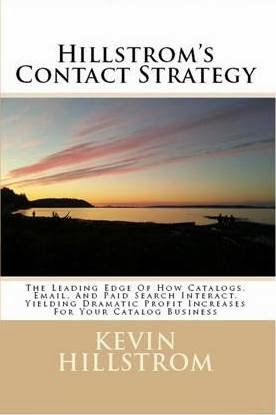
It's Here! Hillstrom's Contact Strategy

Here's your chance to see how I determine the optimal number of catalogs and email campaigns.

In "Hillstrom's Contact Strategy", I explain, soup-to-nuts, how I optimize the annual number of catalog mailings, and the optimal number of email contacts (both at a customer level), given the interaction between catalogs, emails, and paid search.

Yup - you train your customers to use paid search, and you pay your search vendor $$$. Worse, you add ad-cost to your catalogs - and your email campaigns. Yes, your email campaigns! They're no longer free - they now require the same circulation discipline as your catalog campaigns require. You pay $ to send a catalog, you pay $ to send an email, both send your customer to a search engine, where you pay $ to re-acquire the customer you spent $ to mail catalogs/emails to in the first place.

This dynamic must be factored into your circulation decisions. Must be.

Hillstrom's Contact Strategy addresses this key problem - at a customer level. I don't know of a vendor/modeler in our industry who does this elegantly.

The booklet (50 pages) is now available:
The digital version is clumsy to read, of course, given that the figures in the tables are small. The print version is color, and much easier to read. 

Either read the free content on this blog, get the Kindle version, or really dig into the numbers with the $29 print version. Best of all, for a tiny little investment, you'll generate between $1,000,000 and $5,000,000 in annual profit, if you apply the principles in the booklet to a $100,000,000 business. Not bad!
Most of you don't have the resources to do the work - so here I am - at your disposal! My project workload really ramps-up in mid-March, so get your project request in early. Email me today (kevinh@minethatdata.com) to get your project in the hopper!

Or, if you work with Clario, but wish they were conducting this level of sophistication, lobby them to license my algorithm!


Package And A Snack

I ordered a cable ( from Bloom Audio ) that connects my Qudelix Q5k bluetooth dac/amp to my Apos Gremlin hybrid tube amp (2.5mm balanced t...