April 11, 2013

#Omnichannel Future - Channel Pairs Part 4

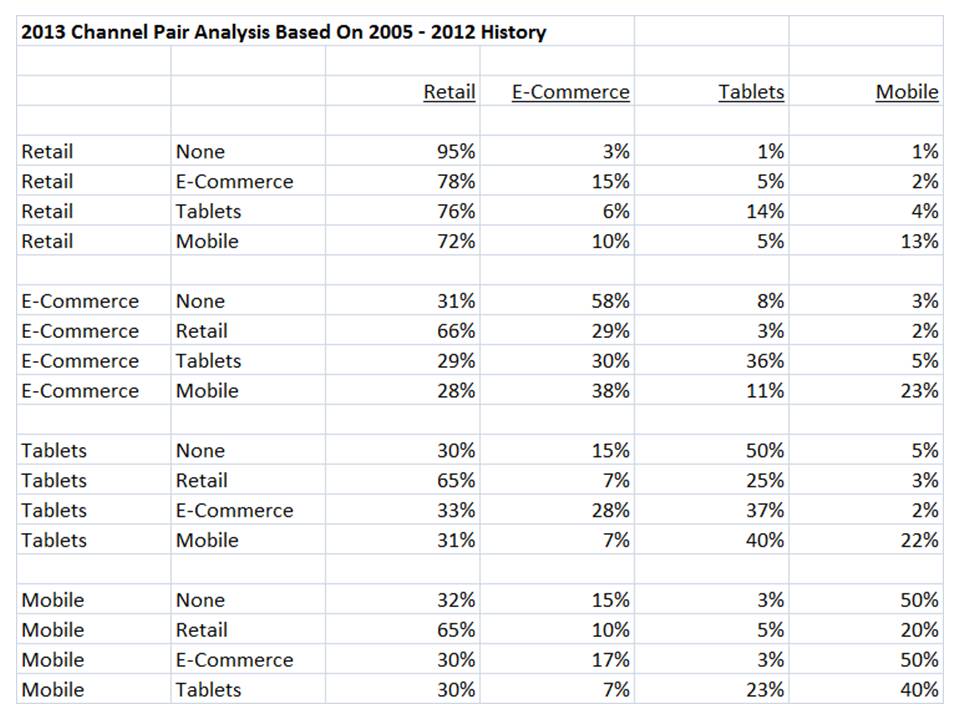
I want to wrap up this series by analyzing four unique channel pairs.

Take a look at any row in the table that has "None" in the second column.  These are customers that only buy from one channel.

By the way, the majority of customers in your database only buy from one channel.  We spend all of our time analyzing omnichannel customers, when in reality, we should be spending a disproportionate amount of time analyzing single-channel customers!

Retail Only Buyers:  95% of future demand is in-store.  This tells us that, for these customers, digital is there to support the in-store experience.  I know, the experts don't want to hear this, but analyze your own data, and you're likely to see a similar outcome.  For retail brands, most of the customers are retail-only, and most of the future sales from this audience are in-store.  The digital experience supports in-store purchasing activity, an important strategic finding.

E-Commerce Only Buyers:  58% of future demand is via e-commerce, while 11% is via tablets/mobile.  About 20% of future online activity is bleeding out of e-commerce, into newer digital channels.  Unless mobile/tablet customers migrate back to e-commerce at the same rate, e-commerce is dying a slow death.  You don't hear the pundits talk about this, because, well, digital advocates just don't want to believe this finding!  Go look at your own data.  What do you observe?

Tablet Only Buyers:  50% of future demand is via tablets, 15% via e-commerce ... ok, this is a very interesting finding.  In reality, tablet customers are switching to e-commerce at FASTER rates than e-commerce buyers are switching to tablets.  We just validated the opposite hypothesis!  Now the new media pundits will get frustrated!  This finding tells us that e-commerce customers want to try tablets/mobile, but may find that experience not fully developed, driving customers back to e-commerce.

Mobile Only Buyers:  50% of future demand is via mobile, 15% via e-commerce ... again, the customer is actually switching back to e-commerce faster than e-commerce customers are switching to tablets/mobile.

So this analysis didn't go where I thought it was going, when I reviewed e-commerce only buyers, did it?  Fascinating!  At this time, customers are switching from tablets/mobile to e-commerce faster than they are switching from e-commerce to tablets/mobile.

By the way ... the relationships in this table (above) are very, VERY similar to the relationships observed when e-commerce broke on the scene in the late 1990s ... customers left the call center to try e-commerce, then shifted back to the call center.  This trend didn't hold - that's why you run this analysis every month/quarter, to understand how customer behavior is shifting.

April 10, 2013

What You Advertise Is Not Necessarily What You Sell

One of the great tragedies of the matchback/attribution era is a failure to understand how presented merchandise determines sales volume across channels.

Let's go back to Nordstrom, way back, in 2005.  Remember 2005?  Home values never dropped, it was the safest investment you could find.  Good times!

At Nordstrom, we conducted a typical mail/holdout test on all catalog and email marketing efforts.  You're executing mail/holdout tests on all catalog and email marketing efforts, right?  Right?  RIGHT?!

Anyway, we mailed co-op funded catalogs ... the vendor paid the freight, and got to advertise what they wanted in the catalog.  We had numerous catalogs that did not have any mens merchandise in them ... mostly womens merchandise was featured.

A funny thing happened.  In nearly every test we analyzed, a significant amount of lift was sourced from mens merchandise ... merchandise not featured in the catalog.  In other words, the catalog drove a customer online or to a store, where the customer (usually a woman) purchased merchandise for a man.  

We didn't have to advertise mens merchandise to get customers to purchase mens merchandise.

Fast forward to 2013, eight full years later.  I can count on one hand the number of email marketers and catalog marketers who perform this analysis.

You cannot identify this finding (womens pages drive mens demand) by doing matchback or by performing attribution work.  Both methodologies fail miserably at telling you what the customer purchases, based on what was offered in your email or catalog marketing activities.

Give this analysis a try - it's terribly easy to perform.  You'll be surprised by what you learn!!

April 09, 2013

Identifying Poor Merchandise Performance

Sometimes, we make things way, way too difficult.

Business is down by 10%, so we dig into landing pages and email performance, not realizing that the reason business is down 10% is because customers don't want to buy the merchandise we offer.

Oh, people hate hearing this.  It can't be the merchandise.  It has to be the marketing folks!

If you're in marketing, fight back. Analyze merchandise performance within the context of different customer audience.

In this example, there are two problems, and neither is audience driven.  Best items are performing poorly, year-over-year.  Low performing items are performing well.  This will happen when there is a level-shift in item performance.

Equally important is that new items are performing terribly.

In this example, the same performance happens across customer segments.  This business is failing because the merchandising team is not doing their job.  Best items stink, and new items stink.  This is the reason the business is struggling.

April 08, 2013

JCP

Yup, you heard the news ... Ron Johnson out at JCP (click here for details).

First of all, there are way too many people out there cheering this news.  Have you ever been fired?  How did it feel?  You pour your heart and soul into a job.  More than a hundred million dollar golden parachute may soften the blow, but it doesn't soften the impact on the ego.  Try pouring your heart and soul into a new strategy, try changing the minds of tens of thousands of employees sometime ... seriously, give it a try.  It's terribly hard work, and when it fails, it eats at you.

Second, there are way too many people out there who, based on tweets, blog posts, and articles, appear to believe they know how to fix JCP.  Good!  Why not dive into retail and prove if your hypothesis has merit?  It is way, way too easy to stand outside of an industry and point at it and beat it up publicly in an effort to generate page views that you directly benefit from.  It is terribly hard to fix real world problems.

Third, JCP wasn't exactly thriving prior to this dramatic change in strategy.  Have you looked at the five year sales trajectory?
  • 2012 = $13.0 Billion.
  • 2011 = $17.3 Billion.
  • 2010 = $17.8 Billion.
  • 2009 = $17.6 Billion.
  • 2008 = $18.5 Billion.
Here is the comp store sales trajectory:
  • 2012 = -25%.
  • 2011 = -3%.
  • 2010 = +1%.
  • 2009 = -5%.
  • 2008 = -7%.
In other words, if you go back to what "worked" previously, you're back to a compound average -3.5% comp store sales decline.  Is that the success you crave, now that the CEO you didn't like got fired?

And look at Operating Income(Loss):
  • 2012 = -$1.3 Billion.
  • 2011 = -$0.2 Billion.
  • 2010 = $0.8 Billion.
  • 2009 = $0.7 Billion.
  • 2008 = $1.1 Billion.
Not exactly a resounding four year trend prior to 2012, correct?

This was a business that was dying prior to the major changes we've all heard about.  So if you are an expert, you now have two problems to fix ... the old one, and the new one.

Fourth, many of you suggest that JCP should have "tested" their way into this strategy.  Not a bad idea.  But that's not how the real world works.  Let's say they did test ... rolled out a new strategy in all stores in California, for instance.  What do you do when the rest of the store profile is dying a slow 4% death?  Try having patience when others scream at you at 110db, spittle flying everywhere.  Human nature has little tolerance for the slow, incremental progress of testing.  Retail is very different than e-commerce, folks, regardless what the omnichannel experts suggest.

Fifth, and this is the thing nobody has an answer for ...  discounts and promotions are taxes placed upon brands for being unremarkable.  This means that JCP generated between $4 Billion and $5 Billion per year of business that was discount/promotionally driven ... one out of four items was not sold because of a love of merchandise, but because of a perceived bargain.  How does a company fix that problem while maintaining sales levels?

What we've learned in the past year is that when we train a customer to purchase via discounts and promotions, we train that customer not to shop when we abandon that strategy.  I see it all the time in my projects, now you got to see it in a real-life laboratory.

This is so important, folks.  I keep getting questions ... "What is the right promotional strategy to tickle the buying bone of the customer?  Is it free shipping?  Is it 20% off plus free shipping? Is it 40% off?  Is it a gift with purchase?"  These are valid questions.  An equally valid question is this ... what is your exit strategy when you decide that you can no longer afford to tease customers with discounts and promotions?

We've destroyed retail (stores + e-commerce + catalogs, the whole thing).  We turned it into a game where chasing a promotional strategy is more important than identifying outstanding merchandise.  The latter is terribly hard.  The prior is, unfortunately, too easy, and impacts every employee outside the marketing department.

So, here we are.  We know that what JCP was doing prior to 2012 wasn't working well.  We know that what was done over the past year-plus really didn't work - it couldn't possibly work given that the entire customer file craved discounts/promos like a drug addict craves drugs!  You have to build a customer file of full-price customers, and that is VERY hard work.  So hard, in fact, that almost nobody does it anymore.

Given where we are, it's time for you to put on your strategy hat.  In the comments section, please offer your thoughts.  I will stay away and not offer my thoughts - this is your forum:
  1. How do you get this business back to where it was - describe your strategy, and the benefits of your strategy?
  2. Once you get the business back to where it was, how do you fix the original problems that caused the business to veer in the direction it took in the past year?
  3. Show cases studies or links that defend your proposed strategy.
Thanks,
Kevin

April 07, 2013

Dear Catalog CEOs: Team Chemistry

Dear Catalog CEOs:

Think back, over the course of your career.  How many times would you say that you worked in an environment that possessed great team chemistry?

It was easier to generate team chemistry in 1993 than it is in 2013.  Especially in marketing.  It's hard to have great chemistry when so many functions have been outsourced.
  • You used to have a customer acquisition department.  Now you ask Abacus to give you a bushel basket full of 61 year old prospects.
  • You worked with your IT team to maintain an in-house customer database.  Now, you outsource your database to Merkle, your web analytics to Google.
  • You used to hire a statistical programmer, who knew your customer and your merchandise assortment inside and out.  Now, you outsource statistical modeling to Clario.
  • You used to have an entire team that performed catalog circulation housefile planning.  Now, you have one person.  Tough to have team chemistry with one person involved.
In marketing, we know that when you double marketing spend, you fail to double sales, correct?

When you have team chemistry, 1+1 = 3.  You know this if you've worked on a team that has great team chemistry.

It has become really difficult to produce a great outcome in catalog marketing.  Who is accountable?  Remember the old days when the Chief Merchant would light up the entire marketing department for perceived incompetence?  How is s/he going to do that today?  Is s/he going to get on a plane and yell at a vendor?  Conversely, how is the statistical analyst at Experian going to hold the Chief Merchant accountable for perceived poor performance?

One of the reasons we catalog brands are in an demographic-fueled spiral (customer base aging rapidly) is because we don't have teams anymore.  How could a group of individuals learn, understand, synthesize, and act upon a complex demographic transition when the team is spread across numerous companies with varying levels of accountability?

In a quest to minimize expenses and pursue best practices, we've neutralized the one area where 1+1 = 3 ... team chemistry.

When did we decide to devalue the importance of people?  Maybe it was 2001.  We decided that people had to be slaves to "multichannel".  Today, people must be slaves to "omnichannel".  We're told that people must work together, in order to link channels together, even though nobody can prove that profitability increases when we accomplish this herculean task.  We teach employees that they should squelch creativity in an effort to appease channels.  What's wrong with us?

Why don't we demand that people work together to benefit people?

Discuss.

April 03, 2013

#Omnichannel Future - Channel Pairs Part 3

We're having fun, aren't we?

Sure, I get it.  It's entertaining to hear omnichannel thought leaders describe improbable versions of a gloriously digital future.

It's more appropriate, however, to analyze your own data, and make your own decisions based on how your own customers are behaving.

So let's do more of that.  Take a look at the Mobile / Retail row of the table.  These customers spent more money on mobile phones than any other channel.

Take a look at where these customers migrate, in the future.
  • Retail = 65%.
  • E-Commerce = 10%.
  • Tablets = 5%.
  • Mobile = 20%.
This tells us a lot about how we'll prioritize future strategies.  Retail, clearly, is the driver among this customer audience.  For this business, retail isn't dying.  Retail, instead, is the "sun" of this solar system.

More important, however, is the relationship between mobile and e-commerce.  Notice that, in the future, these customers spend twice as much via mobile as they spend via e-commerce.

For this customer segment, the future aligns with an in-store experience supported with mobile.  The e-commerce channel, surprisingly, is the one that is dying, not the in-store experience.

This data is readily available in your customer database.  Go analyze it!  The secrets of your business lie in your own customer database.

April 02, 2013

Smartphone Contract: Your Decide The Right Omnichannel Offer!

Here's one for you omnichannel fans out there.

My smartphone contract runs out on April 23.  While visiting a Best Buy store, the rep tells me that he can get me a new phone on April 16, just stop by and see him and he'll get me a new phone one week early.

So I email my smartphone provider, communicating the situation.  Here's the response I received (after being told that I was a valued, loyal subscriber).
  1. I can upgrade my phone, in-store, on April 23.
  2. I can upgrade my phone at Best Buy on April 16.
  3. I can upgrade my phone over the internet today.
Ok, omnichannel gurus.  Time for your input:
  1. We're told that, in order to be an outstanding omnichannel retailer, we have to tear down silos and align our business equally, across all channels.  This implies that each channel should adhere to an April 23 phone upgrade schedule, correct?  Because 4/23 is the date that my contract runs out.  You can't get a phone ahead of schedule, or you'd have chaos.
  2. We're also told that we're supposed to personalize our experience and reward our best customers, reacting in real time where possible.  This implies that I should feel honored to be eligible for an upgrade, because my smartphone provider is treating me better than the April 23 deadline they impose for average customers.  The personalization / CRM community would likely laud this kind customer service initiative, while omnichannel experts would pan it as another example of silo-based channel nonsense.
Now, I suppose both parties might be happy if the upgrade date were today, in any channel, and all systems between retailers linked data together properly (Big Data advocates are heard cheering from near and far).

But given an imperfect world, wouldn't you rather that my smartphone provider approach the problem in a silo-based manner than in an integrated, but less customer friendly omnichannel manner?

Discuss.

Can You Believe It? It's Time, Again

Four months go by in the snap of a finger! It's time for yet another run of the MineThatData Elite Program. Cost is $1,800 for first-tim...