July 31, 2023

Trust

Back in the day I spoke at the NEMOA conference. A day later I'm listening to one of the best and brightest in the vendor industry (meant honestly here) finish his talk. The audience wobbled out of his session, seemingly confused. The speaker turned to me and said (paraphrased) "I think they're too stupid to understand what I'm saying to them."

That comment stuck with me for a long, long time. Even today.

I don't think the audience was too "stupid".

I think the audience simply trusted the speaker.

The speaker could have told the audience to throw nerf balls into a garbage can to generate a sales increase and the audience would have complied.

In the 16.5 years I've consulted, not a month goes by when a traditional catalog client is presented with one of my analyses ... and the analysis clearly shows that customers have changed behavior (i.e. they could mail a lot less and be more profitable). In recent years, the discussions happen via video conference. You can see the faces of the Executives I'm talking to. The Executives trust their vendor partners.
  • "My printer says they are encouraged by what they are seeing!"

At another conference in 2019, a print person stopped me and said "if you think I'm going to let you tell my clients to stop putting catalogs in the mail resulting in me not being able to put food on the table for my family, you are sorely mistaken."

You can trust your vendor partners.

You can also trust your own customers.

Here's where trust comes into play. Look at this article title:
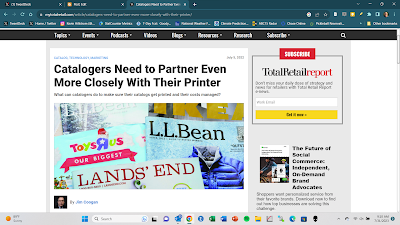

It was written last year by somebody the industry generally trusts (click here). Notice that the author doesn't have anything to say about the myriad ways to use digital marketing or offline marketing to grow your business ... just cut a few pages, or trim circulation a little bit, and integrate yourself deeper with a paper industry who is harming you.

Meanwhile, your test results tell you what your customers think. 

Do you trust your customers?

Many of you in the catalog industry are telling me your mail/holdout tests show increased organic percentages and decreased print effectiveness. Believing in test results suggests you trust your customers.

Do you trust your customers?

July 27, 2023

An Opportunity

Let's try something.

Because the theme of merchandise productivity keeps coming up in Marketing Budget Experiments, I'll add something for you.

For anybody purchasing an MBE (Marketing Budget Experiment) project through August 15, I will include "Class Of" Reporting (similar to the table below) at an overall level and at a category level, at no additional cost. We'll see if merchandise productivity is holding your marketing efforts back or not.

July 26, 2023

Consequences

The brand we are studying greatly reduced the number of new merchandise introductions in the year ending June 2021.


This actually caused at least a $3.0 million dollar demand hit in the year ending June 2021. The business should have been around $46.5 million. And I'm quite confident nobody cared. There were bigger problems and sales were up $4.4 million so the topic just didn't matter.

It mattered the next year.

In the year ending June 2022, demand fell by $6.1 million.

Look at new item introductions in the year ending June 2022. Just 1,729 new items, generating $5.7 million.

Look at the new item introductions from the year ending June 2021. These items generated just $6.2 million the following year (because there were so few of them) instead of the $8 million or $9 million or $10 million they might have otherwise generated.

Between the two years of meager merchandise introductions, the year ending June 2022 suffered by a likely $6 million to $7 million. Had new item introductions kept pace, the business likely generates $43 million or $44 million in the year ending June 2022.

In other words, there's no COVID-bump here, in reality. There's poor management of new item introductions.

By the year ending in June 2023, those two merchandise classes are costing the business maybe $5 million. The impact of older merchandise classes is starting to shrink.

Imagine being a marketer at this brand? You'd be badgered for two years about poor conversion rates and marketing inefficiencies. It would be your fault.

It is not your fault.

There are consequences for decisions made at a point in time. Often, those consequences are paid downstream from the decision. As a marketer, you'd likely want to know if your merchants have made your life more difficult with decisions they made 2-3 years ago. Maybe merchandise productivity is the reason your marketing dollars are "inefficient"?


July 25, 2023

One Little Detail In The Report

Here's our report from yesterday.


The business cratered in June 2022. Instinctively, we'd assume that unwinding of the COVID-bump is to blame.

But there's a tidbit here, in this report, that we cannot ignore.

How many new items were introduced in the year ending June 2021?

  • 1,567 new items generating $6.9 million.
So in the year ending June 2021, the peak year of the COVID-bump, while generating $43.5 million in demand, this brand was already imperiled. You just couldn't see it because the overall business was SO GOOD.

This brand cut back on product introductions (and there may have been perfectly good reasons for this ... supply chain issues, work from home issues, cost of goods issues) that year, introducing 1,567 items that generated $6.9 million (instead of the $10.3 million generated the year prior from 3,741 new items).

Tomorrow we'll explore the consequences of that decision.


July 24, 2023

The Report

Yesterday I mentioned a report that I created back in 2013. Many of you have written me over the years to tell me you cloned this report, and it helped you find a way to communicate to your merchandising teams that there were problems they were not seeing clearly.

The report is a simple one ... it's called a "Class Of" Report.


Here's a business that rode the COVID-bump to riches, growing from $37.9 million to $43.5 million through June 2021.

Then reality hit in 2022 ... it was like a game of Chutes and Ladders. In June 2023 Management is frustrated that this business is worse-off than in June 2019, even though prices are higher and business costs are higher.

Look at June 2022 ... the business collapsed after the COVID-bump.

However, I have a homework assignment for you. What happened in the year ending June 2021 that set the stage for the June 2022 collapse?

The answer? Stayed tuned.


July 23, 2023

When You Cannot Make Marketing Dollars Work Anymore

One of our intrepid readers sent me an email from the paper industry. The content in the message suggested that changing the quality of the paper being used could impact the response/cost relationship.

Or not.

When I was given responsibility for Catalog Circulation at Eddie Bauer in 1998 (my goodness, that's forever ago), our marketing dollars no longer worked. It wouldn't have mattered that a paper rep had a "breakthrough" ... the breakthrough was meaningless. The brand had overspent on marketing for years. Each additional dollar spent was spent at a short-term loss. Each additional dollar spent did not generate enough long-term profit to overcome the short-term loss.

We couldn't make marketing dollars work anymore.

At this point, you have three options.

  1. Keep doing the same thing the same way and cross your fingers, hoping for luck to smile upon you.
  2. Cut back on marketing spend, take a top-line hit, but improve your profitability (hint - Business Leaders DO NOT LIKE DOING THIS).
  3. Improve merchandise productivity by 10% to 20% so that your marketing dollars work again.
Have you ever criticized a merchant at your company?

You better have thick skin if you're going to do it. Criticism is necessary. Your merchants (or your product team) are responsible for 70% of the success of your business. If your marketing dollars no longer work, it suggests your merchandise productivity no longer works.

Back then I'd present multiple scenarios to Management.
  1. Base-case, running the business as-is.
  2. Increased marketing spend based on a 10% increase in merchandise productivity.
In (2) the top-line surged, marketing spend usually increased modestly, and the p&l looked a lot better. That's where everybody would begin grumbling.
  • "How do you increase merchandise productivity by 10%?"
  • "If we could increase merchandise productivity by 10%, don't you think we would have already done that, idiot?"
Tomorrow I'll share a report I created back in 2013 ... having come out of the Great Recession, there were a few good years for my clients, and then ... businesses struggled. One fact stood out, repeatedly ...

Content Creation

Here's the link . I realize many of you are stymied by creating content for your customers. Some of you would say the video above is poi...