April 11, 2022

Carmenere Weekend

In the world of wine, I'd imagine that Carmenere is a "Complementary" category.


It's not something you find easily at your local Safeway. But ... yum!!

Complementary categories support Dominant categories. Your favorite Cab is part of a Dominant Category. A Complementary category requires a customer to likely love the rest of your offering as well as the Complementary category.

Complementary categories are perfect for events, as outlined above from Reininger Winery (click here). Complementary categories lend themselves to "reasons" that the customer should buy something. Cabs or Merlots are always available, they're everywhere. But the Complementary category? That's for special events ... so you create an event to support the Complementary category, and in the process the customer becomes more loyal, spilling money into other categories. 

Your Customer Development efforts thrive when you properly market Complementary categories.


April 10, 2022

Pickleball Central: Dominant, Complementary, Auxiliary

Those of you in the audience who play a lot of pickleball know all about Pickleball Central.


Obviously, "Paddles" are a Dominant category. It's the primary reason you'd visit Pickleball Central. Some of us churn through a paddle every six months, +/-, some of us collect a hundred paddles and use three of them. Regardless, paddles are the reason you visit the website.

Balls are a Complementary category. If you don't belong to a club, you'll buy balls every few months.

Nets are an Auxiliary category. You don't buy pickleball nets every few months.

Sets & Bundles often serve a dual purpose ... beginners purchase here, meaning that they serve as a Welcome Category in Customer Development terms, and then they are a gateway into other categories.

Shoes are likely to be a Complementary category. So are Accessories.

Clothes are likely a Dominant category - everybody likes to look a certain way on the court, and here in Arizona you'll churn through clothes quickly in 100 degree 9:00am heat.

Gifts likely fall into an Auxiliary category, for obvious reasons.

I don't have the data to analyze Pickleball Central (hint ... hint ... new client opportunity), but those are my guesses.

So as a marketer, you focus on Paddles and Apparel ... your email marketing activities center on those categories. Then you look at the products that are complementary and feature those periodically based on prior purchase preference. Align the products with customer life cycle preferences (i.e. know what a customer with 10 life-to-date purchases buys vs. a first-time buyer) and you have something actionable.


April 07, 2022

Sometimes It Is Hard To Calculate Margin

Pre-Article Note:  Lots of you are asking what a Hillstrom's Profit project costs ... click here and you'll find out. Interest in projects is currently at a three-year high, so get your project in the queue now before it gets too busy.


Maybe you work at an Agency. The agency sells a product. It costs $1,000,000 to develop the product. You sell the product for $25,000. When you sell the product, it costs you $5,000 to maintain the product per client. You expect to sell the product to 50 clients in year one, 20 clients in year two, 10 clients in year three, and then just 5 clients in year four.

What is the gross margin of this product?

There are a LOT of experts who will give you different answers. Ultimately, you have to do what is right for your business.

In the example above, you expect to sell the product 50+20+10+5 = 85 times. Each time you sell the product you incur a cost of $5,000 ... 85*5,000 = $425,000. You spent $1,000,000 developing the product. Total cost = $1,425,000.

You'll sell 85 "units" ... so $1,425,000/85 = $16,765. Your cost of goods sold = $16,765.

At $25,000 per "unit", your gross margin is $25,000-$16,765 = $8,235.

Your gross margin percentage is $8,235/$25,000 = 32.9%.

I know, there's a LOT of experts who will tell you that my math is wrong.

But conceptually, you now have an idea how profitable your product is.

You can also play "what if" games. What if you sell the product for $40,000 instead of $25,000? Using the "negative square root rule" you might estimate ($40,000/$25,000)^(-0.5) = 79% of the units sold. Maybe you don't believe that and you believe sales would be cut in half. Ok, fine. Now allocate production costs across 42.5 unit instead of 85 units and then tack on the $5,000 cost per unit to maintain the product and see where that takes you.

Again, there are a LOT of experts who will argue with you about the "right" way to do this stuff.

I'm just asking you to "do something".

April 06, 2022

Dominant, Complimentary, Auxiliary: Impact on Margin

I added summary data to the bottom of the table.


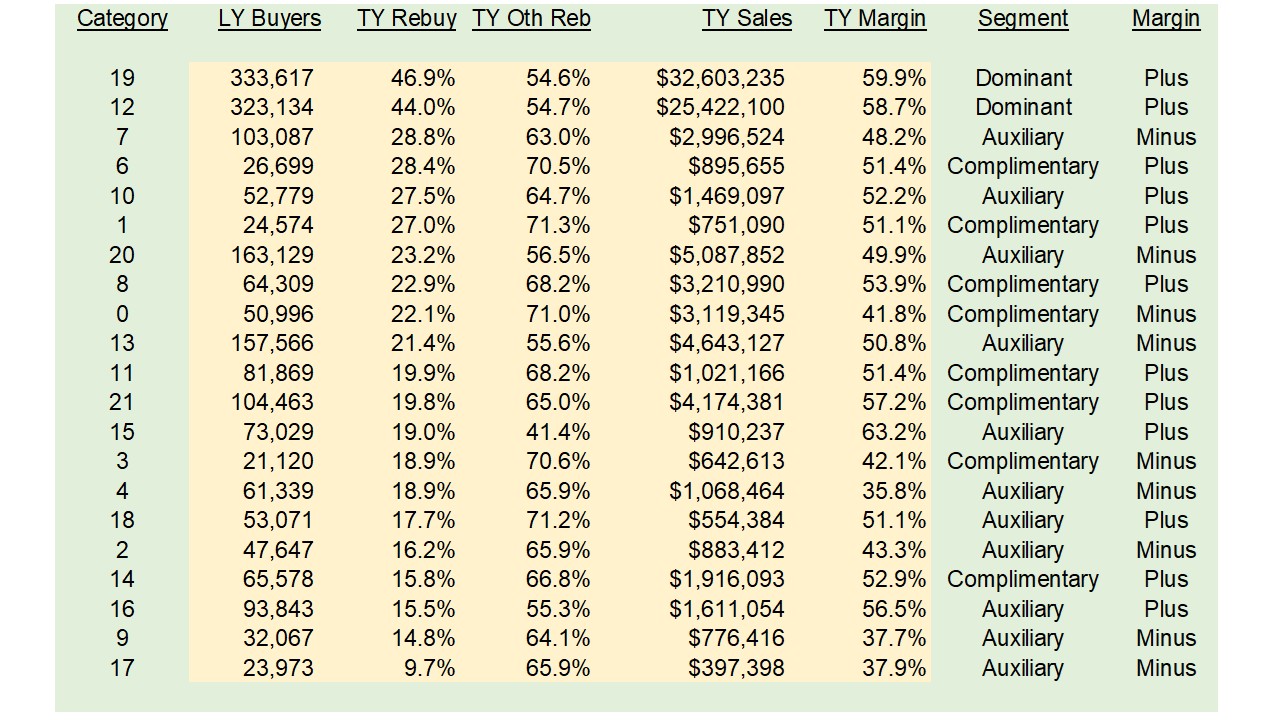
Rebuy Rates:  Dominant Categories possess customers who have a 45.5% chance of buying again from the category. Remaining Categories possess customers who have a 20.4% chance of buying again from the category. That's a big difference.

Other Category Rebuy Rates:  Complementary Categories have customers who have an approximate 69% chance of buying from other categories ... Auxiliary Categories have an approximate 58% chance of buying from other categories. You increase loyalty by showing customers Complementary Categories, all things being equal.

Margin: On average, "Plus" Categories possess a 55% gross margin while "Minus" categories possess a 44% gross margin. Think that's not a big deal? For every $100 you sell in "Minus" categories you generate $11 less profit. As a marketer you can't let that happen. And if somebody demands that you feature those items/categories, ask them what they are going to do about the $11 of profit per $100 they're giving up.

If you think this stuff doesn't matter, well, here, try this one on for size. Say you manage paid search programs at your company. You generate 100 clicks at a cost per click of $0.50. Your conversion rate is 1.2%. Your AOV is $100. Pick/Pack/Ship expenses are 10% of sales. Using these metrics, it's easy to calculate profit.

  • 55% Gross Margin = $4.00 Profit.
  • 44% Gross Margin = Loss of $9.20.
Do you like generating $4.00 profit, or do you like losing $9.20 and having your Leadership Team criticize you for harming company profit?

Complimentary-Minus and Auxiliary-Minus categories harm company profit. You, as a Marketer, are on the front lines for this fight. Push back when you are asked to promote low-margin categories/items.


April 05, 2022

Dominant, Complimentary, Auxiliary: Paired with Customer Development

Each of the categories we've analyzed the past few weeks are outlined below, in terms of rebuy rates into the category, rebuy rates into all other products, and this year's gross margin percentage. Tell me what you observe?


The two columns on the right label each category. We have several segments.

Dominant:

  • Category 19, Category 12.
Complimentary Plus (Complimentary and High Gross Margin).
  • Category 06, Category 01, Category 08, Category 11, Category 21, Category 14.
Complimentary Minus (Complimentary and Low Gross Margin).
  • Category 00, Category 03.
Auxiliary Plus (Auxiliary and High Gross Margin).
  • Category 10, Category 15, Category 18, Category 16.
Auxiliary Minus (Auxiliary and Low Gross Margin).
  • Category 07, Category 20, Category 13, Category 04, Category 02, Category 09, Category 17.
As a marketer, you should be particularly careful about featuring "Auxiliary Minus" items. These items belong to categories where the customer is unlikely to repurchase from the category, less likely to repurchase from the rest of the brand, and if the customer buys from the category the customer generates lower-than-average gross margin dollars. In other words, the marketer who features these products sub-optimizes Customer Development and sub-optimizes profit. 

That's a bad combination.


April 04, 2022

Dominant, Complimentary, Auxiliary

Much of my recent work is coalescing around a common theme when measuring the interaction between customers and merchandise. Every brand has items/styles/skus ... the items/styles/skus belong to a Merchandise Category ... and customers interact with the Merchandise Category in differing ways ... ways that can be segmented and acted upon.

The segmentation outline?
  • Dominant
  • Complimentary
  • Auxiliary
What is a Dominant Category?
  • The category is at the top of your categories for rebuy rates back into the category. In other words, your customers go back to this category after buying from it previously.
What is a Complimentary Category?
  • The category is in the bottom 67%-90% of your categories for rebuy rates back into the category ... however, the category is in the top half for repurchase into other categories. In other words your customers might go back to the category, but the customer is likely to maintain a relationship with the brand regardless.
What is an Auxiliary Category?
  • The category is in the bottom 67%-90% of your categories for rebuy rates back into the category ... however, the category is in the bottom half for repurchase into other categories. In other words, your customers might go back to the category, but the customer might also move away from the brand.
Chew on the definitions tonight. Tomorrow, we'll explore and expand this relationship.

April 03, 2022

Your Data Needs To Look Like This

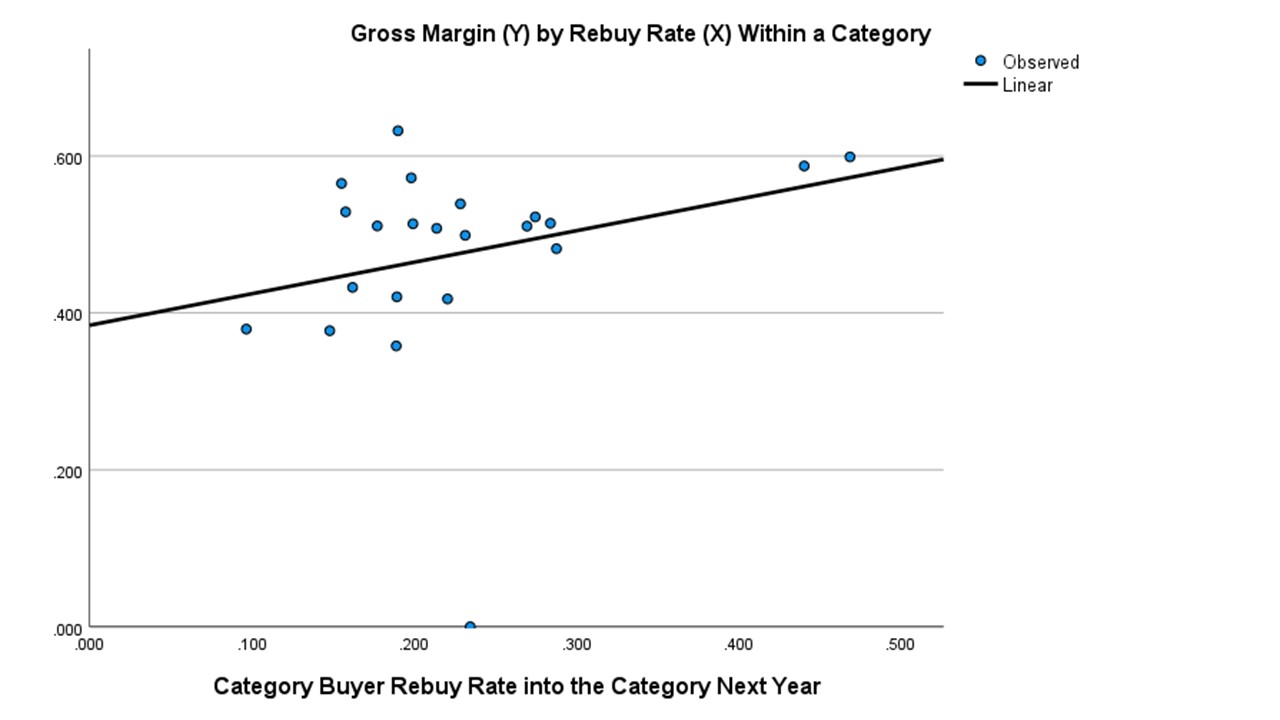
This company has a good relationship between in-category rebuy rates and future gross margin percentage within a category.


Ok, some categories have customers who are very likely to repurchase into that category next year ... for this company, those are rates above 35%. Similarly, other categories possess customers who are unlikely to repurchase into the category in the next year ... their rates are around 15% to 20%.

Here's the positive story told by the graph. Categories possessing customers who are likely to repurchase into the category next year have high gross margin percentages. Categories possessing customers who are unlikely to repurchase into the category next year have lower gross margin percentages.

If your graph has a "negative slope", then your customers are chewing through profit, sub-optimizing the brand.

Not this brand, however. High rebuy categories have high gross margins. Well done!

What does the data look like for your brand?


Newness

I watched some of the US-Spain Women's Soccer match Tuesday night. So many players I didn't recognize. The ones I recognized largely...