March 19, 2019

New Names From Co-Ops, Google, Facebook Is Not A Strategy

It's a tactic, no doubt about it. And it's a brain-dead easy tactic. Pay somebody, do very little, get new customers.

It's not being very strategic however, is it? I know, I know, here come the unsubs. But the New Marketing Leader has to have a toolkit full of ideas within each category of the Great Eight.
  • Audience
  • Awareness
  • Acquisition
  • Welcome Program
  • Anniversary Program
  • Optimization Program
  • New Merchandise
  • Existing Merchandise
For instance, if you are a catalog brand and you are generating 65% or more of your new customers from catalog co-ops, ask yourself a series of questions.
  • Is this the audience you wish to speak to?
  • Other than an expensive catalog plus merge/purge costs plus paying the co-op some cheddar, how do you plan on generating Awareness?
  • What is your plan if the co-op mailed customer visits your website and leaves without buying something. Do you have a plan to capture information (at minimum)? Do you have a plan to capture an email address (at minimum)? Do you have a plan, period?
  • In the unlikely event that the customer buys something, do you have a Welcome Program in place to get the customer to buy for a second time, quickly?
  • What are the Anniversary events, the three or four big events you have each year, the events designed to maximize sales opportunities?
  • Do you have an Optimization Plan in place to minimize over-mailing the co-op buyer who purchases after four website visits?
  • Do you have a separate email marketing program that helps grow new merchandise performance via product categories adjacent to the categories the co-op buyer purchased from?
  • Does the catalog front-load the first twenty pages with the absolute best items you sell, in an effort to maximize profitability?
Your co-op / Google / Facebook programs are not strategies ... they are a minor tactic within the confines of the Great Eight. The New Marketing Leader has answers to the questions I outline above, and implements a program unique to the industry.

Right?

March 18, 2019

Omnichannel Is Not A Strategy

Omnichannel is not a strategy. It's an optimization tactic, an important part of the Optimization component of the Great Eight, but it is not a strategy.

Strategies grow brands ... reference Amazon if you're curious about what a strategy looks like.

From 2013 - here's Macy's plan for omnichannel dominance (click here). How did that work out? Since the article was written, Macy's generated $2.5 billion less in annual net sales than they generated six years ago. That's what happens when you put all your chips on one tactic within the Optimization category of the Great Eight without having an overall (compelling) strategy.

The New Marketing Leader needs to have a comprehensive plan for each category within the Great Eight.
  • Audience.
  • Awareness.
  • Acquisition.
  • Welcome Program.
  • Anniversary Program.
  • Optimization Program.
  • New Merchandise.
  • Winning Merchandise.
Omnichannel has nothing to do with merchandise. It has nothing to do with an Anniversary Program that has several key events each year (think Amazon Prime Day or Nordstrom Anniversary Sale). It has nothing to do with a credible Welcome Program that quickly converts the customer to a second purchase. 

It "could" help with customer acquisition.

It "could" generate awareness, though it's a lousy way to run an awareness program.

It "could" resonate with your Audience, though if it did, sales would greatly increase instead of decreasing by 10% over time.

The New Marketing Leader has answers for each category within the Great Eight ... of which Omnichannel is a tiny, TINY component.

You have a comprehensive program encompassing the Great Eight, correct? Right??

March 17, 2019

Personalization Is Not A Strategy

Ok, we weeded out a bunch of followers who apparently didn't like the concept of implementing your own Marketing Management System.

But it's terribly important.

Why?


Personalization is not a strategy. It's a tactic ... a darn good tactic, an optimization tactic. But personalization doesn't lead to growth ... well, that's not entirely true. Tiny growth is possible. A pure e-commerce brand might see "some" growth. For a retailer? Not so much.

If you are a New Marketing Leader, yes, you'll have personalization as part of your "Optimization" category within the Great Eight (click here). But "what" exactly are you personalizing? And "why" are you personalizing anything? What does your personalization effort support?

Those questions need to be answered ... the New Marketing Leader has an entire strategy of which personalization is a tiny component.


P.S.: Personalization is darn important ... I have clients who increase email response by 20% and various online endeavors by between 15% and 50%. However, top-line sales are rarely moved a ton by personalization. You need new customers or merchandise productivity to move the top-line. But you already know that, don't you?

March 14, 2019

Describe Your Plan, Part 4

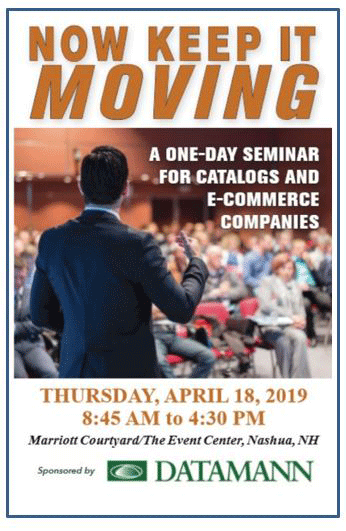
https://www.datamann.com/datamann-seminar-april-2019/
Let's assume you inherit a business with the following dynamics:
  • +3% Overall Merchandise Productivity.
  • +14% New Merchandise Productivity.
  • -8% Existing Merchandise Productivity.
  • -6% New + Reactivated Buyer Comps.
  • 100,000 12 month buyers last year, 40% rebuy rate, 40,000 active buyers.
  • 55,000 new + reactivated buyers last year.
Tell me what is wrong with this business, and tell me what kind of plan you'd implement to fix this business?

March 13, 2019

Describe Your Plan, Part 3

https://www.datamann.com/datamann-seminar-april-2019/
Let's say you inherit this type of business:
  • -6% Overall Merchandise Productivity.
  • -2% New Merchandise Productivity.
  • -11% Existing Merchandise Productivity.
  • -20% New + Reactivated Buyer Comps.
  • 100,000 12 month buyers last year, 40% rebuy rate, 40,000 active buyers.
  • 47,000 new + reactivated buyers last year.
This is one of the most common situations the new marketing leader inherits ... EVERYTHING is broken.

What this business desperately needs is a Leader.

That's where you come into play.

You need to have a plan for every one of the Great Eight.


You don't have a choice ... this business is fundamentally broken. You will address all eight tactics, and you will communicate clearly to every employee in the company that every single aspect of the business is broken and is FIXABLE!!!!

You are going to be the hero.

Get busy fixing things!


March 12, 2019

Describe Your Plan, Part 2

https://www.datamann.com/datamann-seminar-april-2019/
Let's say you inherit a marketing team, and your business possesses the following dynamics:
  • +8% Overall Merchandise Productivity.
  • +9% New Merchandise Productivity.
  • +7% Existing Merchandise Productivity.
  • -18% New + Reactivated Buyer Comps.
  • 100,000 12 month buyers last year, 40% rebuy rate, 40,000 active buyers.
  • 50,000 new + reactivated buyers last year.
What does this tell you?
  • Your merchandising team is doing a fabulous job.
  • The prior marketing leader messed up the business, bad.
Your first job is to fix customer acquisition. Period. Your marketing strategy is the problem. You are the problem. And in a month or so, you'll be the one blamed for business not meeting expectations.

It's on you to fix this problem, asap.

You'll focus on the following.
  • Audience.
  • Awareness.
  • Acquisition.
  • Optimization (i.e. search and offline advertising).
Quite honestly, this business is being held back by one person ... and that person is you. It doesn't matter what your predecessor did, you run marketing now and if you don't fix this problem, everybody suffers.

Get busy!!

March 11, 2019

Describe Your Plan, Part 1

https://www.datamann.com/datamann-seminar-april-2019/
When you take over the marketing department, you need to have a plan. A plan is critical. And you leverage the "Great Eight" to execute your plan.

Let's say you take over Leadership of the Marketing Team. You run your comp segment metrics and you learn the following:
  • -4% Overall Merchandise Productivity.
  • -14% New Merchandise Productivity.
  • +2% Existing Merchandise Productivity.
  • -3% New + Reactivated Buyer Comps.
  • 100,000 12 month buyers last year, 40% rebuy rate, 40,000 active buyers.
  • 62,000 new + reactivated buyers last year.
You basically have a ton of data, right there alone ... you can figure out what your brand needs to do.

What is wrong with this business?

This one is easy, isn't it?

Your merchandising team is imploding the business via new merchandise. Obviously you'll have to dig in deeper and figure out "what" the real problem is ... but you are not dealing with a marketing problem, you are dealing with a merchandising problem.

As a new marketing leader, you probably don't have control over what the merchandising team is doing. But you have analytics on your side, and you can act accordingly.

Notice that new + reactivated comps are -3%. If merchandise productivity is -4%, then adjusted new + reactivated comps are really -3% - (-4%) = +1%. It means that marketing efforts are performing accordingly.

Also notice that you started the year with 100,000 twelve-month buyers, and 40% repurchased, yielding 40,000 active buyers. Couple that with 62,000 new + reactivated buyers, and you grew the customer file by 2,000 customers (100,000*0.4 + 62,000 = 102,000).

This means that new + reactivated buyers are not a problem (unless management wants a lot of growth).

You've diagnosed the issue:
  1. Your Merchants are harming the business with too little or unproductive new merchandise.
  2. Marketing is managing the customer file appropriately.
Within the Great Eight we have options.


I'd focus my efforts on Awareness, Welcome Program, Optimization Program, and New Merchandise. I'd calibrate my email marketing program to focus on the new merchandise that is performing well, working hard to get 'em to winning status. Awareness programs will be important because the annual rebuy rate is at 40%. Welcome programs will be important because we want to convert the customer to a second purchase quickly given that rebuy rates are low. Optimization programs are important because with sluggish merchandise productivity we have to save every penny we have to protect the profit and loss statement.

Now you have a foundation to begin your tenure as the new marketing leader. And you can align the rest of the company around your initiatives. Get busy!!


Content Creation

Here's the link . I realize many of you are stymied by creating content for your customers. Some of you would say the video above is poi...