November 18, 2014

Catalog Marketing: Best Practices Yield Clutter

I'm not a catalog shopper, folks. I was, back in 1999. For me, e-commerce became the primary way to purchase merchandise, and then, Amazon. I doubt I'm alone, among those under the age of 50.

So here I was, this afternoon, exactly nine days prior to Thanksgiving, walking to my mailbox. I remembered the twenty years I spent measuring in-home date effectiveness ... "don't be in-home the week of Thanksgiving" ... "Monday-Wednesday is a better in-home window than Wednesday-Friday" ... blah blah blah blah blah.

Of course, it's 2014 now, not 1999. You have choices. The omnichannel folks will tell you that you have infinite choices. And they expect you to utilize the veritable buffet of choices at your disposal. It's how they get paid.

So why, when I go to the mailbox today, do I obtain a fistful of catalogs, all mailed on November 18, in observance of all established catalog best practices? 

My goodness, how many catalogs do you think the 68 year old retired school teacher living just south of Buffalo received today (assuming that the customer could get to the mailbox amid 70 inches of snow - click here)?

Two problems here.

  1. I'm not a catalog shopper, and yet, catalogers are pummeling me. I can fix that problem among housefile buyers (kevinh@minethatdata.com if you're interested). Only co-ops can fix the problem among prospects, and there's a financial disincentive for them to fix the problem.
  2. Creativity and Original Thought: Best practices are not best practices - they're lazy tactics that eliminate creativity. I realize that you've mailed a catalog for thirty years nine days prior to Thanksgiving. I realize that it's easy to pencil in this in-home date when creating your 2015 plans. Why not try to demonstrate some creativity? At minimum, why not extensively test different ideas? If you test, and you find that being in-home nine days prior to Thanksgiving is best, then you're well ahead of the curve.

November 17, 2014

E-Commerce Moving Into Retail

Seldom do you read anything practical. But then you find this article (click here) from The Economist.

An e-commerce brand moving into retail is not proof that retail is the right move. It is, however, a blatant acknowledgement that growing the customer base via an e-commerce-only business model is really, really hard, and has a ceiling for most.

I've mentioned, on numerous occasions, that The Story Of The Fall is the inability of businesses to reactivate lapsed buyers, or to acquire new buyers. Nowhere is this more acute than in e-commerce. Remember this graph?


When comparing catalog and e-commerce business models, I usually observe that the e-commerce business model struggles to convert the first time buyer to a second purchase. Worse, with a low annual repurchase rate (from 1st to 2nd purchase), e-commerce business models churn through customers at a much faster rate than catalog (and retail) business models.

This makes it very hard for most e-commerce businesses to blast through the $100,000,000 hurdle. Ask any cataloger how hard it is to blast through $100,000,000! Now try doing it with 2/3rd the repurchase rate for 1st-to-2nd time buyers.

E-commerce growth is easy up to $10,000,000 ... you can use social and SEO and viral marketing and you can get there. Then you need a diversified merchandise assortment to grow to $30,000,000 ... each new customer you get has a lower repurchase rate than customers acquired in the $0 to $10,000,000 range, so you almost have to bump the repurchase rate via a broader assortment. From $30,000,000 to $100,000,000, you move into a marketing realm where you have to start spending money. As you spend money, you cannot afford to churn customers with low repurchase rates - the math simply doesn't work.

In other words, you run your five year forecast, and you quickly learn you're going to hit a ceiling.

And you run out of easy answers to grow.

And retail is about 85%, +/-, of total sales.

And you start thinking that retail is a good thing.

Conversely, retailers are going to be closing stores right and left in the next five years. Old school retail slowly dies as it is cut off from a younger demographic - while online businesses catering to a younger demographic move into retail. It's retail Darwinism.

Retail is going to look very different a decade from now. Get out in front of the trends, friends.


November 16, 2014

Speaking Of Breathless Omnichannel Exuberance ...

... this one is about Domino's, courtesy of NPR (click here).

Here's the best part ... the story is a glowing omnichannel festival of tech love ... but when the NPR reporter orders a pizza using fancy omnichannel technology, guess what happens (not listed in the text of the article)?

  • The order arrives, and the toppings are wrong!
The toppings are wrong!

Merchandise and Service are being forgotten. We're constantly being told by folks with a vested interest in technology that customers demand flawless technology across channels. The the folks with a vested interest in technology get paid.

Customers also demand that the darn pizza arrives as ordered. In fact, that's more important. Much, much more important.

There is a lot of room for businesses to simply get the basics right. And customers seem to like it when the basics are executed properly.

Why don't the omnichannel advocates talk about getting the basics right?

Macy's: A Sales Decrease Is Proof That Omnichannel Works

Read the headline, and read the story (click here).

The author cheerleads "omnichannel". Of course, the author mentions and then completely ignores the fact that comp store sales decreased in Q3.

Decreased!

Sales decreased.

What happens to us when sales decrease on our watch? We get fired. We've all been there.

But in the world of omnichannel, a sales decrease is celebrated.

Something is really, really wrong, folks.

The breathless praise continues ... here's one for Nordstrom (click here), a company where inventory levels are outpacing sales increases (hint - that's bad news, it means customers aren't buying at company expectations).

Our industry picks and chooses the arguments that fit the industry narrative. Dig through the narrative, and look at facts.

November 13, 2014

Competing With Zulily

A fellow consultant called me - asking why catalogers are so "pig-headed" when it comes to testing? This individual was frustrated, because the catalogers the person works with will not test pagination, will not execute holdout tests, will not serve up different versions of the website to different customers, will not test personalization, simply "will not" experiment.

"Why is this the case" ... this person asked? Maybe you can answer the question.


Contrast the point of view above with what Zulily is trying to accomplish ... a different version of the website for every single customer (click here).

Now, the conclusions in the article are completely bogus (tenure on the website drives increased purchases - no - the best customers do everything, and have been around the longest, and therefore, they evolve to high-frequency segments much faster than everybody else - and this happens at companies who never change the website too, and maybe the firm helping Zulily wanted that tidbit put in the article for unknown reasons, that's a topic for another day). But the concept of testing, of trying things, of doing something different for every customer, that's going to pay off, and is valid to discuss.

The marketing world is moving in several different directions, simultaneously.
  1. Catalogers are largely "doubling down" - focusing on the 60-75 year old core customer. Here, you do not need to be a sophisticated marketer and you don't need to compete with Zulily - you simply need to offer products that cater to a 60-75 year old customer. Lots of short-term profit to be had here, with undeniable long-term consequences.
  2. E-commerce businesses are heading down the Zulily path - an algorithmic version of marketing. Just ask Amazon. You don't do retargeting because it works, you do it because of the data you collect. E-commerce and Artificial Intelligence are going to become the same thing. Here's the danger - algorithms work really well on commodity items at low prices. Algorithms struggle with fashion-centric and excitement-centric business models.
  3. Retailers will not focus as heavily on algorithmic solutions - they will lag behind e-commerce folks because of all the compromises they have to make to drive customers into stores. Retailers will have bigger issues - in-store fixed costs are going to demand attention. But retailers will be pulled into tech AI solutions ... there's a reason why Google and Macy's tout online search that drives in-store purchases ... Google wants the searches for $$, they want the mobile searches and online visits to fuel their AI engine. Retailers will be pawns, offline inputs for data-starved AI engines (Google, Facebook, Twitter, IBM, Microsoft, and many others).
  4. Mobile will evolve differently than e-commerce - much more of an AI / algorithmic solution that yields convenience, one that yields hyper-personalization among folks under the age of 35. Just use Google Maps for travel, and you'll see where all this is headed.

November 12, 2014

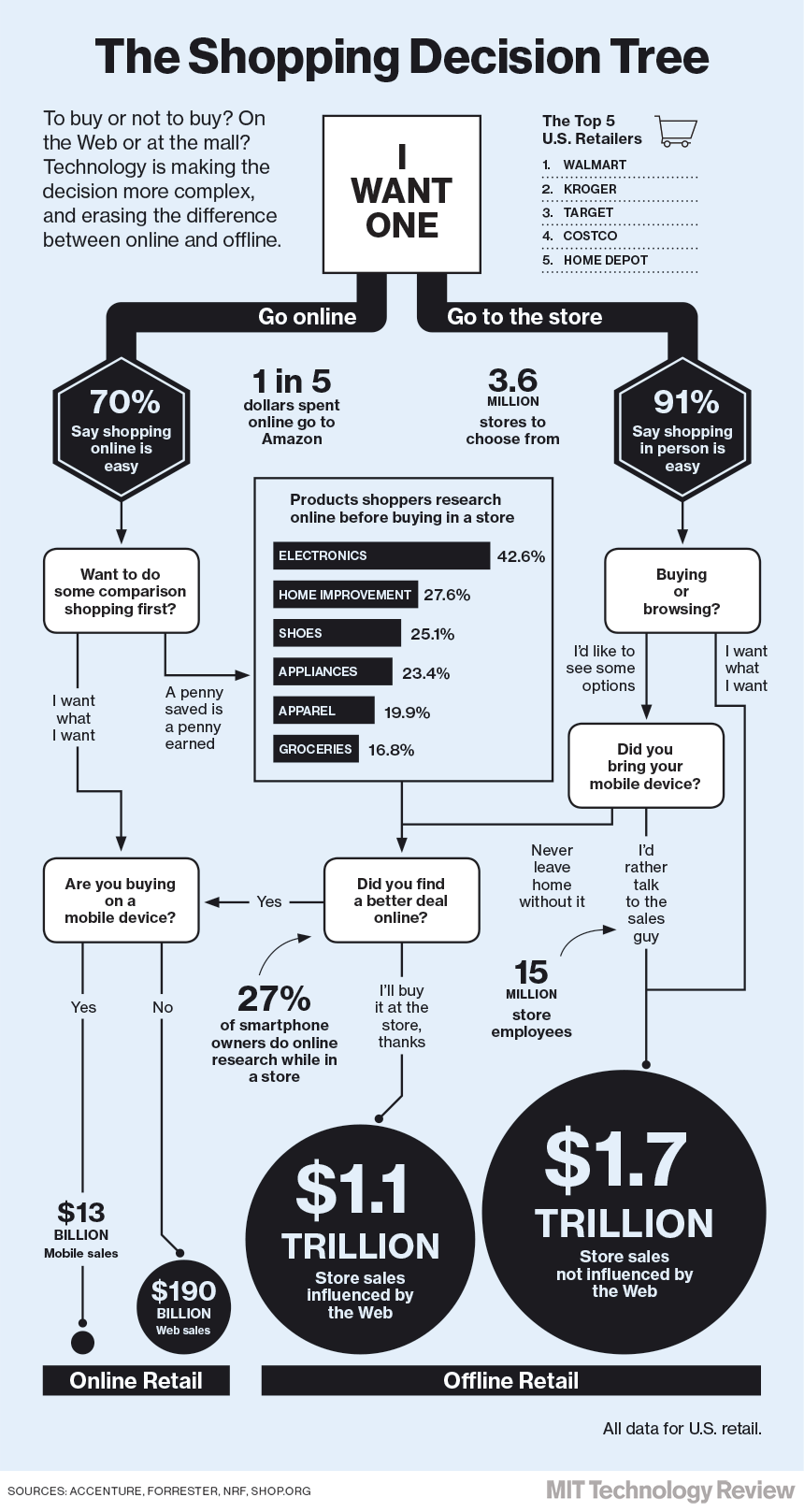
This Is Why Digital Vendors Demand Retailers Become "Omnichannel".

Here's the link to the infographic on the right (click here).

Look at the four circles at the bottom of the graph.
  • $13 Billion in Mobile Sales.
  • $190 Billion in Online Sales.
  • $1,100 Billion ($1.1 Trillion) in retail sales allegedly influenced by online research.
  • $1,700 Billion ($1.7 Trillion) in retail sales not influenced by online research.
That $203 Billion that is Online + Mobile ... let's say that grows at +12% per year for ten years ... compounded ... that gets us to $630 Billion.

If the $2.8 Trillion grows at +2% per year for ten years ... compounded ... that gets us to $3.4 Trillion.

In other words, Online is constantly dwarfed by Retail ... for a decent amount of time, going forward.

This means that vendors looking to make $$$ on digital have their eyes a gigantic amount of Retail volume. If they can convince you that Online/Mobile cause Retail to happen, then they can get paid for the paltry Online portion of the total, and they can get paid for the gigantic Retail portion of the table above.

Just something for you to think about. There's no doubt Online+Mobile influence Retail. There is minimal proof, if any, that Online+Mobile cause Retail sales to increase ... there's plenty of proof that Online+Mobile divert sales away from Retail, at slow rates.

November 11, 2014

Catalogers And Clario And Optimization Theory

There are two common questions among catalog marketers.
  1. How do our demographics and challenges compare to other catalog brands, and how do online businesses deal with these challenges?
  2. Clario is telling me that the optimal solution is to reduce housefile catalog mailings by 43%. This isn't optimal, this kills my business? Why are they saying this?
Mind you, I compete with Clario (Hillstrom's Contact Strategy), but my answer to #2 above should help you feel more confident about your working relationship with Clario.

Clario is telling you what the "optimal" strategy is ... after accounting for your mail/holdout test results (you routinely execute three month mail/holdout tests right ... RIGHT?), after accounting for attribution rules that factor in mail/holdout test results and matchback results and any other attribution rules they've developed for you, after factoring in book costs, and after factoring in the rate that demand flows through to profit. After all of those factors, Clario tells you what the contact strategy is that yields the most profit.

This strategy is going to cost you sales ... it's typical for a 40% reduction in ad-cost to be paired with a 10% to 15% drop in demand (do not believe those who tell you that they can cut 40% of your circ with minimal impact on demand - it's not going to happen). In other words, the optimal strategy is not the optimal net sales strategy - you need to mail more to increase sales.

In most cases, we're looking at "optimal" as being break-even short-term profit. If you want to optimize 12-month profit, you may mail deeper to reactivate customers, customers who will pay you back in the next year. You need to clearly communicate your strategy to Clario, plain and simple. If you want to optimize twelve-month profit (and not book-by-book profit), tell Clario that's what you want to do.

As an Executive, you know that there is no such thing as an "optimal answer". No such thing. There is a continuum of answers, and all answers have pros and cons. In the graph above, if you accept the optimal answer, then you cut circulation by 65% ... and you'll reduce the 12-month buyer file by 10% to 15%, and your business will contract year-after-year-after-year. That may not be optimal, unless you have a strong customer acquisition program in place. With co-op performance where it is, catalogers do not have strong customer acquisition programs in place if co-ops are responsible for more than 40% of new customers.

You are paying Clario a fortune ... usually 2x-4x what you'd pay me to do comparable work. Ask Clario to create the graph at the top of this post ... have them run a dozen different scenarios at different levels of "optimization", then invite Clario in at your cost to educate Clario how your business works. Tell Clario that when they demand you optimize your business that you'll have to liquidate six months of merchandise and that is "not an optimal outcome". Teach Clario how the dynamics of your businesses work.

And then listen carefully to the twelve different optimization outcomes Clario can simulate for you. Think carefully about why the optimal outcome requires so many fewer catalogs than you are currently mailing. Anytime Clario is telling you to greatly reduce circulation, they are not telling you to kill your business - they are telling you that the customers who shop from your business are different than they used to be, are more online-centric, and no longer need catalog saturation to generate volume. Clario is telling you that your business has changed. They are telling you that the world has changed. Why do you choose to argue with Clario? Why not listen to them?

As for the employees at Clario? It's not optimal to have your primary competitor defending your business model for you. I defend you, of course, because it is the right thing to do. Please, please, please, communicate better with the swath of your client base who call me in frustration. Show your clients multiple solutions, and let your clients choose what is right for them, as opposed to arguing over an ideal "optimal" answer.

Need help with issues pertaining to Clario? Email me now (kevinh@minethatdata.com).

8%

Here's a gem. I've been working in corporate America for more than thirty-eight years. The number of blank stares I've received ...