March 01, 2022

Understanding Your Business

I've told this story multiple times on Twitter, but it is worth repeating here.

Back in the day at Nordstrom, Neiman Marcus decided to open a new store in a market where an existing Nordstrom store performed well. The CEO publicly stated how the new store would damage Nordstrom. A reporter followed up on the juicy quote, asking our CEO if we were concerned about the threat?

Well, our CEO asked my team to quantify what happened in the past when new Neiman Marcus stores were opened in our markets. Guess what? Our stores performed BETTER when Neiman Marcus opened a new store in an existing market.

Better!

Our CEO politely responded to the question, citing data showing that when Neiman Marcus opened a store in a market we owned our sales increased. He told the press that we welcomed competition because competition brought in new customers, new customers who would purchase from our brand. 

We didn't hear anything from Neiman Marcus for years after that comment.

Some companies simply know more about business than other companies. The words/actions of a company reveal what a company knows about business.

It's one thing to understand your customers.

It's quite another thing to understand business.

You need to understand both, obviously.

But too few of us understand business. We've sat at the trough of the customer, not realizing that we weren't learning how our businesses really operate. Ask StitchFix. The algorithmic genius of the 2010s can't make money right now while sales are GROWING. They might prove us wrong, absolutely. But at this time, they might not understand how their business actually works.

When I arrived at Nordstrom in 2001, the online side of the business ... those folks ... they did not understand business. $300,000,000 in sales and a -10% EBIT. Our team didn't understand Nordstrom customers, but we understood business ... and within two years the online business was a breakeven.

The "omnichannel movement" of the past twenty years? Authored by folks who did not understand business.

Invest in increasing your understanding of how business works. Your career trajectory depends upon having a knowledge of business.

February 28, 2022

DirecTV

In early 1998 my cable television went down ... for a week. So I made the switch. I installed my own DirecTV satellite dish on my deck, ran coax where needed, and began my DirecTV journey.

In the early days, DirecTV was known for customer service. If we needed to call them, they reminded us that we were a loyal customer "since 1998". We (and eventually professional installers) put DirecTV in seven homes.

Eventually DirecTV was purchased by AT&T.

Eventually customers "cut the cord".

Eventually AT&T spread the costs incurred by departing customers on to those who remained ... a classic "dying brand" strategy that penalizes the customers who remain loyal, causing loyal customers to leave, causing the brand to spread even more of the cost across remaining customers, causing even more customers to leave ... you get the picture.

Our bill ... which used to be somewhere around $60 ... ballooned to $190. Inflation suggests the cost should have doubled over twenty-four years.

So on Friday I made the call. The AT&T call center employee made no effort whatsoever to keep me. Didn't offer his DirecTV Stream service. Just did his job in a kind fashion. Within five minutes, a twenty-four year relationship ended. Quietly.

All of us work for companies where this happens.

Product Preference comes in different forms. Is the customer loyal to Guy Fieri, Food Network, or the carrier that delivers Food Network into a home? Part of understanding customer Product Preference is understanding "why" a customer purchases what she purchases.

February 27, 2022

Product Preference

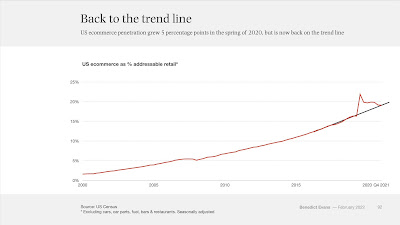
Here's a graph I observed a few weeks ago. Look at what the author of the graph suggests happened to e-commerce post-lockdown.


Maxine Nightingale authored a song called "Right Back Where We Started From" ... the title is appropriate for modern e-commerce. We're back on trend. How a foreign war impacts the trend remains to be seen.

This means that Customer Acquisition is going to be really important ... and in e-commerce you have Facebook performance crumbling (and getting more expensive) after Apple's changes ... and you have Google becoming more expensive as well. In catalog marketing you have the great paper shortage of 2022. As a marketer, your sources for "cheap names at scale" are ending.

Which means you are going to have to focus on what you sell and sell it in a manner that increases merchandise productivity so that you can exceed the pace of increased costs in marketing activities. You need better merchandise productivity so you can attract more customers who pay you back (with interest) in the future.

Every customer has a product preference. We'll talk more about product preferences in upcoming posts.

February 24, 2022

The Snooze

No, not Costanza sleeping under his desk.

Rather, Oracle is talking about pausing email campaigns to customers who don't want them for a period of time (click here).

Some email vendors (not the one referenced above) will tell you that you absolutely cannot allow unsubs to happen, because you "lose all of the revenue" from that customer going forward. That statement "lose all of the revenue" is inaccurate for several reasons.

  1. Email marketing typically represents a minority of customer spend among customers most "engaged" with email marketing. The best companies generate 50% of revenue from email marketing among email subscribers ... most companies are between 5% and 20% among subscribers. So you are not losing all of the revenue, you are losing the amount attributed to email marketing.
  2. We don't attribute sales to email marketing properly. Some companies hold out email campaigns for a month among email subscribers and learn that 30% or more of the volume generated by email marketing still happens when email campaigns are not executed. Email cannibalizes other channels, take email marketing away and sales increase in other channels as a consequence.

Let's review a common situation. Email subscribers spend 20% of their volume via email marketing, and if you take email marketing away, 30% of the 20% still happens in other channels, meaning that 86% of customer spend still happens in total among email subscribers. In other words, if the customer unsubs, you might still expect 86% of customer spend to still happen.

This means that the concept of "snoozing" email subs upon their request is reasonable for keeping the customer on your subscriber list and is reasonable from a "maintaining sales levels" standpoint.

Win / Win!!

February 23, 2022

Best Sellers

I worked with a company where 5% of sales came from one item.

Customers who bought that item stayed loyal ... to that item.

If you want to run an effective Customer Development program, you have to encourage customers to buy multiple items from multiple categories. One item does not maketh a brand.

February 22, 2022

A Lot of Profit

BC (before Covid) I sat in a meeting. The marketing leader talked about how she personalized her website and email campaigns with merchandise that aligned with the interests of the specific customer interacting with her brand.

She mentions that email is responsible for about 15% of her sales, that email conversion rates were +20% vs. before personalization endeavors began, and that her website was performing about 15% better (at times up to 50% better).

As she finishes up her presentation, I'm looking at a $100,000,000 business. Email had to be worth 15% of $100,000,000 ... or $15,000,000. If she squeezed an additional 20% out of email marketing, she was responsible for $2,500,000 in sales.

The rest of her website performed 15% better ... or $11,100,000 for in sales, due to personalization efforts.

If her profit factor were 35%, then we know the following:
  • $2,500,000 + $11,100,000 = $13,600,000 in incremental annual sales.
  • $13,600,000 * 0.35 = $4,760,000 in incremental profit.
  • Cost of the program? Likely a few hundred thousand dollars.
As she finished her presentation, the audience ... the Executives leading this company ... they largely yawned. They had no idea what the financial impact was on the business.

They heard percentages.

They didn't hear sales/profit figures.

This young woman likely generated more incremental profit for her company than her entire Executive Team put together. 

But because she spoke in terms of percentages, she got no credit for the amazing job she did fueling sales/profit.

You contribute A LOT OF PROFIT toward your annual p&l. Take credit for it.

February 21, 2022

Optimal Answers Change As The Business Evolves

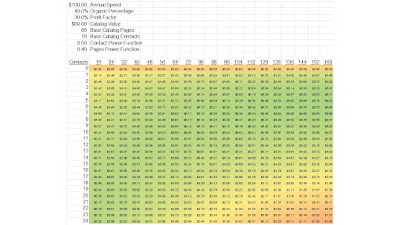
In our example from yesterday, there were a lot of "optimal" answers ... solutions that were comparable to each other.


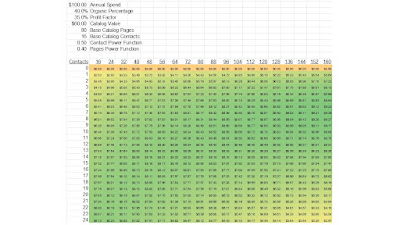
Now let's assume that your inventory team does a great job, your finance team manages expenses properly, and your profit factor goes from 30% to 35%. Your "optimal" solutions change ... all of 'em.


You can add contacts ... or you can add pages with a small number of contacts ... and in either case, you can do more from a marketing standpoint and make more profit.

As your business evolves and your finance / marketing / inventory partnership thrives, you generate more profit ... allowing you to market even more, generating even more profit ... it's a feedback loop that benefits both your company and your resume at the same time.


Content Creation

Here's the link . I realize many of you are stymied by creating content for your customers. Some of you would say the video above is poi...