March 11, 2019

Repost Due To Delivery Problem From Yesterday

I am re-posting this today given that 75% of yesterday's deliveries failed for some wonky reason that my email provider cannot explain.


How about joining me in Nashua on Thursday, April 18?? Click here to register!!
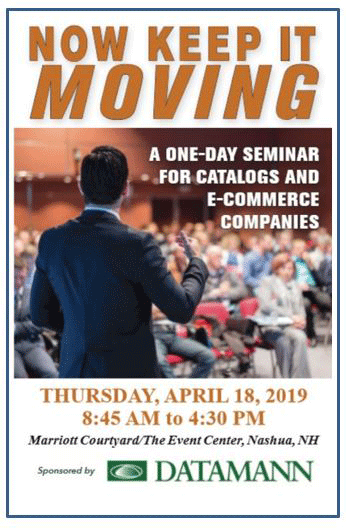


I'm taking a different approach to my presentation. In the past few years, I've asked organizations to change. That simply doesn't work. You can't present a bunch of ideas to a Director at Orvis and expect the individual to change the organization. The ideas aren't the ideas of the Director at Orvis ... they're my ideas. Why would a VP at Orvis adopt the idea of a speaker with no skin in the game?

So this year the presentation is all about you ... yes ... YOU! You are reading this because you are likely a Marketing/Analytics Leader, or you want to be a Marketing/Analytics Leader. 

In the past year or two, there's been a huge influx of new Leaders ... the Baby Boomer generation has had thirty years to dominate commerce, and they are now passing the torch to younger Gen-X folks or older Millennials. This is a very exciting and challenging time in the career path of a young professional. It's also a disorienting time ... you are new and a lot of people around you have twenty or thirty years of Management experience. They have their ways of doing things, and they're going to impose their style of Management upon you.

This became clear to me a few years ago ... I sat in a room while a Young Professional shared six months of findings about how to grow the business (not only how to grow it, but how she already grew it without anybody else knowing what she accomplished) ... when her presentation ended, one VP whispered to another VP "she's young, she'll come around to how we do things around here". In other words, the seasoned leaders did not respect what this person accomplished (and hint - this person grew sales by 10% or more, something almost nobody else accomplished at the company in the past decade).

The hour-long session just plain angered me. How could these Leaders treat this woman so poorly, given how good she made them look?

It became clear that the new Marketing Leader needs a set of tools to "set the tone" ... to diagnose real problems (not the problems people perceive to exist) ... and then to align the organization around what really matters.

I went through this process ... I didn't have a formalized process in 1998 at Eddie Bauer and I paid the price for being new and disorganized. I did have a formalized process in 2001 at Nordstrom and while some folks hated my process, the process worked wonders. And yes, the process generated enemies ... but it was so important to have a process in place and to constantly point back to the process and say "this is what we are doing, and this is why we are doing it" ... and to not get distracted by noise, even if the noise came from those who could fire you!!

I'll spend two hours sharing with you the process and diagnostics necessary to get you, the New Marketing Leader, set up for success.

This talk will be about you. No more sharing of tactics that you'll disagree with and say "Thank You, Next". This time you are responsible for doing something. I have faith that you are ready to do great things!

March 10, 2019

Now Keep It Moving

How about joining me in Nashua on Thursday, April 18?? Click here to register!!

I'm taking a different approach to my presentation. In the past few years, I've asked organizations to change. That simply doesn't work. You can't present a bunch of ideas to a Director at Orvis and expect the individual to change the organization. The ideas aren't the ideas of the Director at Orvis ... they're my ideas. Why would a VP at Orvis adopt the idea of a speaker with no skin in the game?

So this year the presentation is all about you ... yes ... YOU! You are reading this because you are likely a Marketing/Analytics Leader, or you want to be a Marketing/Analytics Leader. 

In the past year or two, there's been a huge influx of new Leaders ... the Baby Boomer generation has had thirty years to dominate commerce, and they are now passing the torch to younger Gen-X folks or older Millennials. This is a very exciting and challenging time in the career path of a young professional. It's also a disorienting time ... you are new and a lot of people around you have twenty or thirty years of Management experience. They have their ways of doing things, and they're going to impose their style of Management upon you.

This became clear to me a few years ago ... I sat in a room while a Young Professional shared six months of findings about how to grow the business (not only how to grow it, but how she already grew it without anybody else knowing what she accomplished) ... when her presentation ended, one VP whispered to another VP "she's young, she'll come around to how we do things around here". In other words, the seasoned leaders did not respect what this person accomplished (and hint - this person grew sales by 10% or more, something almost nobody else accomplished at the company in the past decade).

The hour-long session just plain angered me. How could these Leaders treat this woman so poorly, given how good she made them look?

It became clear that the new Marketing Leader needs a set of tools to "set the tone" ... to diagnose real problems (not the problems people perceive to exist) ... and then to align the organization around what really matters.

I went through this process ... I didn't have a formalized process in 1998 at Eddie Bauer and I paid the price for being new and disorganized. I did have a formalized process in 2001 at Nordstrom and while some folks hated my process, the process worked wonders. And yes, the process generated enemies ... but it was so important to have a process in place and to constantly point back to the process and say "this is what we are doing, and this is why we are doing it" ... and to not get distracted by noise, even if the noise came from those who could fire you!!

I'll spend two hours sharing with you the process and diagnostics necessary to get you, the New Marketing Leader, set up for success.

This talk will be about you. No more sharing of tactics that you'll disagree with and say "Thank You, Next". This time you are responsible for doing something. I have faith that you are ready to do great things!


March 07, 2019

The Great Eight

We spent the past two weeks talking about the events and influences that shaped what I call "The Great Eight".

My Influences:
  • Audience = CMO Nordstrom.
  • Awareness = Duluth Trading Company.
  • Acquisition = Jim Fulton and Eddie Bauer Home.
  • Welcome Program = Eddie Bauer Home, B2B Brand With A Great Program.
  • Anniversary Program = Nordstrom Anniversary.
  • Optimization Program = IBM/Lands' End, Client With Brilliant Website Personalization.
  • New Merchandise = Bankrupt Client.
  • Winning Merchandise = Failed Retail Brand.
The influences result in a style of performing work, a style that is fundamentally different than the style used by any other professional. Not only fundamentally different, but in theory useful. Once you know the importance of new merchandise, you approach marketing very differently, don't you?

Now, I'm not asking you to blindly follow The Great Eight. Instead, I'm asking you to create your own version. Look back on who your influences were. Who was the expert who shaped what you've become? Document the influences, and a story will drop into your lap. The story becomes your Marketing Management System, your own unique way of doing things. Don't borrow taglines from the vendor community, that's not your system, that's their system! Your system is unique to you.

Your system gives you a competitive advantage.

Document your influences. Create your own system. And when you get your opportunity as a Marketing Director or Marketing Executive, be sure to implement your system from Day One.

March 06, 2019

Winning Merchandise

I'm at Eddie Bauer, and folks from the "brand marketing team" enter my office.

They want to mess around with the catalog.

"If we can just add eight pages of new stuff to the catalog we can really reach out to younger customers and protect our brand."

They got their eight pages.

Those eight pages performed at less than half the productivity as the rest of the catalog.

Guess who's fault it was that the catalog didn't perform well?

At Nordstrom, retail folks wanted to put stuff in email campaigns that had no reason to be in email campaigns. The stuff got in the email campaigns. Those campaigns performed 20% worse than the baseline average. Retail folks weren't blamed for sub-standard performance.

I first learned about the importance of Winning Merchandise at Lands' End. We reviewed every catalog ... marketing, creative, inventory, merchandising, finance. One of our analysts put together a compelling story ... if two catalogs were equally merchandised, the catalog with winning items at the front of the catalog significantly outperformed the catalog with the same winning items in the back of the catalog. All things being equal, show the customer the winners, now.

I worked with a large retail brand. A new Leadership team took control over this brand. This Leadership Team HATED the winning merchandise being sold. "Outdated". "Frumpy". They killed the winners.

Guess what?

The demand that would have been generated by winning items disappeared.

New items did not succeed. Customers just vetoed them. And customers had no winners to buy. So customers just stopped buying. Not 100% of demand, but the 15% required to collapse a brand.

I had more than twenty-five years of data to prove that winning merchandise mattered deeply. But one consulting project a few years ago caused the concept of Winning Merchandise to be included in The Great Eight. A retail brand, destroyed because Winning Merchandise were sent to the curb.

Don't kill your winners before they deserve to be killed.

Your winners contribute a disproportionate share of profit and customers.

My Influences:
  • Audience = CMO Nordstrom.
  • Awareness = Duluth Trading Company.
  • Acquisition = Jim Fulton and Eddie Bauer Home.
  • Welcome Program = Eddie Bauer Home, B2B Brand With A Great Program.
  • Anniversary Program = Nordstrom Anniversary.
  • Optimization Program = IBM/Lands' End, Client With Brilliant Website Personalization.
  • New Merchandise = Bankrupt Client.
  • Winning Merchandise = Failed Retail Brand.

March 05, 2019

New Merchandise

This is where twelve years of consulting work come into play.


I spent eight or nine years trying to solve problems from a marketing standpoint. What a fruitless endeavor that was, my friends.

I wrote more than a million lines of code trying to figure out a marketing solution to merchandising problems. I probably wasted six years trying to find marketing solutions to merchandising problems.

It was a disaster.

I had a client that went bankrupt while I was working with them. I structure my projects so that the client pays half up-front, half upon project completion. This client didn't pay the final portion of the project because they went bankrupt during the project. That project showed that the brand (out of business halfway through the project) had a serious new merchandise issue.
  • Comps on existing merchandise were positive.
  • Comps on new merchandise were seriously negative.
That project cost me a lot of $$$.

That project still pays me to this day. Why?

Because that project caused me to shift the focus of my work from marketing to merchandising.

If a company went bankrupt because their merchandising team committed the capitalistic version of malpractice, was it possible that other companies could be saved before hitting the wall?

Absolutely.

In response to losing a lot of money due to bankruptcy, I wrote this (click here). One of the reviewers hated the booklet, so please don't buy it.

From that point forward, half of my work has been merchandise-centric. Not centric-enough for merchandising folks and pundits. More than "centric-enough" to identify if new merchandise is a problem.

New merchandise is a huge problem. In 80% of my projects, there is a serious merchandising issue holding the company back. It's almost always a new merchandise issue that eventually becomes an existing merchandise issue. From there, the marketing team is blamed, and the blame leads to all sorts of reckless behavior ... from overspending on Google/Facebook to 40% off plus free shipping to surveillance via retargeting to just about any marketing mistake you can possibly think of.

This keeps the blame game away from those who've earned blame ... merchants ... and more importantly, Leadership.

In more than three decades of work, there isn't a more seminal moment than the moment when a bankrupt client did not pay me. The moment was life changing ... career altering.

The moment became an integral part of my Marketing Management System ... the Great Eight.


My Influences, To Date
  • Audience = CMO Nordstrom.
  • Awareness = Duluth Trading Company.
  • Acquisition = Jim Fulton and Eddie Bauer Home.
  • Welcome Program = Eddie Bauer Home, B2B Brand With A Great Program.
  • Anniversary Program = Nordstrom Anniversary.
  • Optimization Program = IBM/Lands' End, Client With Brilliant Website Personalization.
  • New Merchandise = Bankrupt Client.

March 04, 2019

Optimization Program

Two things really stand out here, one recent, one old-school. Let's begin with the old-school example.

Twenty-five years ago at Lands' End we had about 50 catalog in-home dates. As we've learned in the past few months, you can have 50 in-home dates as long as the vast majority of customers get a handful of mailings and only the very best-of-the-best get fifty. But when half of the customers are being clobbered with 25ish contacts, well, a funny thing happens.
  • Every catalog circulation decision, evaluated independent of every other catalog circulation decision, looks profitable.
  • When you try to optimize the decision on an annual basis, you realize you made a TON of bad decisions.
We were going to implement an optimization algorithm, one that determined the most profitable strategy. This tactic required each business unit to work together for the benefit of the profit-and-loss statement. It meant that a customer might not get six Home mailings ... instead the customer might get two Home mailings but the company would be more profitable. 

Understandably, if you were in the Home divisions you'd be upset if you had to contract your business in the name of "Optimization". As a result, the program was not implemented. A few months later I interviewed for a job in Dallas with IBM ... they were going to take their knowledge combined with our proposed strategy and create a product to help catalogers optimize their businesses.

That business still exists today ... and the vast majority of catalogers still don't trust 'em. That's what happens when you use math that takes control away from Business Leaders.

Speaking of math that takes control away from Business Leaders, I sat in a meeting where the Online Marketing Manager explained how she worked with a vendor to boost conversion rates by about 25% (sometimes much higher) by optimizing/personalizing the merchandising assortment customers saw when they visited the home page or key landing pages. She made her company Brinks Trucks worth of coin. She wasn't even looking for credit, she just wanted to do what was right for her business. She gets done with her presentation, there's a smattering of applause, and then one Exec leans over and whispers to another Exec ...
  • "She's only been here six months. Eventually she'll figure out how to fit in here."
My goodness ... this young lady just made sure that the Exec would earn a six-figure (or better) bonus payout and the Exec ... well, she sure missed the point of the whole exercise.

Optimization isn't about fitting in.

Optimization isn't about pleasing everybody.

Optimization is about NOT WASTING RESOURCES. If you can get 20% more customers to buy something, you're not wasting money on Google & Facebook, are you?

Optimization is all about generating more profit/cash, cash that you get to fatten the wallets of shareholders (I know, you don't like that) ... or more importantly, cash that you get to use to grow your business via new initiatives. If you waste money today, you have less money to spend on something clever tomorrow.

It's been my experience that Optimization requires collaboration and compromise. Not everybody is thrilled with collaboration and compromise. In fact, the only person thrilled with optimization is the person doing the optimization.

And yet, it's a fundamentally critical part of your Marketing Management System. If you don't have a credible Optimization Program, you aren't a credible Marketer.


My Influences, To Date
  • Audience = CMO Nordstrom.
  • Awareness = Duluth Trading Company.
  • Acquisition = Jim Fulton and Eddie Bauer Home.
  • Welcome Program = Eddie Bauer Home, B2B Brand With A Great Program.
  • Anniversary Program = Nordstrom Anniversary.
  • Optimization Program = IBM/Lands' End, Client With Brilliant Website Personalization.


March 03, 2019

The Anniversary Program

I had to confirm that the numbers were truly that stunning. But they were. Oh yes, they were that stunning.

I came to Nordstrom via Eddie Bauer and Lands' End. You couldn't sell anything in July or August at those two companies.

But upon arriving at Nordstrom, I looked at daily sales numbers (that was my job, of course).
  • We sold as much merchandise on July 25 as we sold on November 25.
Turns out that if you never discount and can count the number of sales you have on one hand, you can do Christmas level business in late July by offering 20% off on the newest fall styles.

Oh, we promoted the living daylights out of this. You can promote the living daylights out of something if you limit the number of events you have. There's a reason sports and entertainment focus on Anniversary Events ... some sports use media to promote a big event (Wrestlemania for instance), and then via FOMO the customer spends $59.99 (oh wait, high definition is $69.99 ... ok, sign me up). Look at what the NCAA does with Men's Basketball ... a four month lead-up to the announcement of 68 teams, and then you fill out your own bracket to see if you can outperform millions of other people (which means you likely pay attention to the games which gets everybody paid, one way or another).

I was in a meeting at Eddie Bauer back in 1998, when business was awful. We had something like 30 week-long promotional windows. There were (are) only 52 weeks in the year. I remember our CEO telling the folks in the room ... "we've only got room for a few more events before they all lose their luster." 

Oh, they'd already lost their luster.

There's a reason the NFL doesn't host a monthly "playoff" leading to a monthly "champion".

And in business, there's a reason you create an Anniversary Program ... an event so big and so crazy that your customers have no choice but to shop.


My Influences, To Date
  • Audience = CMO Nordstrom.
  • Awareness = Duluth Trading Company.
  • Acquisition = Jim Fulton and Eddie Bauer Home.
  • Welcome Program = Eddie Bauer Home, B2B Brand With A Great Program.
  • Anniversary Program = Nordstrom Anniversary.

Content Creation

Here's the link . I realize many of you are stymied by creating content for your customers. Some of you would say the video above is poi...