March 08, 2016

A Five Tool Analyst


RIGHT??!!

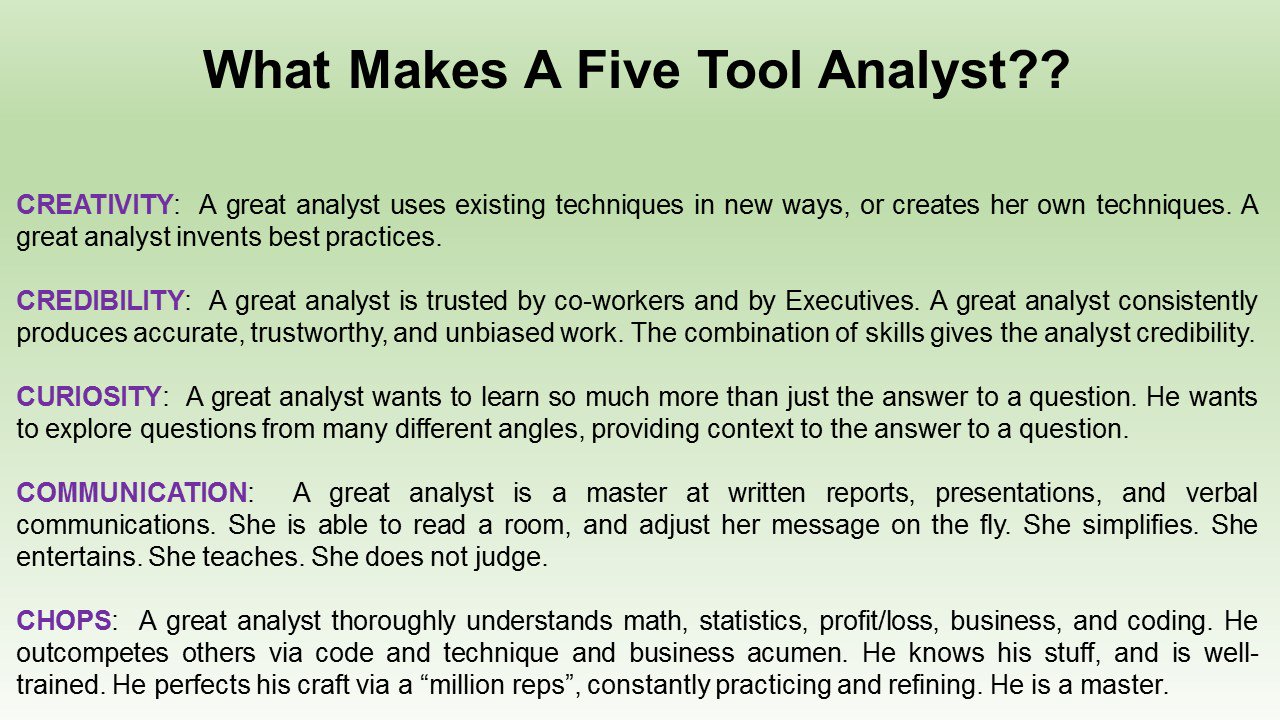
A few months ago, I talked about what makes what I call a "Five Tool Analyst".

The concept is similar to baseball, where the coveted five-tool prospect becomes a major league All-Star.

The podcast has been interesting, in that I get feedback on two fronts.
  1. Analysts who think Execs are knuckleheads.
  2. Execs who think Analysts are knuckleheads.
Only the Analyst can change this dynamic - by earning the requisite skills necessary to become a Five Tool Analyst.

CREATIVITY:  Here's what I've learned in the past twenty-eight years of analytical work ... creativity is sorely missing. When an Exec asks a question, an analyst provides a dry, non-living query that yields a boring answer that never anticipates the next question the Exec will answer. Consequently, the Exec keeps running the analyst in circles, and both parties end up hating each other. The best analysts come up with new techniques (i.e. stuff you cannot do in Google Analytics) that surprise and delight Execs. 

CREDIBILITY: In my consulting work, I'm frequently hired because an analyst failed in some way. If in-house analysts pleased Execs, nobody would hire me. And if I pleased everybody, I would have earned enough money to retire already. Since truth is somewhere in-between, it is really important to earn credibility. You won't please everybody all the time, but if your answers are unbiased and always accurate and tend to anticipate the next question, you will undoubtedly earn credibility. When people think you are credible, you get invited into situations that you have no right being in. When you are in those situations, many people get to see your work, and your career advances.

CURIOSITY:  The best analysts perform work nobody asked for, because they identify problems before Execs see the problems coming. This gets the analyst in trouble ... I was nearly fired once because I spent too much time focusing on an issue that the CEO believed to not be an issue at all, and then felt that I was 100% wrong and he was 100% right. Regardless, you will identify issues and you will play a key role in pushing your company in the right direction if you have sufficient curiosity.

COMMUNICATION:  The best thing that ever happened in my career was being forced to attend Dale Carnegie sales training. In just eight weeks, sixteen hours, I learned how to sell a message. Nobody teaches analysts how to SELL. It turns out that Execs buy what analysts sell. Work hard on your sales skills.

CHOPS:  I once worked with an analyst who ran a Monte Carlo simulation. The analyst then claimed that he had the answers to a problem because he could simulate different outcomes. The analyst knew a methodology - but the analyst didn't realize that the results were simulated results and were not actual findings. Naturally, the analyst crashed and burned when the findings where shared with analysts who possessed "chops". It is really important to know how to code, preferably in multiple languages. It is really important that the analyst know, at minimum, Generalized Linear Models, Ordinary Least Squares Regression, and Logistic Regression. The combination of coding and models / regression enables the analyst to do just about anything. The combination of Google Analytics and Excel allows the analyst to do what Google / Microsoft wants the analyst to do.

Ok, you've made it this far. How many of the tools do you possess, if you are an analyst? And if you are an Exec, how many of the tools do you perceive your analyst possesses?

March 07, 2016

Catalogers & Christmas Customer Acquisition Best Practices


Now, I've been publicly holding this little fact back for quite a while (not to paying clients, of course) ... but in repeated lifetime value simulations, this always comes up. I'm repeatedly asked why customers are not loyal ... and the data consistently points to our own issues.

Here's how the story goes.

1 - For the average pure catalog brand (i.e. was a cataloger before the internet arrived in 1990), 85% or more of new customers come from one of the catalog co-ops, of which there are a handful. 85% of your customer base has been recruited by the co-ops. The same thing goes for Google/Facebook in e-commerce, FYI.

2 - Catalog circulation plans overload names into Nov/Dec, because those are more "responsive" timeframes. Names are acquired.

3 - On average, most catalogers and e-commerce brands do not measure lifetime value. 

4 - For most catalogers not possessing a strong seasonal business in Spring, between 25% and 50% of annual new customers are acquired in November / December.

5 - To acquire these customers, %-off and free shipping promotions are offered. These promotions frequently harm customer acquisition costs.

6 - Companies that measure lifetime value observe this dynamic, outlined in a lifetime value simulation I ran for a cataloger last week.  Look at the three year profit of names acquired in December, vs. other months:


7 - The customers you acquire in March - June repurchase during responsive times ... and then repurchase during November/December. They are more valuable. December buyers are recent in January/February, when they are not likely to buy again. The customer goes dormant until November/December, at which time the customer purchases with a discount and free shipping.

8 - The dynamic is not limited to Customer Acquisition. Look at customers who place a third order, by month of third order (for a client analysis conducted last week). I then measure three year lifetime value. It's the same story, just at a different magnitude.


What is the dynamic I'm talking about?
  1. Your co-ops do a good job of optimizing for Nov/Dec response. They find buyers who are likely to buy in Nov/Dec.
  2. These customers often purchase via a promo (#cybermonday), and are therefore less profitable in their a first order.
  3. Because the order happened in Nov/Dec, lifetime value is less.
  4. Because you try to maximize Nov/Dec, your loyal buyers are less valuable in the future as well.
What should you do about it?
  1. Plant your customer acquisition seeds early in the year. Harvest your yield by early Fall. Enjoy Christmas repurchases. Generate profit next year. Do this by reviewing the tactics in my Customer Acquisition presentation (click here) and build out your Brand Response Marketing team.
  2. Your co-ops know this happens, they've had your data forever. Ask then why they do not optimize for long-term success?
  3. Stop worshipping November/December.
  4. Calculate lifetime value. Any analyst and/or vendor should do this as a matter of practice. Contact me (kevinh@minethatdata.com) if you need help. I use a simulation of 100,000 customers over "x" years to measure lifetime value for any segment. Your vendor partners don't do this.
Are you at NEMOA this week?
  • You are paying NEMOA a lot of money to attend. Your vendor partners are paying NEMOA a lot of money for prime speaking gigs, so that they can get you to spend a lot of money. How about using the conference as a forum to teach your vendor partners to optimize for long-term value, so that you, your vendor partners, and NEMOA can all make a lot more money? Seem reasonable? Everybody wins! How is that a bad thing?
The same logic applies to Google/Facebook in e-commerce. I see the same thing, repeatedly. Challenge them as well.

Your vendor partners are optimizing for immediate conversion/response. They tell you to be data driven. They are using data to sub-optimize customer loyalty and future profit. That's not acceptable.

You can fix this problem. But you need to speak up.

March 06, 2016

Big Trouble During The Christmas Season For Customer Acquisition

Allow me to show you summarized results from a lifetime value simulation I ran for a client.
  • Customers Acquired January - October:  12-Month Future Demand = $60. 12-Month Future Profit = $14.
  • Customers Acquired in November:  12-Month Future Demand = $45. 12-Month Future Profit = $8.
  • Customers Acquired in December:  12-Month Future Demand = $35. 12-Month Future Profit = $4.
Show of hands ... how many of you look at future value by month of acquisition? Three of you? That's not good enough!!

Which customer would you prefer to acquire?
  • The customer worth $14 next year?
  • The customer worth $8 next year?
  • The customer worth $4 next year?
When I go back to the late 1990s at Eddie Bauer, I recall a strategy my team used to grow our business.
  1. Acquire customers in September/October.
  2. Get those customers to repurchase in November/December, when the customer is very recent, before the customer lapses.
  3. Be willing to spend $5 additional marketing dollars to acquire the September/October customer, because that customer will pay us back in November/December, and we still end up with more long-term profit than obtained by being lazy and acquiring a November/December customer with a discount/promotion.
How many of you employ that strategy? Show of hands, please.

I know, I know, you are executing real-time optimization, employing the most brilliant search algorithm coupled with a co-op model that overlays external data to create a rich, robust, responsive outcome. Or so the vendors tell you.

Go look at your own in-house data for once. Do you see the same trend that I observed above for a client? If the answer is "yes", does that not change your customer acquisition philosophy?

Customer Acquisition is all about planting seeds. You have to acquire the customer before Christmas, and then turn that customer right around into a second purchase at the time of the year the customer is most likely to repurchase. That's how you grow customer value.

But here's what is most important ... so many of you acquire a significant minority to a majority of new customers in November/December. You tell me that this is the "easiest" time of year to acquire customers. Then, those customers fail to purchase during the following year, so you grumble that you have poor customer loyalty so you plug in a bunch of discounts and promotions and other nonsense to stimulate a customer who only likes to purchase in November/December.

Might it be smarter to spend more to acquire customers in September, given that long-term value may well be so much greater? Is it possible that our industry is simply creating problems by acquiring a customer on December 1 at 30% off plus free shipping ... a customer that is unlikely to purchase for the next ten months?

Please analyze this issue. What do you see happening?

March 03, 2016

Google / Brand Response Marketing

I noticed a commercial during the Oscars ... a cute little thing about being picked on and inclusiveness and the like:


Think about this for a moment. The most "digital" company of all time ... a company that has repeatedly told you to measure ROI and be data driven ... going so far as to provide you free software to prove that digital activities "work" ... and in the process biasing/blinding you into a "digital first" thought process ... that company runs happy, airy branding commercials on network television, a platform the digital elite tell you is "dead".

You are repeatedly being lied to by lemonheads who use Lizard Logic to promote a biased agenda.

Put a Brand Response Marketing team in place.

Plant seeds this spring.

Harvest new customers this fall.

Earn profit next year.


March 02, 2016

Like A Sore Tooth

It started with one of those random tweets you see from somebody attending a conference ... stuff that is completely out of context to anybody not at the conference but is completely relevant to a person absorbing fifty-five minutes of vendor-paid content.

The tweet went something like this:
  • Instead of asking for 30 minutes of time with a CEO, try asking for 15 minutes. You will increase your chances of landing a meeting.
Immediately, the cold, unending reality of being a Vice President entered my mind ... the non-stop phone calls, the random individuals showing up in my office, the sales rep calling 15 execs hoping to land one meeting where he demanded that the other 14 execs be invited (that was Forrester Research), and then performing a victory lap around the table, celebrating his ability to navigate the labyrinth of corporate matrixed hierarchy. Naturally, IT took the bait on that one.

So I tweeted out the cartoon above. That's what I do on Twitter now. Nobody listens to anything anymore, so why not entertain?

Then I found out that people were listening.
  • "This is my life, and I hate it."
  • "These people are just throwing darts and don't care about my time."
  • "I have to deal with 40 of these cold calls every single day."
I spent a year working for a vendor ... 2000, at Avenue A. I worked with two different people. Each person offered me an interesting quote that I never forgot.
  1. "It is my job to lie, it is your job to make my lies come true."
  2. "We aren't selling anything today. The reason I'm the best sales rep at this company is because I never sell. These people want to meet with me because I don't sell. Surprisingly, I learn what these people need, and then I find people like you to deliver a solution."
The sales rep in (2) was phenomenal. I traveled with him a few times. He didn't sell. He was invited into companies, where I witnessed Execs that you know open up their confidential information, share their secrets, and then hand over $750,000.

The person in (1) was like a sore tooth that few people wanted to be anywhere near.

Identify if your vendor partners are (1) or (2).

Throw (1) out the door.

Double-down your investment in (2).

March 01, 2016

Omnichannel Costs


Pundits misunderstand the cost structure of channels. There is a reason certain merchandise is sold online, and certain merchandise is sold in stores.
  • Retail has horrific fixed costs.
  • E-commerce has horrific variable costs.
The omnichannel thesis, then, is highly dependent upon one key customer behavior ... without this behavior, the thesis crumbles under a mix of fixed and variable costs.
  • Existing customers must spend more, and there must be more new customers who are willing to shop each channel, in order for the omnichannel thesis to deliver incremental profit.
To date, neither has happened. Existing customers tend to spend less over time (ask Macy's, the omnichannel flag bearer), and new customers (Millennials) choose merchandise/experiences over channel experiences.

When neither happens, all you do is transfer sales from one channel to another, and that doesn't work for anybody.

So, today, we sit here with increased expenses (variable) and decreasing store sales (as customers move online) causing stores to de-leverage (fixed costs).

This will cause stores to close (ask Macy's and/or Wal-Mart, for instance).

When stores close, fixed costs disappear, but debt remains.

When stores close, the sales do not all shift online and/or to other stores. You are lucky to recoup 30% of your sales, on average. The fixed costs are gone, the debt stays there, and the sales that are left are largely variable in nature (if they go to other stores, you cover fixed costs ... if they go online, they are tagged with added variable costs).

Without a dramatic gain in merchandise productivity, the math simply doesn't yield growth ... the math can yield increased profit, in some instances, depending upon how poorly the lower quarter of stores perform and how sales shift when the poorly performing stores close.

Only the very best retailers know the math, and understand the right path into the future.

It is highly unlikely that anybody who doesn't work at a retail brand truly understands the math and the dynamics, unless they've written tens of thousands of lines of code to thoroughly understand the dynamics.

When A Brand Surprises People


My cube at Lands' End was in a great spot - building five, up against the atrium, sun pouring in from the glass rooftop. It got so bright at my cube that I put tagboard up to block the midday sun ... allowing me to see my mainframe dummy terminal (black background, green text).

The tagboard drew attention. It looked like garbage. The two men running the company, founder Gary Comer & Dick Anderson, would stop by and ask my why I had a piece of junk blocking my cube? I would ask them sit in my seat, and try to read my monitor without the tagboard. 

They let me keep the tagboard.

So when Mr. Comer brought a prospective Congressman into Building 5 in the summer of 1992, I participated in a quick drive-by. "Kevin, I'm not telling you how to vote, I just thought you'd like to meet the future Congressman from our district."

Of course I was being told how to vote.

But Mr. Comer also thought it was important to give employees Christmas Eve off, even though he held different religious beliefs. He also paid half of our annual bonus prior to Christmas, knowing how important that was for many of his employees, even though the fiscal year ended in late January and the annual numbers that determined bonuses were not final yet.

When you see a consistent mix of blue and red, it all blends together, and is purple. Customers are tolerant of a consistent mix of blue and red.

When we see a consistent purple, it's surprising to suddenly see blue or red. The consequence is abrupt customer behavior. It's kind of like when JCP reinvented itself into a 30% comp store sales drop. Purple turned into something else.

The Worst Long-Term Customers to Acquire

From tomorrow (November 25) to December 5 ... it might be the easiest eleven days to acquire a customer. You'll give away everything ima...