March 25, 2013

The #Omnichannel Challenge - Forecasting Sales

Here's the challenge that nobody wants to talk about.

We know that mobile is growing, exponentially.  Some businesses (not retailers) generate 30% or more of volume via mobile.  Most businesses, especially those catering to a customer over the age of 45, generate a very small ratio of sales via mobile.

When newer channels "explode", we make an invalid assumption ... we assume that the new channel will result in an increase in total sales.

It is more likely, however, that the new channel will cannibalize existing channels.  Credit cards and 1-800 numbers eliminated the need for customers to mail checks.  E-commerce ended the call center.  And rest assured, mobile will end something.

The only question, then, is this ... "what channel will be cannibalized at the expense of mobile?"
  • E-commerce.
  • Retail.
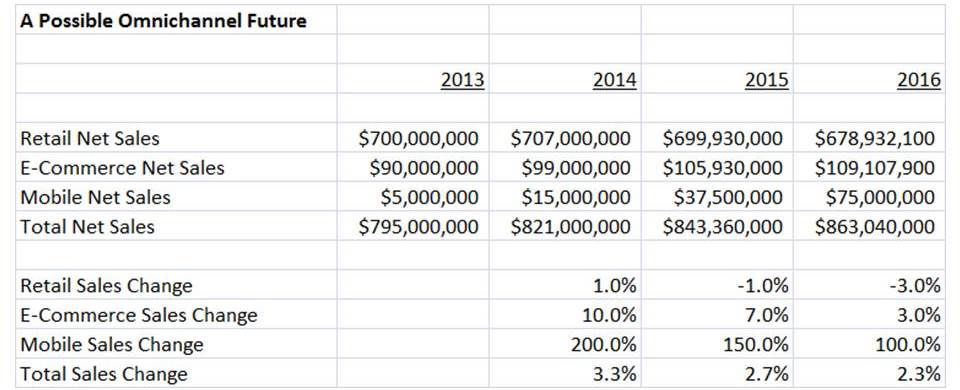
Look at our example, above.  This is a reasonable forecast for a large retailer.  Omnichannel experts tell us that customers will use the retail channel as an "experience channel".  They tell us that retail will not be where sales are generated, in the future.

Ok, let's accept the premise (flawed though it may be).  In our example above, if retail sales begin to drop (see 2015 and then 2016), then we must get a dramatic increase in e-commerce + mobile sales to offset the retail drop --- or the retailer goes out of business due to retail debt obligations.

If the omnichannel experts are right, then mobile is going to explode, e-commerce growth is going to slow (causing e-commerce folks to add mobile to their totals to keep e-commerce relevant when, really, it is being replaced by mobile), and retail is going to shrink.

This will require mobile to really, really explode, in order to keep the total net sales line growing.  You have to project some really big mobile numbers to make this happen.  It will be fun to watch, no doubt.

March 24, 2013

Dear Catalog CEOs: Answers To Your Questions

Dear Catalog CEOs:

Last week, I asked you to submit questions that you wanted me to answer via a blog post.  You responded!  Let's address your questions.

Question:  How will Big Data impact my catalog business?
  • There are several answers to this question.  First, you've been using Big Data for twenty years.  Co-ops are Big Data, always have been, always will be.  This means that the behavior of your competition dictates how your business evolves.  When your competitors do well, especially within certain product categories, your business is influenced as well.  Big Data, a generic information technology term, suggests that what we've observed in catalogs will now take over mobile and social, but much faster.  In other words, when catalogers / co-ops interact, the impact is almost glacial.  When data providers harvest social/mobile activities in real-time, your business will evolve faster.  By the way, 90% of what you hear/read about Big Data is going to be completely meaningless.  Look for depth of meaning in what you read.  Finally, look for actionable information ... just because your customer is within 1.0 miles of your retail store doesn't mean the customer wants a 10% off notification to visit your store.
Question:  Do I have to worry about Amazon?
  • The answer, quite honestly, is that we had to worry about Amazon from 2000 - 2005.  We largely ignored Amazon during this timeframe.  Now, it's almost too late to "worry". I want you to think about something for a moment.  You ask me how you should calibrate free shipping offers (hurdle, no hurdle, channel-specific, with or without a percentage off).  Amazon gets customers to pay $79 (or whatever the number is) for shipping a year in advance of any possible purchase.  You are trying to figure out how to give shipping away.  Amazon has figured out how to charge the customer for shipping before purchases have ever been placed.  It's time to pick another fight.  I know, this isn't the easy, tidy answer you were looking for, but there are many ways to attack giants.
Question:  Can I sell merchandise that isn't featured in my catalog?
  • You bet!  Go analyze your mail/holdout tests.  You execute mail/holdout tests, right?  Right?!  Analyze items featured in catalogs, comparing mail/holdout performance.  Then analyze items that only appeared online during that timeframe, comparing mail/holdout performance.  Many of my clients find that between 10% and 40% of incremental demand comes from items that did not appear in catalogs.  The job of the catalog, in 2013, is to stimulate purchasing, and to tell a story.  Your job is to find items that stimulate purchasing, and to find items that tell a story.
Question:  What benefits do you get when you re-purpose offline marketing on tablets?
  • This is a multi-step process, and the process benefits the employee and the company.  From an employee standpoint, do you remember 1996 - 2000?  This was a time when e-commerce accounted for almost nothing.  And yet, those working in e-commerce put in 10,000 hours.  This became an insurmountable experience difference between 2001 - 2005, when the e-commerce folks took all the good jobs at catalog companies.  Employees need to test channels like tablet commerce.  If the channel ever takes off, the employee is the subject matter expert.  In our modern economy, you MUST be the subject matter expert at something.  From a company standpoint, the current iteration of tablet commerce is not going to last, regardless what your printer or vendor tells you.  Somebody is going to figure out HOW to sell on a tablet at scale (i.e 10% or more of annual sales).  The form (current website, tablet website, mobile website, app aggregators like CoffeeTable and Catalog Spree) will be decided by the customer.  You can wait until the battles have been decided, or you can jump in with low risk and use analytics to learn as much as you can about how customers interact with a hybrid of your catalogs and technology.  Go learn something!  Go learn something that might be applicable to other channels.
Question:  What is the appropriate email contact frequency?
  • The individual asking this question links us to this article (click here).  Here's the thing.  Out of 100 projects, I can't think of 10 where somebody told me that they've tested email marketing frequency and know the optimal number of email messages to send to customers, on a weekly basis.  When I apply my findings, it is common to learn that a business under-mails - it sends one campaign a week when it could send three a week.  Of course, there's a law of diminishing returns here ... $0.20 for the first campaign, $0.10 for the second, $0.06 for the third ... but why not get the additional $0.16?  But make that decision after doing a few tests ... it only takes a month and you'll have the answer.  And if critics get upset, test for a year and satisfy them, why the heck not?
  • Here's another way to think about this ... folks will tell you that you can't have opt-outs. Let's assume that you go from one campaign a week at $0.20 each, to three campaigns a week at $0.12 each.  You've increased demand from $0.20 a week to $0.36 a week ... or by 80%.  Eighty percent!  This means that if you lost more than half of your email file, you'd still generate more sales at 3x contacts a week.  Just do the math, folks.  Do the math!
Question:  How do I perform a square inch analysis in the age of the internet?
  • You don't.  That train left the station in 2005.  Perform a quarterly profit and loss statement by item, factoring in all advertising channels and marketing spend.
Question:  How does the omnichannel movement impact catalogers?
  • The omnichannel movement is going in two opposite directions.  First, retailers are going to encourage omnichannel as a way to drive customers into stores.  Long-term, retailers may have challenges (high debt + tepid sales = low profit), so they will leverage every possible channel (hint - mobile + social + big data) to push customers into stores.  That's the first half of the movement.  The second half of the movement comes from online marketers that now realize just how little customer behavior they've actually measured in the past decade.  Their omnichannel objective is to align strategy across channels (like catalogs & retailers a decade ago in the multichannel movement), and then measure every single customer breadcrumb.  They're going to learn that 95% of the breadcrumbs are stale, and useless!
  • From a data standpoint, omnichannel will impact Jasmine more than anybody.
  • For Judy, omnichannel is likely to have little meaning.  Judy, at age 60, isn't going to be using six digital devices before buying in-store after receiving a relevant email marketing message.
  • In other words, omnichannel is the e-commerce / digital version of multichannel, and is more likely to impact Jasmine, not Judy ... and therefore, be of less importance to catalogers who already integrated operations and creative.
  • That being said - ask good questions.  Did your business explode when you aligned channels?  Not many did.  Keep an eye on those who claim to be making omnichannel progress, and ask them to validate results via sales/profit data.

Barnes and Noble: #Omnichannel Struggles

Have you had a chance to read through the most recent 10-Q for Barnes & Noble?  Click here to take a peek.

Barnes and Noble continue to generate a loss - and according to the profit and loss statement, the loss is in the Nook division.

We hear an awful lot about omnichannel, especially from the retail side of the spectrum.  We're told that we have to do the following (at minimum):
  • Align inventory across channels.
  • Align creative strategy across channels.
  • Same promotions in all channels.
  • Price parity, where reasonable, across all channels.
  • Be everywhere your customer is by participating in an explosion of channels.
If businesses do this, then omnichannel experts suggest that profit should be robust - because the business is meeting the needs of the customer.

Does Barnes and Noble meet the needs of the omnichannel customer?  Absolutely!
  • Inventory available via Nook (digital), e-commerce, or in-store.  How do you beat that?
  • Digital device (Nook), or available on iOS and Android devices via an app.  How do you beat that?
  • Similar book-based merchandise assortment to the competition (Amazon).
And yet, Barnes and Noble struggles to generate a profit.  The Nook division appears to be losing hundreds of millions of dollars, and it appears that sales of the Nook device are in decline ... content was +6.8% last quarter.

If omnichannel strategies are so critical to success, then wouldn't Barnes and Noble, with retail, e-commerce, and digital (Nook) have an enormous advantage over Amazon, which doesn't have the bricks 'n mortar advantage?

You can't blame the failure on merchandise (same merchandise as Amazon).

Why does an omnichannel strategy, one that should guarantee success for Barnes and Noble, lead to the opposite outcome?

Discuss.  And discuss what this truly means for the validity of omnichannel strategies.

March 22, 2013

Facebook Likes, Size of Business, Age of Online Customer

I follow nineteen publicly traded retail / catalog / department store / online brands that sell apparel.  Via Quantcast, I can estimate the average age of a website visitor.  Via Facebook, I can quantify the number of likes.  Via the SEC, I can measure annual net sales.

This allows me to develop a relationship between Facebook likes, annual sales, and Quantcast estimates of customer age.

  • Facebook Likes = Constant + (X1) * (Annual Net Sales) + (X2) * (Average Quantcast Age).
This simple relationship accounted for 52% of the variability in the dataset I track.

Here are a few tidbits from the model.
  • Each incremental billion in net sales add 266,000 Facebook likes.
  • Each additional year of average age of customer reduces Facebook likes by 345,000.
  • Both annual sales and likes are statistically significant at a 0.07 level, on just 19 observations.
The age factor is important.  Let's pretend we're analyzing a five billion dollar business.
  • Average Customer Age of 30 = 8.3 million predicted likes.
  • Average Customer Age of 40 = 4.8 million predicted likes.
  • Average Customer Age of 50 = 1.4 million predicted likes.
I get a lot of requests for what I'd call "social media viability".  In other words, the business owner asks if she can grow sales by 10% per year by shifting marketing focus to social media.

I have a simple answer to that question.
  • If your customer is 35 or younger, social media isn't a marketing tactic, it must be part of the fabric of your brand experience.
  • If your customer is 55 or older, social media is meaningless.
I know, the social media elite will reject these findings, citing research articles published in trade journals.

But if you're one of my catalog clients, the findings are relevant.  If you want to grow via social media, it is going to be terribly hard to do so when your customers are acquired via co-ops that spin you 55+ age customers.  And if you do succeed, somehow, in social, your customers will be younger, and will likely reject your catalog.

March 21, 2013

Honest #Omnichannel Assessment From Internet Retailer

Give this little ditty from Jack Love at Internet Retailer a read.
Key Takeaways:
  • He cites growth rates, showing that e-commerce grows faster at pure plays than at retail brands.  I see this in my work, too.
  • Stock prices are tepid.
  • Comp store sales have to be lousy, and are then masked by e-commerce growth rates to report overall totals that sound impressive but truly aren't.  I see this in my work, too.
I've worked on more than 100 projects in the past six years.  When you force e-commerce (and now mobile/social) to be a slave to retail, you do get an omnichannel outcome.  And that's ok.  But you don't achieve the potential of e-commerce (and now mobile).

We need more people to speak the truth.  Just analyze the numbers, the proof is in the pudding.

And I know, most of you will think I'm wrong, here.  You'll quote something from Forrester or Gartner or Shop.org, where 1,143 likely shoppers were surveyed and 43 executives were cited.  You'll show me how "everybody" is talking about omnichannel, so it has to be the right way for retailers to go.

You can help me.  Find non-survey research that shows how a business like Macy's, after subtracting the impact of merchandise strategy and marketing strategy, grew by 10% solely due to multichannel / omnichannel strategies.  Find this information, and I'll happily publish it here on this blog, and I will cite you as well.

March 20, 2013

What Are You Doing April 4?

Are you located in Eastern Ohio, Southern Pennsylvania, or Maryland?  Do you have a free hour during the afternoon of April 4?

I'll be passing through that general area on April 4 ... so I will have time for a meeting, first-come, first served, with catalogers, e-commerce brands, retailers, or other commerce organizations.

Click here to contact me via e-mail.

Thanks,

Kevin

Each Channel Has A Unique Merchandise Profile

Hopefully, your analytics team run merchandise reports that illustrate best selling items by marketing channel.

Your analytics team run these reports, don't they?  If they don't, click here and have me do it for you.  

I create an index for each marketing channel.

  • Index = (Item Demand Within Channel / Total Demand Within Channel) / (Item Demand Overall / Total Demand Overall).
This merchandise index tells me the items that sell best within a channel, after standardizing for overall merchandise performance.  For example, an index of 2.0 tells me that the item sells twice as well within a channel as it sells overall.  An index of 0.5 tells me that the item sells half as well within a channel as it sells overall.

Why perform this analysis?

Simple.  Each marketing channel attracts a somewhat different mix of customers, and those customers have unique preferences that are different than the overall merchandise preference of your average customer.

In the image above, we clearly see that the items that sold best over the telephone to catalog customers performed worst among customers buying from email marketing campaigns.  In other words, the customer who buys over the telephone is looking for fundamentally different merchandise than the customer who buys from an email marketing campaign.

Now, I can already hear the critics screaming from all corners of the Twitter world ... "yeah, but you offered different merchandise in email campaigns, and that drove the result."

Ok.

Let's look at another graph ... this one compares phone/catalog demand with online/search demand, at an item level.


Notice that the outcome is similar?  For the most part, the items that sold best in search are different than the items that sold best in catalogs over the telephone.  Search is driven by catalogs and by customer questions (for many of my clients, half of search volume is catalog driven, a quarter is email driven, and a quarter is customer driven).

We simply have to measure the performance of merchandise by channel, especially now that some businesses are generating 25% to 40% of demand via mobile devices.  The merchandise customers by within channels are different - yes, go analyze your own business and you'll learn the same thing - go create the index I outlined above!

Furthermore, the customers who use different channels are in different demographic cohorts.  Judy buying from a catalog over the phone is fundamentally different than Jasmine buying from a mobile device.

This is important.

  1. The merchandise purchased in each channel is fundamentally different.
  2. The demographics of customers buying in each channel are fundamentally different.
Therefore, if you are a cataloger and you want to see what the future of your business looks like, analyze the merchandise purchased by Jennifer in email and search.

If you are an e-commerce brand or retailer, and you want to see what the future of your business looks like, analyze the merchandise purchased by Jasmine on mobile devices.

In fact, analyze the top 200 best selling items, creating an index by channel.  On the wall of a conference room, post the items ... on the left side of the room, post the items preferred by Judy ... on the back of the room, post the items preferred by Jennifer ... on the right side of the room, post the items preferred by Jasmine.  Bring your creative team into the room, bring your merchandising team into the room.  Ask each team what they see.

Then it's time to make a decision.  Who do you want your customer to be in the future ... Judy, Jennifer, or Jasmine?  Once you pick your customer, look at the merchandise that your customer prefers, and look at the creative presentation of the merchandise your chosen customer prefers.  You now have a merchandise/creative road map into the future.

I recently performed this analysis for a business.
  • Judy = "Feel younger".
  • Jennifer = "Hard to find merchandise".
  • Jasmine = "Popular favorites at a low cost".
Same business, mind you ... but the themes in the creative were different.  Pick your creative, pick your merchandise, and you end up picking the customer you want.
Can You Believe It? It's Time, Again

Four months go by in the snap of a finger! It's time for yet another run of the MineThatData Elite Program. Cost is $1,800 for first-tim...