December 30, 2018

Adjusting The Budget

For the most part, digital analytics fail to allow the aspiring analyst to perform budgeting work. You know who converted and how they converted and where they came from. You don't know how much you "should" spend.

If you know nothing, go with a rule of thumb (but be sure to get the appropriate data so that you know "something").

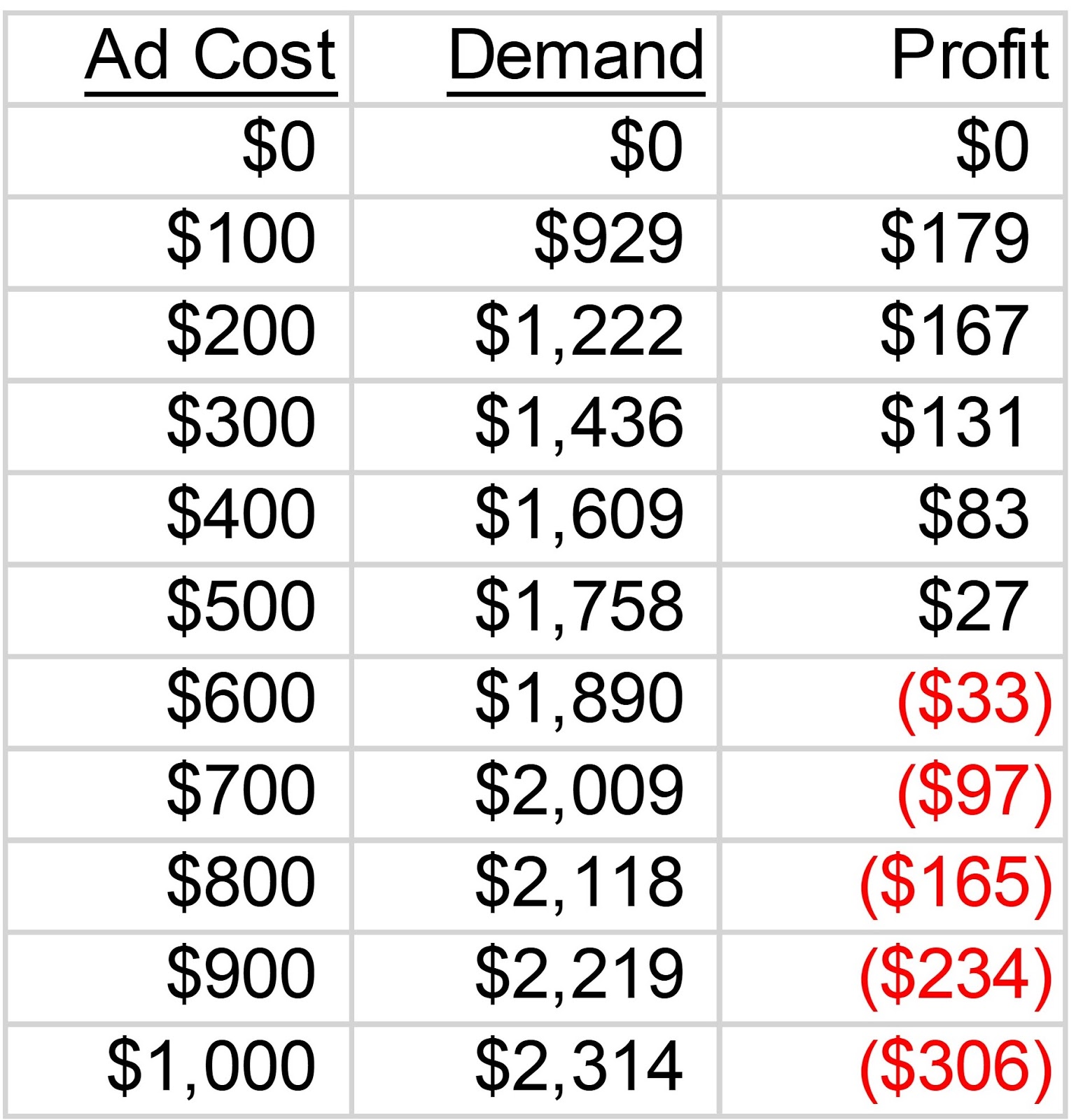
Say you are trying to figure out an appropriate paid search budget for January. Here's what has happened each of the past five years:


The relationship can be depicted graphically ... and therefore, can be modeled.


Now that we have a relationship, we can estimate the optimal amount of spend.


Sit down with your CFO and go over your options ... you now have a relationship based on historical data that you can rely upon!!


December 26, 2018

The Draft

When your favorite sports team fails, you go back and look at what went wrong. Three things frequently come to mind.

  1. Financial mismanagement.
  2. Poor drafts that result in having too few good players from previous drafts.
  3. Free agent signings that become "busts".
As a Green Bay Packers fan, I've seen the impact of (2) over the past five years. This year, the team staggers to the finish line, missing a core of 15 players +/- that should fuel success but aren't because the wrong players were drafted since 2013. As too few draft choices panned out, the team was forced to sign free agents ... and the free agent signings didn't pan out either. The result? A 6-8-1 record heading into the Toilet Bowl game against Detroit.

Why bring this up?

The same issues plague your business. Ask your CFO about financial mismanagement. There was a quarter at Lands' End back in the 1990s when business was ok but profit was bad because of the mismanagement of exchange rates between the US and Japan and Germany and the UK and I can still hear the Finance folks being berated by Gary Comer.

Poor drafts in sports are like bad merchandising classes. You look at "Class Of" reporting, right? RIGHT??? Two bad years of new merchandise mean three tepid years (unless you are a fashion brand) of subsequent existing merchandise performance. New merchandise classes are like draft classes in the NFL.

Free agent signings are like trying to make big splashes in partnerships (or influencer marketing) and then seeing it go horribly wrong.

As we head toward 2019, run your darn "Class Of" report and see if your brand is suffering from the same issues that sports teams suffer from.


December 25, 2018

Check The Stats

It's common for somebody to increase discounts, especially in November and December. You've got to get market share, right? (or do you?).

This year, you sold at 40% off (on average). Last year you sold at 30% off (on average).

So you'll look at your twelve-month buyer file (as of 10/31), and you'll measure a handful of repurchase metrics.
  • Rebuy Rate = 22%.
  • Spend per Repurchaser = $135.
  • Customer Value (rebuy * spend) = $29.70.
Then you'll look at last year.

  • Rebuy Rate = 21%.
  • Spend per Repurchaser = $132.
  • Customer Value (rebuy * spend) = $27.72.
The analytics guru will say that spend increased by 7% (29.70 vs 27.72) and will say that "all is good" and the marketing team will pat themselves on their backs and everybody but the CFO will move on and celebrate a successful season.

Why is the CFO choosing not to celebrate?
  • 2018 Gross Margin Dollars = ($29.70*0.60 - $29.70*0.35) = $7.43.
  • 2017 Gross Margin Dollars = ($27.72*0.70 - $27.72*0.35) = $9.70.
  • Change = -23%.
When measuring response, please check the stats ... don't just look at the stuff Google tells you to analyze ... and don't trust your classic rebuy / spend / value metrics. 

Look at Gross Margin Dollars.


December 23, 2018

Merry Christmas!!


For the thirteenth year (#amazing ... a tradition that began in December 2006), Merry Christmas!!

December 20, 2018

Outrunning A Recession

No, you aren't going to be able to outrun a recession. 

Not by a long-shot.

But you can position yourself to weather the recession better than your competition.
  1. Make sure your Inventory Management Team is not buying to forecast. The last thing you need to do is mark down good merchandise because you didn't plan ahead.
  2. Instead of discounting in the short-term, over-invest in marketing. The goal is to get through inventory now and get new customers in the process ... it's better to lose money acquiring a customer than to lose money via discounts/promotions ... the former gets you a new customer, the latter gets you a new/existing customer who expects to never pay full price again.
  3. Be ready to then reduce marketing spent at a moment's notice. Know exactly where you can reduce marketing spend with virtually no impact on the total business ... y'all have cases where you are spending money and not obtaining a return on investment ... be ready to pull those dollars immediately, protecting your profit and loss statement.
  4. Stop expensive marketing among customers with high return rates ... why churn merchandise during a recession? If the customer has a high return rate, shut the customer down. Let your competition deal with unprofitable transactions.
There's probably 22,000 different ideas and tactics. Get your grease board out, write down the ideas / tactics, and begin executing the minute your metrics suggest you are headed into a recession.

December 19, 2018

Marketing Challenge vs. Recession

Let's say you have four key customer acquisition efforts:
  • Google
  • Facebook
  • Other Digital
  • Offline
Let's say that your comps were flat in September / October. Now in November and December, you observe this:

  • Google = -9%.
  • Facebook = -7%.
  • Other Digital = -11%.
  • Offline = -6%.
  • Merchandise Productivity = -10%.
If you observe this issue, you do not have a marketing challenge ... you have to revisit yesterday's post to determine if you have a merchandising challenge or you are headed into a recession.

Let's say your data looks like this:
  • Google = +1%.
  • Facebook = -7%.
  • Other Digital = -11%.
  • Offline = +3%.
  • Merchandise Productivity = -1%.
This is what a marketing challenge looks like. Google and Offline have signatures comparable with Merchandise Productivity, while Facebook and Other Digital are plunging.

Make darn sure you are running these analytics ... and if you aren't, get the booklet below from Amazon to help you do 'em.


December 18, 2018

Merchandising Challenge vs. Recession

Let's pretend you have a traditional apparel business with five categories.
  • Mens
  • Womens
  • Co-Ed
  • Kids
  • Home
You run your comp segment analytics for November - December (your comps were about flat for September - October), and you see this:

  • Mens = -8%
  • Womens = -11%
  • Co-Ed = -9%
  • Kids = -7%
  • Home = -10%
This is the signature of a recession or a complete merchandising meltdown. More often than not, it's the signature of a recession. The percentages are all about the same, and all switched to negative at about the same time.

Here is the signature of a merchandising problem.
  • Mens = +4%
  • Womens = -11%
  • Co-Ed = -3%
  • Kids = -7%
  • Home = +5%
Notice that Mens and Home are positive. Notice that Co-Ed is an average of Mens/Womens. This is what a merchandising problem looks like ... your merchandising team messed up Womens/Kids and is hurting the business as a consequence.

Be darn sure to measure this stuff, and know if you have a recession on the horizon or if your merchandising team needs some assistance. And if you don't have the tools to do this work, check out the booklet below, available on Amazon.


The Worst Long-Term Customers to Acquire

From tomorrow (November 25) to December 5 ... it might be the easiest eleven days to acquire a customer. You'll give away everything ima...