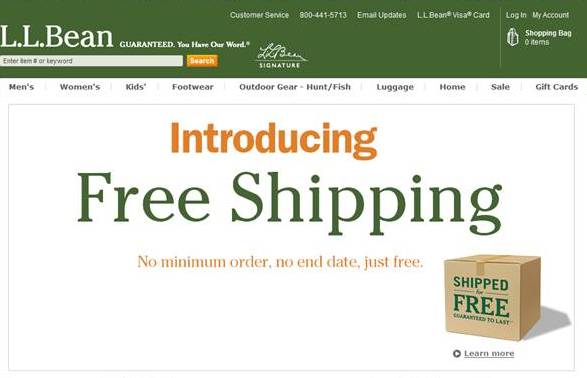
Our favorite group of fictional catalog executives are back to discuss free shipping. We begin, by vising the boardroom at Gliebers Dresses world headquarters, where Interim CEO Roger Morgan is about to enter.
Faith Kelley (Executive Administrative Assistant): Friends, I introduce to you, Roger Morgan.
Faith opens the door to the boardroom. The Executive team stands. Roger enters.
Roger Morgan (Interim CEO and Chief Operating Officer): Please, sit everybody. We've got a big agenda to cover today, so let's get right down to it. Pepper, what do the numbers look like this week?
Pepper Morgan (Chief Marketing Officer): This week, we did $1.1 million in demand, five percent ahead of forecast, flat with last year. For the month, we did $3.8 million in demand, one percent ahead of forecast, five percent behind last year. We're behind last year because of the shift in Easter.
Roger Morgan: It would make it easier for us to understand business trends if Easter fell on the same weekend each year.
Pepper Morgan: Our first quarter is over. We did $11.7 million in demand, two percent below forecast, flat with last year.
Lois Gladstone (Chief Financial Officer): From a profit standpoint, we generated $50,000 profit in the first quarter, flat with last year. We're generating enough free cash flow to pay the bills. Of course, our world blew up this week when L.L. Bean announced free shipping 24/7/365, and then our biggest competitor, Anna Carter, announced that they will also offer free shipping 24/7/365. This is the last thing we need.
Libby Benson (Director of Social Media): The social media world is buzzing about each announcement. We've been monitoring this in the listening center all week. @dressdiva77 said this earlier this week ... "Gliebers wants to charge me $14.95 to ship two dresses. Even though Anna Carter is more expensive, they're worth it now that they have free shipping."
Meredith Thompson (Chief Merchandising Officer): You know, we work so hard on having a fashion forward assortment. We've spent years reinventing the supply chain. We monitor fashion trends in the blogosphere, and you know how much I hate doing that! We're making progress. And then, our progress is stunted by marketing and financial strategy. What is our answer?
Lois Gladstone: We need to stay the course. We have our "buy four dresses, get free shipping for a year" policy. Obviously, customers see the value, right?
Roger Morgan: When we run free shipping promotions, what kind of lift do we get?
Pepper Morgan: When we run free shipping with no hurdle, we get a twenty percent sales lift, but we lose money on the promotion. When we run free shipping with a $100 hurdle, we get a ten percent sales lift, and we can generate a profit. When we run free shipping with a $100 hurdle for more than three consecutive months, the lift is reduced to just three percent, and we lose money.
Lois Gladstone: So, strategically, we're well positioned with our current loyalty strategy of free shipping for a year if the customer buys just four dresses.
Pepper Morgan: What we've observed, however, is that the loyalty strategy works with best customers. We really struggle with acquiring new customers. We expect the new customer to buy two dresses at $160, plus $14.95 shipping and handling. The customer can simply go to Anna Carter and pay $169, but get free shipping.
Libby Benson: Our listening center shows that we're generating a lot of negative sentiment. And our Klout scores are in decline since the announcement. We can't afford this kind of negative publicity.
Meredith Thompson: Klout scores?
Libby Benson: Yes, we can measure, in real time, what people think of us. Our shipping and handling policy is hurting our reputation.
Roger Morgan: So let me get this straight. If we follow suit, we'll generate an unprofitable sales lift. If we add a hurdle, like $100, we're still not competitive. If we extend free shipping beyond a few months, we'll be unprofitable. And if we stay where we are, we're not competitive, and we're barely making money as we speak. We don't have the money to match free shipping. And we can't afford not to match free shipping.
Lois Gladstone: Maybe we can afford to cover free shipping if we mail fewer catalogs. We'll use the money we save mailing catalogs, and instead use that to fund free shipping on a permanent basis. We've got to have a ton of waste there, right?
Meredith Thompson: Wait one minute, Lois. The catalog is our heritage. The catalog IS Gliebers Dresses. Without the catalog, we're just, what, what the heck would we be?
Pepper Morgan: An e-commerce dress retailer?
Meredith Thompson: An e-commerce dress retailer who couldn't drive traffic to our website, that's what we'd be. How does the customer get to our website without a catalog?
Lois Gladstone: How does the customer get to Amazon.com without a catalog, or to Zappos.com without a catalog?
Meredith Thompson: Or pets.com? It's easy to point out the successes, but we never point out the hundreds of thousands of failures. You must have a catalog, because the catalog is what is used by the customer to get to the website. When we eliminate catalog mailings, we reduce demand. And when we reduce demand, we have to clear overstocked products. When we clear overstocked products, we lose gross margin dollars, making us even more unprofitable. And we're not very profitable right now, are we?
Libby Benson: Today's modern customer doesn't care about our plight. All she wants is a dress at a fair price, coupled with free shipping. That's her expectation. We're going to have to absorb the cost.
Lois Gladstone: We can't afford to absorb the cost. And even I agree with Meredith, we can't circulate fewer catalogs, we've bought inventory to match the number of catalogs we're going to mail. The last thing we can afford to do is liquidate product at a loss. We're going to have to continue moving forward with our free shipping loyalty program, where you get free shipping for a year when you buy four dresses. We don't have a choice.
Libby Benson: But we do have a choice. We can take a risk. Or we can market why our current program is better than free shipping all day, every day, all year ... and we know that our current program isn't better, it is worse.
Pepper Morgan: Here's the problem, folks. We are all going to be forced to offer free shipping. We aren't going to have a choice. And when every one of us offers free shipping, the lift associated with free shipping disappears. In other words, we're going to be forced to offer free shipping, and when we all offer free shipping, the lift disappears, causing us to all be less profitable.
Meredith Thompson: Good gravy.
Lois Gladstone: Roger, you've been uncharacteristically quiet. What do you think?
Roger Morgan: I recently read a Woodside Research report. It talked about something they called the "Nimble Touchpoint Trooper". This is a customer that is all mobile, all social, 24/7/365, using offline marketing and online marketing and websites and hip, modern tools to get the best deals. This customer will demand that we all offer free shipping. But in the short term, I agree with Lois, we can't afford to match free shipping 24/7/35.
Libby Benson: We'll get stoned in the social media world.
Roger Morgan: We, as a team, are going to need to find ways to grow revenue. And if we cannot grow revenue by selling merchandise, we're going to have to sell our marketing platform.
Meredith Thompson: What?
Roger Morgan: Next week, I expect to announce that Gliebers Dresses will be sold.
Meredith Thompson: What?
Roger Morgan: Yes, Gliebers Dresses will be sold to J.J. Glieber.
Meredith Thompson: You have GOT to be kidding? What does he know about selling dresses? Glenn Glieber WAS Gliebers Dresses. J.J. benefited from Dad's money, using that money to become one of the greatest snow boarders of all time. We've all seen him on TV, hawking Nitro-Blitz, the six hour energy drink.
Roger Morgan: When this transaction closes next week, I will be appointed President and Chief Executive Officer. J.J. is not likely to be a hands-on owner. But he does have plans for our business. He wants a younger customer base. He told me yesterday that we're not going to be a "Geezer Brand". He wants to introduce Gliebers Dresses to his demographic. And he has a lot of marketing money from Nitro-Blitz, marketing money that might help us fund free shipping.
Meredith Thompson: Oh boy.
Lois Gladstone: President and Chief Executive Officer, Roger. You must be very happy.
Roger Morgan: It is the pinnacle of my career. And yet, I sit here, in front of you, curiously quiet. Our private equity overlords nearly killed our business. I have to rebuild the business, and in doing so, I probably have to offer free shipping on every order, because companies "with scale" decided to put the squeeze on everybody else. The expenses associated with free shipping are going to reverberate through this organization. We may need marketing dollars from Nitro-Blitz Six Hour Energy Drink. We may need to source cheaper fabric. We may need to reduce salaries, eliminate bonuses, trim benefits, mail fewer catalogs. The little people are going to be hurt, the folks who work in the contact center or distribution center. They are going to be hurt because free shipping is going to become a standard offer.
Meredith Thompson: And you get to be the one who delivers this message.
Roger Morgan: That's right.
Lois Gladstone: We're hooped.
Helping CEOs Understand How Customers Interact With Advertising, Products, Brands, and Channels
March 31, 2011
March 30, 2011
Lifecycle Marketing and Touchpoints: Weighting
One of the biggest problems facing an analytics or marketing professional is the weighting of data.
Here's an example. A customer purchases on August 1, 2008, purchasing on the website, spending $100. Then, on August 1, 2009, the customer purchases via paid search, spending $100. Finally, on August 1, 2010, the customer purchases via e-mail marketing, spending $100. Is this customer a loyal website buyer, a search buyer, an e-mail buyer, or a multi-channel buyer? And how does the customer skew across channels? Is the customer weighted equally, or do recent transactions carry more weight.
When I first obtain customer data, I like to run a quick regression model. Any transaction in the past year represents the dependent variable. My independent variables represent dollars spent in each prior year. I'll obtain an equation that looks something like this, using just twelve-month buyers in the equation:
Finally, I divide weighted dollars in each channel by total weighted dollars:
Does the weighting strategy make sense? Weighting is important, because we do not want older transactions to skew the customer profile, and we do not want to focus only on new transactions.
Here's an example. A customer purchases on August 1, 2008, purchasing on the website, spending $100. Then, on August 1, 2009, the customer purchases via paid search, spending $100. Finally, on August 1, 2010, the customer purchases via e-mail marketing, spending $100. Is this customer a loyal website buyer, a search buyer, an e-mail buyer, or a multi-channel buyer? And how does the customer skew across channels? Is the customer weighted equally, or do recent transactions carry more weight.
When I first obtain customer data, I like to run a quick regression model. Any transaction in the past year represents the dependent variable. My independent variables represent dollars spent in each prior year. I'll obtain an equation that looks something like this, using just twelve-month buyers in the equation:
- 2011 Spend = 30 + 0.65*(2010 Spend) + 0.30*(2009 Spend) + 0.15*(2008 Spend) + 0.08*(2007 Spend) + 0.04*(2006 Spend).
- 12 Month Purchases = Weight of 1.000.
- 13-24 Month Purchases = Weight of (0.30 / 0.65) = 0.462.
- 25-36 Month Purchases = Weight of (0.15 / 0.65) = 0.231.
- 37-48 Month Purchases = Weight of (0.08 / 0.65) = 0.123.
- 49-60 Month Purchases = Weight of (0.04 / 0.65) = 0.062.
- August 1, 2008 Website Purchase Weight = $100 * 0.231 = $23.10.
- August 1, 2009 Search Purchase Weight = $100 * 0.462 = $46.20.
- August 1, 2010 E-Mail Purchase Weight = $100 * 1.000 = $100.00.
Finally, I divide weighted dollars in each channel by total weighted dollars:
- Website = $23.10 / $169.30 = 13.6%.
- Search = $46.20 / $169.30 = 27.3%.
- E-Mail = $100.00 / $169.30 = 59.1%.
Does the weighting strategy make sense? Weighting is important, because we do not want older transactions to skew the customer profile, and we do not want to focus only on new transactions.
March 29, 2011
Lifecycle Marketing and Touchpoints
Social and mobile changed things, didn't they?
At minimum, each channel added a level of complexity. Back in the day, we used to manage catalogs. Then we added e-commerce, and after that, a ton of e-commerce micro-channels.
So it was bad enough in 2007 ... and then we tossed social and mobile into the mix.
This causes complexity ... we want to optimize our marketing investment, and that's hard to do when you don't know how a chain of events truly contributed to a purchase. Worse, we don't have a good understanding of how customer activities, managed over the lifecycle of the customer, yield loyalty.
So, our next series will focus on a methodology for plotting, on a map, customer touchpoints. The map will illustrate the lifecycle the customer follows. On a simple, two-dimensional plot, you'll get to see how channels fit together.
A few caveats.
- There really isn't a true customer lifecycle. We're doing this because the vendor community pushes us in this direction. The reality is that the customer orbits areas on the plot, each purchase pushes the customer in a different direction. The reality is that we need facts to tell us what is actually happening.
- I'm using a small number of channels here. You can do this with hundreds of micro-channels, if you wish. I'm using a small number of channels so that you can accurately see what is happening.
- The methodology isn't easy. If you don't like statistics, you'll want to hire me to do this for you.
March 28, 2011
Tuesday Mailbag: L.L. Bean, J. Jill, and More
Here's our mailbag ... these are questions from fictional readers that real readers should be asking.
Craig in Ephrata asks: What's up with J. Jill being sold again?
Ralph in Cannon Beach asks: L.L. Bean will offer free shipping, all day, every day, going forward. I don't think my business could ever afford to do this. Will they back away from free shipping in the future?
Kevin: In November and December, almost everybody offers free shipping, and it "works". It works, of course, because the control group ($14.95 shipping) is so uncompetitive that the lift free shipping provides pays for itself. The interesting thing, to me, is what happens in the future when nearly everybody has some sort of free shipping strategy outside of the Nov/Dec window. When everybody offers some version of free shipping, the "lift" associated with free shipping largely disappears. This means that the profitability of the offer disappears. Free shipping will have to be funded by "something". It is my opinion that catalogers, in particular, will fund free shipping with a significant reduction in "mailing waste". A smart cataloger will mail a customer thirteen times a year instead of twenty-three times a year, funding free shipping with the ad-cost savings while protecting 95% of the sales. The net-net of this relationship will be a positive.
Amelia in Nashville asks: Did I see that Groupon is now losing market share? I thought this was the business model of the future? What's going on?
Kevin: A couple of things. First, never confuse market share and net sales. If a market triples in size, and you go from owning 100% of the market to 50% of the market, your business grew. Second, the pundits don't know a whole lot, how could they know a lot? Three years ago, Groupon didn't exist, so how could a pundit know how the "space" was going to evolve? Thought leaders offered strongly worded opinions based on a limited dataset that offered virtually no ability to forecast the future accurately. We have no idea how group buying or "social commerce" will evolve. Enjoy the ride!
March 27, 2011
Dear Catalog CEOs: How To Measure If You Are Mailing A Segment Too Often
Dear Catalog CEOs:
| Demand | $2.00 |
| Net Sales | $1.60 |
| Gross Margin | $0.88 |
| Less Ad Cost | $0.65 |
| Less Pick/Pack/Ship | $0.16 |
| Contribution | $0.07 |
When you look at this segment, on an annual basis, across twenty catalogs, "all is good", right?
| Demand | $40.00 |
| Net Sales | $32.00 |
| Gross Margin | $17.60 |
| Less Ad Cost | $13.00 |
| Less Pick/Pack/Ship | $3.20 |
| Contribution | $1.40 |
Now, let's pretend that you don't believe in the organic percentage stuff that I specialize in --- you 100% believe that your matchback analytics are rock solid. Ok.
You still have an opportunity for profit improvement.
Mail/Holdout tests clearly indicate that you get maybe 70% of the catalog demand on 50% of the catalog mailings. This has been known for decades. Therefore, you can create a relationship that helps you understand how many of twenty catalog mailings yields an optimal level of profitability. Take a look.
| Catalogs | Demand | Ad Cost | Profit |
| 0 | $0.00 | $0.00 | $0.00 |
| 1 | $4.91 | $0.65 | $1.12 |
| 2 | $7.98 | $1.30 | $1.57 |
| 3 | $10.60 | $1.95 | $1.87 |
| 4 | $12.97 | $2.60 | $2.07 |
| 5 | $15.16 | $3.25 | $2.21 |
| 6 | $17.22 | $3.90 | $2.30 |
| 7 | $19.18 | $4.55 | $2.36 |
| 8 | $21.06 | $5.20 | $2.38 |
| 9 | $22.87 | $5.85 | $2.38 |
| 10 | $24.62 | $6.50 | $2.36 |
| 11 | $26.32 | $7.15 | $2.33 |
| 12 | $27.97 | $7.80 | $2.27 |
| 13 | $29.59 | $8.45 | $2.20 |
| 14 | $31.16 | $9.10 | $2.12 |
| 15 | $32.70 | $9.75 | $2.02 |
| 16 | $34.22 | $10.40 | $1.92 |
| 17 | $35.70 | $11.05 | $1.80 |
| 18 | $37.16 | $11.70 | $1.68 |
| 19 | $38.59 | $12.35 | $1.54 |
| 20 | $40.00 | $13.00 | $1.40 |
Mailing this customer segment nine times a year yields more profit than mailing this customer segment twenty times a year. Take all of your ad cost savings, and invest it in customer acquisition, or in online marketing, or in something new and interesting. I assure you, these profit opportunities exist all across your database.
Now, pretend that you believe the premise that customers generate demand without the need for catalog marketing. Pretend your organic percentage is 30% --- then 70% of your demand is from catalog mailings. Here's what your catalog profit and loss statement looks like, after removing organic demand:
| Catalogs | Demand | Ad Cost | Profit |
| 0 | $0.00 | $0.00 | $0.00 |
| 1 | $3.44 | $0.65 | $0.59 |
| 2 | $5.59 | $1.30 | $0.71 |
| 3 | $7.42 | $1.95 | $0.72 |
| 4 | $9.08 | $2.60 | $0.67 |
| 5 | $10.61 | $3.25 | $0.57 |
| 6 | $12.05 | $3.90 | $0.44 |
| 7 | $13.43 | $4.55 | $0.28 |
| 8 | $14.74 | $5.20 | $0.11 |
| 9 | $16.01 | $5.85 | ($0.09) |
| 10 | $17.24 | $6.50 | ($0.30) |
| 11 | $18.43 | $7.15 | ($0.52) |
| 12 | $19.58 | $7.80 | ($0.75) |
| 13 | $20.71 | $8.45 | ($0.99) |
| 14 | $21.81 | $9.10 | ($1.25) |
| 15 | $22.89 | $9.75 | ($1.51) |
| 16 | $23.95 | $10.40 | ($1.78) |
| 17 | $24.99 | $11.05 | ($2.05) |
| 18 | $26.01 | $11.70 | ($2.34) |
| 19 | $27.01 | $12.35 | ($2.63) |
| 20 | $28.00 | $13.00 | ($2.92) |
We learn that three catalog mailings is optimal.
This is why my Catalog PhD projects are able to yield about $1,000,000 of additional, incremental profit, per year, every year, for a $100,000,000 business. What's not to like about that?
Hillstrom's Catalog PhD:
March 24, 2011
Forecast Forensics + Digital Profiles: Time To Act!
Well, we've covered a lot of ground, haven't we?
Our Digital Profiles can be used to forecast the future. This allows us to craft a scenario that meets Management expectations.
We end up with an actionable analysis that helps us understand how to grow a business.
You'll learn that CEOs, CFOs, and CMOs really like this style of analysis, because for once, they get to actually see what needs to be done to truly grow a business.
It's time to act!
Start your own project. I've given you all of the tools you need to do a project like this. Get busy!
Or, contact me now and I'll create your own customized project for you. This project is very popular among CEOs, CFOs, and CMOs.
March 23, 2011
Forecast Forensics + Digital Profiles: Case Study
Let's say that your Management team is being asked to grow the business over the next five years. The mandate is simple ... the business must be 2.5 times as big in 2015 as it was in 2010.
Well, somebody might say ... "I'll bet if we can increase customer loyalty by 20%, we'll be able to grow this business. Let's see what impact that has:
Good gravy, that doesn't get the job done, does it? Now, be honest, there's nothing wrong with the business being 33% bigger in year five because annual repurchase rates increased from the mid-40s to the mid-50s. That's a big home run.
But it isn't what Management is asking for, is it?
The answer has to come from new customer acquisition. Let's try something. Let's reset loyalty metrics to base levels, and let's double new customer acquisition counts.
Now, be honest, it isn't easy to double customer acquisition counts, is it? And yet, if you double counts every year, it isn't good enough! It isn't good enough!
How about a 2.83x increase in new customers?
That does it!
Your job is to make this message easy for everybody to understand. You are going to have to, essentially, triple the number of new customers, in order to grow the business by a factor of 2.5x.
Dashboard mavens will love this ... you set up dashboards for everybody to see, illustrating the number of new customers vs. the goal of tripling current totals, by source. Everything gets measured.
Profit should get measured, too. If it costs you $10 of profit to acquire an incremental new customer today, and it will cost you an incremental $25 of profit to acquire a new customer in this new scenario, well, you know exactly how much money you need to ask for to make this happen, right?!
That's how we use Forecast Forensics in combination with Digital Profiles. We instantly see what is required to grow the business. We, as analytical experts, guide our CEO, CFO, and CMO toward tangible, actionable solutions.
This is an analytics system, a Segmentation/Forecasting system, that yields actionable outcomes.
Subscribe to:
Posts (Atom)
Your November / December Forecast
Let's try something ... contact me (kevinh@minethatdata.com) and for a nominal fee I'll produce a forecast for three timeframes, bas...
-
It is time to find a few smart individuals in the world of e-mail analytics and data mining! And honestly, what follows is a dataset that y...
-
It's the story of 2015 among catalogers. "Our housefile performance is reasonable, but our co-op customer acquisition efforts ar...
-
Here's a recent email campaign from Macy's. The $24.99 UGG Throw. That's the place where MRV matters. Items featured in email ca...


