April 09, 2018

Profit Outcome

Here's our test from yesterday. Three email contact strategies, three catalog contact strategies, executed for six consecutive months.

You execute tests like this all the time, don't you?

You are about to see why the tests are so darn important!

In our example, we take demand, subtract marketing cost (notice that customers with 0 catalogs and 0 emails still cost $2.00 each ... they incur costs via paid search and Facebook and affiliates, etc), and multiply demand by the profit factor. The net result is total profit (on a variable basis, before fixed costs).

At this time, somebody will point out that the maximum number of catalogs and maximum number of emails is "most profitable". They'll wash their hands of the issue and move on, confident that they've "optimized" the business, end of story!

They would be wrong!!

Tomorrow, we'll take our exercise a step further.

April 08, 2018

Test Results

Surely you execute test designs similar to what is observed here, right?
This test was run over a six month period of time.

Customers were randomly selected, and then placed into one of nine test panes.

Test Panel 1 = 0 Emails, 0 Catalogs (for the next six months).

Test Panel 2 = 0 Emails, 4 Catalogs.

Test Panel 3 = 0 Emails, 8 Catalogs.

Test Panel 4 = 50 Emails, 0 Catalogs (for the next six months).

Test Panel 5 = 50 Emails, 4 Catalogs.

Test Panel 6 = 50 Emails, 8 Catalogs.

Test Panel 7 = 100 Emails, 0 Catalogs (for the next six months).

Test Panel 8 = 100 Emails, 4 Catalogs.

Test Panel 9 = 100 Emails, 8 Catalogs.

At the end of six months, total demand amounts are listed above.

Again, you execute tests like this, don't you? How else would you know the "optimal" combination of email campaigns and print campaigns to send to a customer?

Tomorrow, we evaluate profitability.

April 05, 2018

Merchandising Imbalance

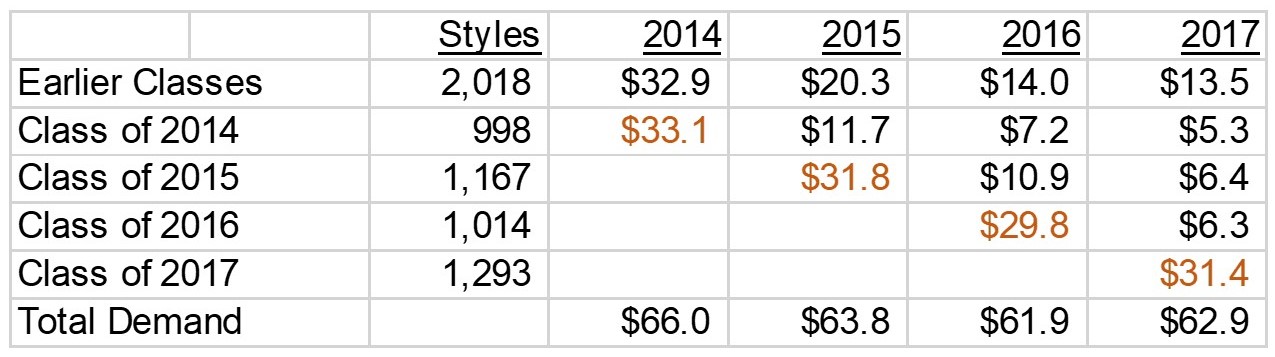
Look at the items from classes prior to 2014 ... those items generated $13.5 million in 2017.

Meanwhile, items from the classes of 2016/2017 only generated $12.7 million in 2017.

In most of my projects, there is what I call a "Merchandising Imbalance". There is a class of historical items that generate a ton of demand ... and new items generate a ton of demand ... with items from recent years being "killed off" too soon.

This creates all sorts of productivity problems that marketers get blamed for. When you don't have enough good items from 2014 - 2016, the "brand" appears to bifurcate ... it looks both old and chaotic at the same time. Existing customers are bored with seeing the same thing month after month for a decade while seeing a bunch of new merchandise that will quickly be discontinued. Boredom and chaos lead to lower conversion rates, and lower conversion rates yield blame ... for the marketer.

You MUST measure this stuff ... you don't want to get blamed for merchandising sins from 2-4 years ago, do you?


P.S.:  If you are bored by this stuff, read about Under Armour getting hacked (click here). I'm increasingly confident all of this digital stuff is going to turn out just fine ...

April 04, 2018

New Merchandise

Look at the Class of 2016 at Gliebers Dresses ... fewer new items than surrounding years and poor productivity of those items.

You know who gets blamed?

Sometimes marketers get blamed ... conversion rates fall because new items perform about $2.0 million worse than they should and it becomes a marketing issue.

These aren't marketing issues ... these are merchandising issues that marketers get blamed for.

As a marketer, you MUST measure this stuff. You have no choice, your job depends upon it. If you don't measure it, somebody will eventually blame you for having miserable conversion rates ... it'll be your fault.


P.S.:  If you don't like this stuff, then read how 28% of traffic is not human ... I'm increasingly confident that all of this digital stuff is going to turn out just fine.

April 03, 2018

Killing Items

Your job is to ferret-out information that "really" describes why your business is struggling.

Here's one of the ways you do that. You listen to co-workers. For instance, a merchant might say something like this:

  • "We've got a lot of new product and we need the company to get behind us and support what we're doing."
#OhBoy

There's nothing wrong with new merchandise.

But you have to analyze what happens to the merchandise you used to sell.

Merchandise has a natural "decay" ... the older merchandise gets, the less of it you sell, until one day you discontinue selling VCRs and Palm Pilots and you move on.

When your merchandising team purposely kills off existing items "too soon", well, that's when you have problems.

Here's an example. This is the typical "decay" relationship for items introduced five years ago.
  • Year 1 = $30,000,000.
  • Year 2 = $18,000,000.
  • Year 3 = $12,000,000.
  • Year 4 =   $7,000,000.
  • Year 5 =   $4,000,000.
The problem happens when a new merchandising regime decides that the prior merchandising regime was "stupid". They'll kill off items in Year 2, and that creates a whole set of issues.
  • Year 1 = $30,000,000.
  • Year 2 = $11,000,000.
You just lost $7,000,000 because the new merchandising team hated what the old merchandising team introduced a year prior. How are you going to make that demand up?

Most of the time, new merchandise doesn't make up for this problem ... you're always introducing new merchandise. So the merchandising team just cost you $7,000,000. Congrats!!

But it gets worse.

What do you think happens in Year 3, Year 4, and Year 5? We can project the shortfall.

  • Year 1 = $30,000,000.
  • Year 2 = $11,000,000.
  • Year 3 =   $7,000,000.
  • Year 4 =   $4,300,000.
  • Year 5 =   $2.400,000.
Yup - you lost $7,000,000 in Year 2, but you also lose $5,000,000 in Year 3 and $2,700,000 in Year 4 and $1,600,000 in Year 5.

If your merchandising team does this two years in a row, well, you know what happens, don't you?

Marketers get blamed for this nonsense. When this happens, online conversion rates fall, and when online conversion rates fall marketers take the blame. It's wrong, of course, but it is the way that business works.

As a marketer, you MUST measure the living daylights out of this stuff. Stop getting blamed for the sins of your merchandising team. And when your merchandising team succeeds, GIVE THEM CREDIT, PUBLICLY. Shout it out!


P.S.: If you're really bored by this stuff, then read about how Slack enables your boss to read your DMs (click here). I'm increasingly confident that all of this digital stuff is going to turn out just fine.

April 02, 2018

Blaming Marketers

Yup - it happens all the time. It's the reason for many of my consulting projects ... business is off and nobody knows why so somebody asks me to look at all of the ways that marketing is making mistakes.

And marketers make a ton of mistakes - so it is easy to point the finger at the stupid marketer and then see that conversion rates are down 10% and therefore the marketer messed up and we go fire the marketer and we start over with a new marketer.

The marketer in commerce is not unlike the head coach in sports ... if the General Manager fails to acquire talent, the GM should be fired, right? Too often, the head coach takes the blame.

For the rest of the week, I'll share examples of ways that marketers get blamed for merchandise challenges.

In 2018, the marketer MUST analyze merchandise productivity ... it's a requirement of job security (and brand health).


April 01, 2018

Final Slides for VT/NH Event on April 5

Here you go, folks ... the final set of slides for my presentation on Thursday.


If you cannot download the presentation or see it via your email client, click here for access.

Honestly, if you are Professional in New England, what is stopping you from attending? An omnichannel task force meeting where you'll discuss how many pages need to be in the October catalog in order to drive response via affiliate marketing? Get in your car and join us (click here to attend).

Content Creation

Here's the link . I realize many of you are stymied by creating content for your customers. Some of you would say the video above is poi...