November 12, 2014

This Is Why Digital Vendors Demand Retailers Become "Omnichannel".

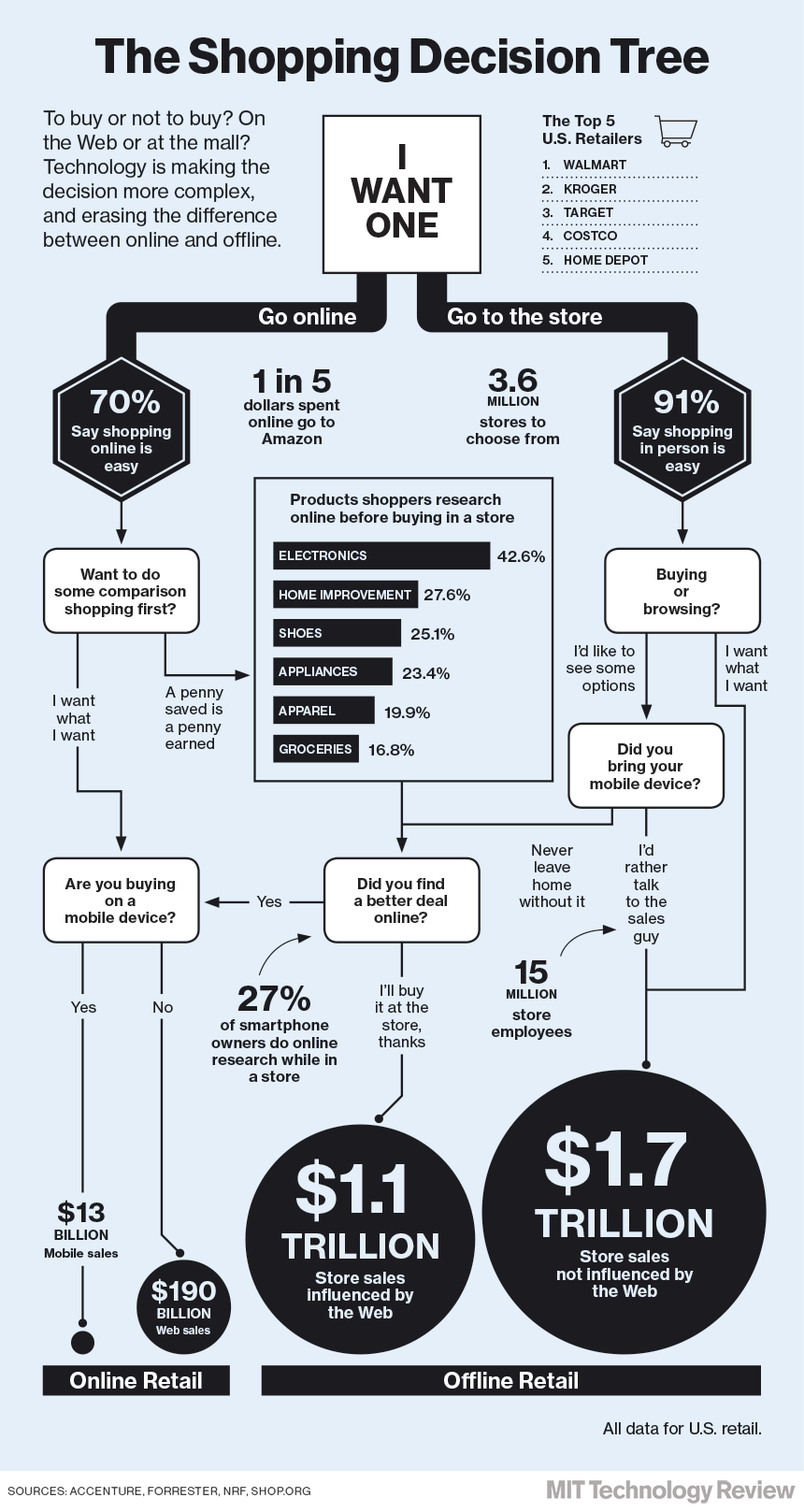
Here's the link to the infographic on the right (click here).

Look at the four circles at the bottom of the graph.
  • $13 Billion in Mobile Sales.
  • $190 Billion in Online Sales.
  • $1,100 Billion ($1.1 Trillion) in retail sales allegedly influenced by online research.
  • $1,700 Billion ($1.7 Trillion) in retail sales not influenced by online research.
That $203 Billion that is Online + Mobile ... let's say that grows at +12% per year for ten years ... compounded ... that gets us to $630 Billion.

If the $2.8 Trillion grows at +2% per year for ten years ... compounded ... that gets us to $3.4 Trillion.

In other words, Online is constantly dwarfed by Retail ... for a decent amount of time, going forward.

This means that vendors looking to make $$$ on digital have their eyes a gigantic amount of Retail volume. If they can convince you that Online/Mobile cause Retail to happen, then they can get paid for the paltry Online portion of the total, and they can get paid for the gigantic Retail portion of the table above.

Just something for you to think about. There's no doubt Online+Mobile influence Retail. There is minimal proof, if any, that Online+Mobile cause Retail sales to increase ... there's plenty of proof that Online+Mobile divert sales away from Retail, at slow rates.

November 11, 2014

Catalogers And Clario And Optimization Theory

There are two common questions among catalog marketers.
  1. How do our demographics and challenges compare to other catalog brands, and how do online businesses deal with these challenges?
  2. Clario is telling me that the optimal solution is to reduce housefile catalog mailings by 43%. This isn't optimal, this kills my business? Why are they saying this?
Mind you, I compete with Clario (Hillstrom's Contact Strategy), but my answer to #2 above should help you feel more confident about your working relationship with Clario.

Clario is telling you what the "optimal" strategy is ... after accounting for your mail/holdout test results (you routinely execute three month mail/holdout tests right ... RIGHT?), after accounting for attribution rules that factor in mail/holdout test results and matchback results and any other attribution rules they've developed for you, after factoring in book costs, and after factoring in the rate that demand flows through to profit. After all of those factors, Clario tells you what the contact strategy is that yields the most profit.

This strategy is going to cost you sales ... it's typical for a 40% reduction in ad-cost to be paired with a 10% to 15% drop in demand (do not believe those who tell you that they can cut 40% of your circ with minimal impact on demand - it's not going to happen). In other words, the optimal strategy is not the optimal net sales strategy - you need to mail more to increase sales.

In most cases, we're looking at "optimal" as being break-even short-term profit. If you want to optimize 12-month profit, you may mail deeper to reactivate customers, customers who will pay you back in the next year. You need to clearly communicate your strategy to Clario, plain and simple. If you want to optimize twelve-month profit (and not book-by-book profit), tell Clario that's what you want to do.

As an Executive, you know that there is no such thing as an "optimal answer". No such thing. There is a continuum of answers, and all answers have pros and cons. In the graph above, if you accept the optimal answer, then you cut circulation by 65% ... and you'll reduce the 12-month buyer file by 10% to 15%, and your business will contract year-after-year-after-year. That may not be optimal, unless you have a strong customer acquisition program in place. With co-op performance where it is, catalogers do not have strong customer acquisition programs in place if co-ops are responsible for more than 40% of new customers.

You are paying Clario a fortune ... usually 2x-4x what you'd pay me to do comparable work. Ask Clario to create the graph at the top of this post ... have them run a dozen different scenarios at different levels of "optimization", then invite Clario in at your cost to educate Clario how your business works. Tell Clario that when they demand you optimize your business that you'll have to liquidate six months of merchandise and that is "not an optimal outcome". Teach Clario how the dynamics of your businesses work.

And then listen carefully to the twelve different optimization outcomes Clario can simulate for you. Think carefully about why the optimal outcome requires so many fewer catalogs than you are currently mailing. Anytime Clario is telling you to greatly reduce circulation, they are not telling you to kill your business - they are telling you that the customers who shop from your business are different than they used to be, are more online-centric, and no longer need catalog saturation to generate volume. Clario is telling you that your business has changed. They are telling you that the world has changed. Why do you choose to argue with Clario? Why not listen to them?

As for the employees at Clario? It's not optimal to have your primary competitor defending your business model for you. I defend you, of course, because it is the right thing to do. Please, please, please, communicate better with the swath of your client base who call me in frustration. Show your clients multiple solutions, and let your clients choose what is right for them, as opposed to arguing over an ideal "optimal" answer.

Need help with issues pertaining to Clario? Email me now (kevinh@minethatdata.com).
November 10, 2014

Chicos and Retail

Have you read this ditty about Chicos (click here please)?

I've talked extensively about retail ... as e-commerce takes over (not next year, but over time), pressure is placed on the profit and loss statement. Given that so many retailers owe a ton of debt on retail stores, there is double whammy about to hit. In other words, it will get harder and harder to generate profit in a physical retail store, while at the same time, the expense structure of the store is saddled with debt ... interest and principal payments that do not change.

So if you have fixed debt payments and reduced income, something has to give.

In the article, the future of retail is clearly articulated.
  • Stores are going to get smaller.
  • Expenses must be cut.
  • E-commerce must pick up the slack to cover the debt.
  • Only best sellers will be made available.
  • An assumption is made ... customers will enter a store, not find what they want to purchase, and then be perfectly happy shopping online while standing in the store chatting with strangers who instantly become dear friends. 
  • The online purchase may or may not be credited back to the store.
The assumptions are the biggest piece of this puzzle. We hear this all the time ... we assume that if the customer doesn't find what s/he wants, s/he will buy it online while standing in the store.

Big, big assumption.

Catalogers know all about this dynamic. Large catalogers actively measure the relationship between reduced space and reduced demand. The relationship looks something like this:


What do we observe here?

With a 96 page monthly catalog, $2.00 million is generated that month.

With a 72 page monthly catalog, $1.86 million is generated that month.

With a 48 page monthly catalog, $1.71 million is generated that month.

With a 24 page monthly catalog, $1.41 million is generated that month.

Without a monthly catalog, $1.00 million is generated that month. Without a catalog, half of the demand flows online anyway.

This, then, is the secret to the alleged omnichannel movement. This is the theory. If the store gets smaller (or even disappears), and if only best sellers are offered in the store, the theory suggests that customers will still spend $1.86 million, or $1.71 million (instead of $2.00 million), even though the store is 75% or 50% the size it used to be and only offers best sellers. The theory is that the customer will, even if standing in the store, shop online. The theory suggests that it is ok to have the entire assortment online, only selling best sellers in-store.

Theory does not equal reality.

But the theory could be proven correct.

That's what makes work so much fun!!

November 09, 2014

Why Is It So Hard To Find New Customers And Reactivate Lapsed Customers? Some Numbers, Please!

Here's something I ran across in a recent analysis. The metric is a simple one ... percentage of demand at full price (click here to pick up your copy of Hillstrom's Diagnostics).
  • New Buyers = 46% Full Price.
  • Lapsed Buyers = 41% Full Price.
  • 1x Buyers Last Year = 37% Full Price.
  • 2x Buyers Last Year = 33% Full Price.
  • 3x Buyers Last Year = 28% Full Price.
  • 4x Buyers Last Year = 21% Full Price.
  • 5x+ Buyers Last Year = 18% Full Price.
Not surprisingly, on a comp basis, there's a problem with this business:
  • New Buyers = -15% vs. Last Year.
  • Lapsed Buyers = -8% vs. Last Year.
  • 1x Buyers Last Year = -2% vs. Last Year.
  • 2x Buyers Last Year = +1% vs. Last Year.
  • 3x Buyers Last Year = +3% vs. Last Year.
  • 4x Buyers Last Year = +4% vs. Last Year.
  • 5x+ Buyers Last Year = +5% vs. Last Year.
I keep seeing stuff like this ... companies give the "best" customers all the promotions and sale purchase opportunities and liquidation opportunities. Not surprisingly, folks hang on to better customers.

The CRM folks demand that only best customers are rewarded, and we listen. Either don't discount, or discount to everybody equally, if you want uniform outcomes. We're causing our own problems, folks!!

Go run this query on your own business. Right now! Go do it. What did you learn?

And if the numbers look like these numbers, well, maybe you just learned why you cannot acquire new customers anymore.

November 06, 2014

It's Here! Hillstrom's Diagnostics

You are doing everything right. The trade journalists praise your omnichannel efforts. You are aligned with every single vendor that Woodside Research deems to be in the "best quadrant". Your mobile traffic is skyrocketing into the stratosphere. Your social efforts are engaging.

And yet, comp stores sales are +2%.

Or your catalog customer is now 63 years old, on average, and you're struggling to find enough 63 year old customers to keep growing.

Or you are an e-commerce business that is seeing slowing growth, for the first time ever.

You need Hillstrom's Diagnostics.

I'll help you identify why your business won't grow in an age of unlimited marketing channels.

Click here to pick up your Print or Kindle version, and start identifying why your business won't grow.

November 05, 2014

Hillstrom's Diagnostics: The Problem With Campaigns

Do you see the image on the cover of Hillstrom's Diagnostics - available soon from an Amazon website near you?

That's the Snake River - my favorite river, if I may be so bold. It begins near Yellowstone National Park, hops across Southern Idaho, forms part of the border between Oregon and Idaho, defines a portion of Southeast Washington State, then merges with the mighty Columbia River at The Tri-Cities.

Here's the thing with the Snake River. You can stand near Twin Falls (where the image on the cover of the book was taken), look down, and surmise that "all is good". Looking at the Snake River in Twin Falls is a lot like evaluating an omnichannel campaign.

However, salmon born in the Snake River exit into the Pacific Ocean nearly a thousand miles away in Astoria, Oregon. There, salmon feed endangered Resident Orca Pods (J, K, and L). In recent years, there aren't nearly enough salmon to feed the endangered Orca Pods, causing greatly reduced numbers.

In other words, you can do everything right in Twin Falls, and you can measure that you're doing everything right. And yet, the outcome, in Astoria, is lousy, causing an endangered species of Orca whales to become even more endangered.

Such is the case with omnichannel marketing strategies.

The vast majority of our measurement techniques are campaign-centric, like looking at the Snake River in Twin Falls. We measure what happens at a point in time, in one location. We do not measure the impact on the total ecosystem, do we?

In retail, omnichannel is slowly killing store performance - the exact opposite of the desired outcome. Our digital marketing tactics cause customers to sit at home, browsing, not traveling to a store to shop. Worse, when the customer shows the slightest interest in buying something, we exhibit no patience for the online-to-retail experience to happen. Instead, we demand that the customer empty that shopping cart into a viable purchase transaction - now - NOW! That has to happen online, further decreasing the in-store buying opportunity.

After a decade to training the customer to sit at home and shop, is it any wonder that we're fretting about foot traffic in stores?

Hillstrom's Diagnostics help the retailer, cataloger, or e-commerce maven to understand if there are specific productivity issues or new+reactivated customer issues. Across forty companies during the past two years, these two issues (merchandise, new+reactivated customers) are the dominant challenges facing my clients. The booklet will help you diagnose your specific problem.

November 04, 2014

Coming Soon: Hillstrom's Diagnostics

Each year, I look back at what clients asked me to do. Then I map their requests and issues against the direction our industry is headed in.

The story of the Fall of 2014 is obvious - new + reactivated customers. Retailers have spent a decade teaching customers to never visit a store, just sit at home and browse (omnichannel). As a result, anywhere between 25% and 50% of store foot traffic simply disappeared over the past four years, depending upon the specific study you read. Loyal customers are hanging in there, but there are too few new + reactivated customers to allow the retail channel to grow, sinking so many omnichannel strategies.

In e-commerce, the story is the coming ceiling on new customer acquisition. This will set off a rapid deceleration in sales growth, given that most e-commerce brands retain between 25% and 40% of twelve-month buyers, coupled with a sub-standard 1x-to-2x customer evolution process.

And in catalog marketing, the story is demographics - new + reactivated customer counts are falling apart, as the merchandise assortment caters mostly to a 60+ customer audience.

It became obvious, then, that most businesses are struggling to diagnose customer problems. If businesses could accurately diagnose the problem, then we'd see strategies and tactics to counter the issues I consistently identify. Worse, most businesses are using campaign-centric reporting (RFM response in catalogs, conversion metrics in e-commerce, monthly comp store sales in retail), and as a result, businesses cannot possibly diagnose the problems I am seeing.

So, it's time for a booklet on diagnosing customer productivity problems.

You'll learn all about the diagnostics I am using to identify popular retail, e-commerce, and catalog problems. The diagnostics quickly identify when problems started, and frequently outline (in short order) what the problems are. The diagnostics do not, of course, tell you how to fix the problems. But they clearly identify where the problems are, so that your merchandising and marketing experts know where to start.

Hillstrom's Diagnostics - coming soon to an Amazon website near you.

Content Creation

Here's the link . I realize many of you are stymied by creating content for your customers. Some of you would say the video above is poi...