I have been invited to meet with Anna Carter, President of Anna Carter, the main competitor of Gliebers Dresses.
As you may know, Anna Carter elected to discontinue their catalog in Fall 2009. Ms. Carter's office building is almost space age, in comparison with the office space leased by Gliebers Dresses. Ms. Carter's office is lined with LCD televisions on the walls. One LCD monitor posts a dashboard with call center and live chat information. Another lists daily website metrics, including conversion rates and bounce rates, new/existing visitor information, that kind of stuff. Another LCD monitor scrolls live customer feedback on Twitter. Yet another LCD monitor scrolls through updates from various fashion blogs.
These monitors are posted in every Executive's office, and hang from the walls of every major congregation point in the building. In fact, all aspects of the office building are positively 2010 in nature. On-site daycare, company paid iPhones for all employees, Twitter accounts for all employees that require, as a condition of employment, one tweet per day. There is an amazing cafeteria that is subsidized at a rate of $10 per employee per day, enough money for employees to enjoy breakfast and lunch. A workout room is fully furnished with clean towels and the latest equipment, and is staffed with a Wellness Director. This individual prescribes workout routines and dietary opportunities that can be supplemented in the cafeteria. Employees can pay an annual fee of $2,500, and in kind, receive free health care for the year ... in fact, an on-site nurse practitioner deals with daily issues, referring employees to medical attention as appropriate. Employees who drive Hybrid vehicles, who take public transportation to work, walk to work, or ride their bike to work receive free health care ... their $2,500 annual health care fee is waived.
In other words, Anna Carter has gone to great lengths to create an environment where an employee feels valued. Let's chat with the person behind this company.
Kevin: "Thanks for inviting me to be here today, Ms. Carter."
Anna Carter: "Please, call me Anna."
Kevin: "Let's get right to the question most people would want to know about. Why did you end your catalog marketing program?"
Anna Carter: "Oh, this is a complex issue. Let me start by asking you a series of questions, Kevin. When is the last time you subscribed to a newspaper?"
Kevin: "At least ten years ago."
Anna Carter: "Why do you keep a landline-based phone?"
Kevin: "I need it for my DSL service, and use my cell phone for almost everything else."
Anna Carter: "What is the ratio of CDs you've purchased in the past year to MP3s?"
Kevin: "I think I purchased 124 songs on iTunes, and purchased one CD."
Anna Carter: "When is the last time you purchased a DVD, and when is the last time you got a movie via Netflix?"
Kevin: "I only purchased one DVD last year ... I get three movies a month from Netflix."
Anna Carter: "What is the ratio of time you spend watching network television, vs. watching cable networks?"
Kevin: "I probably only watch 4-5 shows that are on network television. Most of what I watch is on a cable network."
Anna Carter: "When is the last time you purchased something from Amazon.com, and when is the last time you ventured into a department store?"
Kevin: "I bought from Amazon last month, I probably haven't purchased something from a department store in six months."
Anna Carter: "We could do this forever, Kevin. Times change. In 1999, I went to Tower Records, and I browsed a hundred CDs before walking out of the store with a half-dozen CDs. Today, I let iTunes and Genius recommend to me what I would like to listen to, and then wirelessly add the song to my iPod touch. It's magic. How the heck would Tower Records compete with that?"
Kevin: "They couldn't. And now Best Buy and Wal-Mart are shrinking their physical music offerings, too."
Anna Carter: "At some point, you ask yourself a simple question. Are you in business because of the technology that delivers product to a customer, or are you in business because of the merchandise that customers want to buy from you? The catalog is simply a technology. My brand is about connecting customers with fashion. I don't need a catalog to facilitate that connection, do I?"
Kevin: "But what if the technology is still viable? Why kill the catalog altogether? Why not target it to the customers who want catalogs, and let everybody else shop online or via the micro-channels they prefer?"
Anna Carter: "That's an oversimplification of an issue, Kevin. That's a theoretical question raised by folks who have a vested interest in CRM, or in selling paper or printing services, or in hosting a co-op database that pays them whenever somebody rents a name."
Kevin: "Well, no, if it is more profitable to target only those customers who want a catalog, then why not make the more profitable decision?"
Anna Carter: "Profit is a flexible concept, Kevin."
Kevin: "How so? Isn't profit a simple mathematical calculation?"
Anna Carter: "Let me give you an example. Our catalogs averaged 124 pages, and we mailed them about seventeen times a year ... no remails. This means that we had to create 2,108 unique pages each year. You don't do that with a small number of individuals, Kevin. It takes a boatload of talent to put 2,108 pages in the mail. It costs us $1,500 just to produce each page. And we paid $0.67 to put each 124 page catalog in the mail."
Kevin: "And then you received $3.00 per catalog, yielding you $0.25 of profit."
Anna Carter: "The issue, Kevin, is what COULD you do with the $0.67 of catalog marketing expense. Could you do something that generated a better return on investment?"
Kevin: "But why not spend the money on catalog marketing and spend additional dollars on the other activities that generate a better return on investment ... then you win on both fronts, right?"
Anna Carter: "That's not the way marketing works, Kevin, and you know that, you talk about that issue all of the time on your blog. We tested not mailing catalogs in Q1-2009. After two months, the performance of our e-mail marketing campaigns doubled. You mention that marketing is a big game of whack-a-mole on your blog. Well, that's exactly what it is. In our test, we learned that customers age 55 and above are nearly 100% dependent upon catalog marketing. Customers age 40-54 began to migrate to e-mail marketing, paid search, portal advertising, that kind of stuff. Customers age 30-39 were into e-mail marketing and social media. Customers age 20-29 are a whole different ballgame, we haven't learned how to market effectively to them. But in all cases among customers age 20-54, catalogs did not yield the sales that our matchback reporting suggested."
Kevin: "Explain that concept to me, because the co-ops keep telling catalogers that if you don't mail a catalog, you don't get sales in other channels."
Anna Carter: "Of course they tell you that, because if you cut back on catalog mailings, they lose revenue. They don't technically lie to you. They tell you that customers who received the catalog spend $2.20 online in the sixty days after receiving a catalog. Well, technically, that statement is 100% accurate. Of course, it doesn't mean that BECAUSE the customer received a catalog the customer spent money online. Our tests showed us that 50% of the demand matched back to a catalog would happen anyway if a catalog was not mailed.
Kevin: "So in your case, the matchback algorithm grossly overstated how effective the catalogs were?"
Anna Carter: "Exactly. We ran a profit and loss statement on the incremental demand generated by catalogs. We were generating 3% EBIT on our catalog business. I could spend $10,000,000 of marketing expense mailing catalogs to generate $750,000 profit, or I could put $10,000,000 in a CD at 3% interest and earn $300,000 profit, without doing any work whatsoever."
Kevin: "You still make more money doing the catalog marketing, right?"
Anna Carter: "This brings us back to the question of what we could do with $10,000,000 of catalog marketing expense. We used the results of our test to forecast what we could spend in online marketing if a catalog didn't exist. For instance, we learned that we could quadruple our paid search investment if we didn't have a catalog."
Kevin: "How is that possible?"
Anna Carter: "Part of the increase happens because paid search orders were no longer being matched back to catalogs, causing paid search performance to look much better. But here's the really interesting part of the equation. We took our creative staff, folks who used to work on catalog spreads, and gave them a new challenge. We assigned each creative staffer a set of keywords, and told them to design landing pages customized to the keywords assigned to them. Our landing pages were good for crap when we focused all of our efforts on catalog spreads. Our landing pages absolutely blossomed when a creative person designed a page tailored to a family of keywords. Conversion rates for tailored landing pages increased by 125% when catalog creative folks designed the pages. This fact alone allowed us to triple our paid search spend."
Kevin: "But those customers have significantly lower long-term value, compared with a catalog customer, correct?"
Anna Carter: "Yes, that's correct. But so what? If I can acquire 10 customers at break-even with $20 of long-term value, I am better off than acquiring 3 customers at break-even with $40 of long-term value. You simply change your mindset. You ask your people to focus on something different."
Kevin: "Ok, but how do you acquire customers now that you don't have a catalog?"
Anna Carter: "That one is harder to solve, Kevin. Starting in February 2010, we will offer $3 shipping on all orders, and free returns on all orders. We can do this because we know that our conversion rate will increase by 20% with this strategy, offsetting some of the lost shipping and handling revenue. And then we acquire new customers, because first time visitors to the site bail on us when they get to shipping and handling expense. We will use catalog marketing dollars to subsidize $3 shipping and free returns."
Kevin: "That still doesn't solve your new customer acquisition problem."
Anna Carter: "Nope, it doesn't. And honestly, I don't care. Traditional customer acquisition through list rental was wiped out by the co-ops. And now the co-ops are being wiped out by Google. In five years, the co-op business model will not work anymore for catalogers. I'd rather get a five year head start experimenting with new strategies than wait for co-op customer acquisition to completely implode."
Kevin: "This has to have a brutal impact on top-line sales, right?"
Anna Carter: "Sarah Wheldon thinks sales will drop by 35%. I am forecasting a 40% drop in sales in 2010. But we will be more profitable in 2010 without a catalog than we were in 2009 with a catalog."
Kevin: "So you had to fire a bunch of staffers, right?"
Anna Carter: "Yes, in the call center and distribution center, it wasn't pretty. But we kept about ten of our best sellers in the call center, and gave them a new title --- Social Media Store Manager."
Kevin: "Describe that job title to me."
Anna Carter: "Their job is to use blogs and Twitter to solve customer service problems, to build an audience, and to sell to customers. It's a $400,000 investment that we'll try for one year."
Kevin: "How does one sell on Twitter?"
Anna Carter: "Here's the thing, Kevin. We gave every employee, not just merchants or Social Media Store Managers, but every employee a new level of accountability. We told them that SPREADS = LANDING PAGES. In other words, everybody used to work hard to merchandise a spread in a catalog. Now, our merchants and creative staff focus entirely on creating landing pages. They get to see the performance of their landing pages, in real time, via our web analytics tool. Employees who design the best performing landing pages earn a weekly bonus. Employees who refer customers to the best performing landing pages via their blogs and Twitter accounts receive a weekly bonus. We froze salaries for 2010, and told employees that they can earn that money back via bonuses. The average employee would have received a $1,500 salary increase. As long as the employee has a social media presence and updates their social media presence at least twice a week, they get $500. Then, the best performing employees all earn bigger bonuses based on what they sell via their social media presence --- I mean honestly, we pay affiliates a percentage of every order they generate, so why not do the same for every employee? I mean, who has more passion for selling, an affiliate, or one of our employees?"
Kevin: "That's interesting."
Anna Carter: "It sure is. There is an insane amount of competition to create highly performing landing pages. Landing pages that don't work are killed, quickly. You have merchants doing de-centralized marketing on their own Twitter pages, driving customers to the their own landing pages. You have creative staff doing de-centralized marketing on their own Twitter pages, driving customers to their own landing pages. You have employees competing against each other, trying their hardest to outperform each other, creating a Darwinistic style of landing page evolution that we could never have learned on our own when we have a catalog. In fact, conversion rates on our landing pages have improved by 80% since we terminated the catalog and developed this style of competition."
Kevin: "Have you had any problems on Twitter, using this strategy?"
Anna Carter: "We have three rules. Don't lie. Always reflect the brand favorably. And you're not allowed to offer discounts or promotions. Everything else is fair game. If you want to see innovation on Twitter, you'll see it using this strategy. We have employees offering merchandise deals of the day. We have employees who offer social media links to anybody who promotes our merchandise on their blogs. In fact, we now see that 17% of our website traffic comes from social media. The important thing is to allow each employee to be their own "store manager". They get to pick and choose the landing pages that they like best, and then they are rewarded when customers buy from their landing pages or via their social media presence. I've seen merchants who earn bonuses by selling the merchandise offered by a co-worker ... if that merchandise is working better than what the merchant is selling, you'll see merchants promote other merchandise over their own. You won't see that happen in a traditional catalog business."
Kevin: "All of this happens because employees aren't focusing on catalog spreads anymore?"
Anna Carter: "And it happens in real-time, Kevin. If a landing page isn't working, it gets pulled down, and fast. If a catalog spread doesn't work, it sits there in homes for sixty days, and we don't fix the problem for maybe six months. We optimize our business on the fly. Do you have any idea what we've learned about customer behavior since disbanding the catalog, stuff that we never had the resources to learn previously?"
Kevin: "Sounds like you need web analytics and information technology alignment to pull this off."
Anna Carter: "You have no idea. It's nice to have an information technology executive who is incented to provide a framework for dynamic landing pages that can be modified by any creative staff member. And you should see the merchandising, creative, and information technology integration that happens ... they all realize that they need each other to make the business work. And you should see how merchants all of a sudden are spending time in the contact center, encouraging employees to use live chat or Twitter to promote their landing pages. All of a sudden, employees are working together in ways we never imagined."
Kevin: "So this is how you make more profit than by running a traditional catalog business?"
Anna Carter: "Yes, this is how you do it. But you cannot do it if you are passionate about catalog marketing. You can only do it if your are passionate about selling merchandise. This is the mistake that old-school marketers make. They are passionate about the form of distribution. The music industry wanted to sell you music via a CD, they didn't want to sell you music. The newspaper industry wanted to sell you news via paper, they didn't want to sell you news. I want to connect a woman with a dress, and I'll go door-to-door to do that if I have to. I do not care one bit about the way I connect a woman with a dress. I care deeply about having passionate employees who want to sell!"
Kevin: "Based on the benefits employees have, it looks like you re-invested catalog dollars in a lot of employee programs."
Anna Carter: We sure did. We built the workout center, the cafeteria, we hired a Wellness Director, we added the daycare center, we did all of that with the money we used to spend on catalog marketing. Our employees, in kind, spend more time here, they are healthier, happier, and work harder at merchandising and marketing our website."
Kevin: "Thanks for taking the time to chat with me today, Ms. Carter."
Anna Carter: "And thank you for spending time working with Sarah Wheldon on a five year forecast for where our business will be in 2015 without catalog marketing. I appreciate the Online Marketing Simulation work you did for us. If Gliebers Dresses invites you back, be sure to pass along my best wishes to Glenn. I'm sure that our decision to kill the catalog is absolutely knawing at him."
January 07, 2010


January 06, 2010
Planning: New Customers
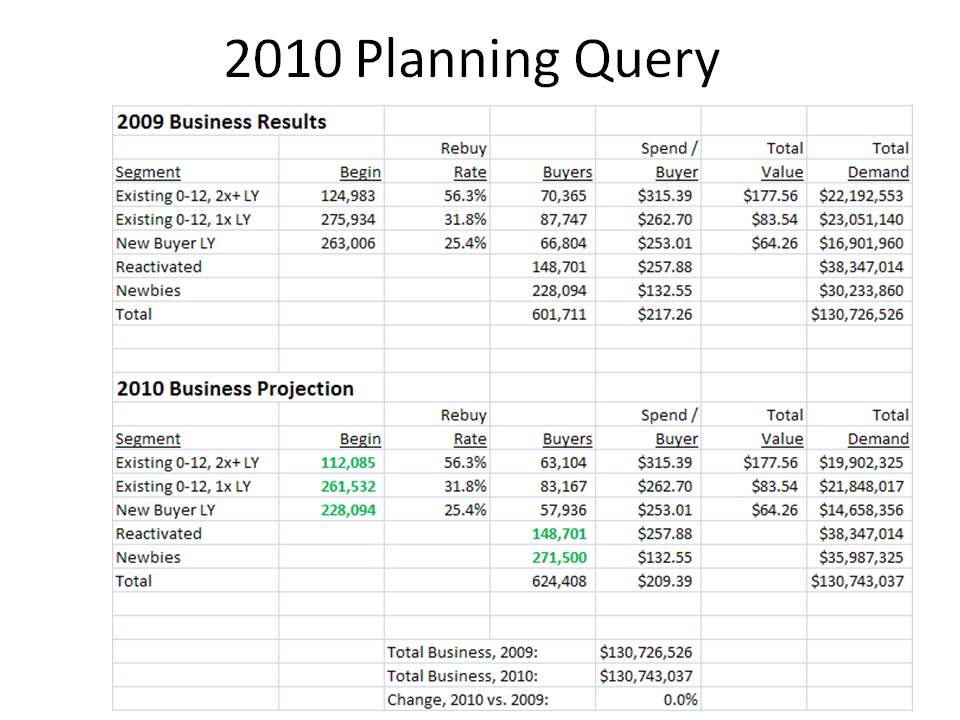 Annual Sales Planning is an important art, one that has been largely lost in the e-commerce era, as traditional web analytics packages focus on conversions, and not on actual customer behavior measured over time.
Strategically, we want to know what the future holds. We need to be able to react to business trends that are within our control.
In this example, a soft 2009 yields a customer file that is likely to generate a 4.4% decrease in annual sales.
So, what can we do to get business back on track?
First, let's calculate how many new customers we need, in order for the business to be at the same size as last year. In this case, if I increase new customers from 228,094 to 271,500, the annual sales total is constant.
Now, given that new customers dropped from 263,006 to 228,094 from 2008 to 2009, there must be a valid strategy in place to cause new customers to increase to 271,500.
As an analyst, your job is to communicate to your CEO, CFO, and/or CMO what it would cost to acquire enough new customers to keep the business at a flat sales level. If that cost is prohibitive, then it is reasonable to assume that the business will decline.
Next up --- we'll look at what has to happen across customer retention metrics, in order to keep the business flat.
January 05, 2010
Planning: An Overview
Please click on the image to make it bigger.
Annual Sales Planning is a lost art in the e-commerce era. In many cases, this happens because standard web analytics software applications are customized for conversion analysis --- the tools are not designed to answer strategic questions, instead, they are designed to answer important, tactical questions.
In other cases, this happens because nobody is teaching the craft of annual sales planning to a new generation of business leaders.
So let's do some teaching!
It's not terribly hard to construct the queries necessary to analyze the business. Pull all customers who purchased during 2008, and segment them into three groups ... those acquired prior to 2008 who purchased twice, those acquired prior to 2008 who purchased once, those acquired during 2008. Then, pull all customers who purchased during 2009 and not during 2008, split them into two groups --- those who had previously purchased, those who were new in 2009.
You now have five segments. For these five segments, calculate the percentage who purchased in 2009, calculate how much each purchaser spent, and then calculate total demand.
This set of queries yields the top half of the table. We can deconstruct where demand was generated for this $130,000,000 business.
Now, we run the exact same set of queries, but we adjust the date ranges by one year. This gives us the starting number of customers in the three existing customer segments. These three quantities are plugged in to the bottom portion of the table (color = green).
Finally, we have to plug in an estimate for how many reactivated customers we will have, and how many new customers we will have. For the purpose of this table, I assumed that the quantities will be the same as in 2009.
Plugging these values into the spreadsheet, I have a forecast for demand for 2010 ... $124.9 million is the forecast, a demand decline of 4.4%, assuming that everything in 2010 is the same as in 2009.
We'll stop the discussion here, for today. What we know is that, if things go the same way in 2010 as they went in 2009, the business will be 4.4% smaller in 2010. This is a metric that you must know, one that I routinely calculate for CEOs, CMOs, and CFOs.

Annual Sales Planning is a lost art in the e-commerce era. In many cases, this happens because standard web analytics software applications are customized for conversion analysis --- the tools are not designed to answer strategic questions, instead, they are designed to answer important, tactical questions.
In other cases, this happens because nobody is teaching the craft of annual sales planning to a new generation of business leaders.
So let's do some teaching!
It's not terribly hard to construct the queries necessary to analyze the business. Pull all customers who purchased during 2008, and segment them into three groups ... those acquired prior to 2008 who purchased twice, those acquired prior to 2008 who purchased once, those acquired during 2008. Then, pull all customers who purchased during 2009 and not during 2008, split them into two groups --- those who had previously purchased, those who were new in 2009.
You now have five segments. For these five segments, calculate the percentage who purchased in 2009, calculate how much each purchaser spent, and then calculate total demand.
This set of queries yields the top half of the table. We can deconstruct where demand was generated for this $130,000,000 business.
Now, we run the exact same set of queries, but we adjust the date ranges by one year. This gives us the starting number of customers in the three existing customer segments. These three quantities are plugged in to the bottom portion of the table (color = green).
Finally, we have to plug in an estimate for how many reactivated customers we will have, and how many new customers we will have. For the purpose of this table, I assumed that the quantities will be the same as in 2009.
Plugging these values into the spreadsheet, I have a forecast for demand for 2010 ... $124.9 million is the forecast, a demand decline of 4.4%, assuming that everything in 2010 is the same as in 2009.
We'll stop the discussion here, for today. What we know is that, if things go the same way in 2010 as they went in 2009, the business will be 4.4% smaller in 2010. This is a metric that you must know, one that I routinely calculate for CEOs, CMOs, and CFOs.
January 04, 2010
Open Your Spreadsheets: Increased Advertising
 Let's get overly simplistic here, but let's do so in order to prove a point. Open your spreadsheet! (contact me for a copy).
In the old days of cataloging, if you didn't advertise with a catalog, you didn't get sales. In the modern world of e-commerce, if you don't advertise, you still get sales. This is called the "organic percentage", the percentage of business that happens regardless whether you advertise or not.
Let's assume that 50% of the retention rate of existing customers happens regardless whether you advertise or not.
Now, let's say that you want to increase your overall advertising budget by 20%. In old-school marketing, there's a rule of thumb ... a 20% increase in advertising yields a 10% increase in business.
If half of the business is organic, then we can only impact the other half of the business with marketing. So a 20% increase in marketing to existing buyers yields a 10% increase in business on the half of the business impacted by advertising, yielding a 5% increase in volume.
So, open your spreadsheet, and look at demand over the next five years.
- Year 1 = $75.9 million.
- Year 2 = $70.4 million.
- Year 3 = $66.7 million.
- Year 4 = $64.4 million.
- Year 5 = $62.9 million.
Now, let's increase the advertising budget for one year by 20%. We need to change cell C5 from 1.00 to 1.05. If we only change our advertising strategy for one year, we see the following outcome:
- Year 1 = $79.0 million.
- Year 2 = $72.0 million.
- Year 3 = $67.8 million.
- Year 4 = $65.1 million.
- Year 5 = $63.4 million.
You get a $3.1 million dollar improvement in year one, and you get an additional $3.9 million in improvement in years two through five.
This is one of the things you simply cannot see with your standard web analytics package or sales attribution model or matchback algorithm.
Online Marketing Simulations can help you see the short-term and long-term impact of your marketing decisions. Don't you think your CEO (or CFO or CMO) wants to know this information? These are the kind of projects I routinely work on for CEOs, CFOs, and CMOs.
Exercise For You: Increase retention for five years by 5% ... type 1.05 into cells C5 - G5. What is the impact of spending more in advertising across five years?
January 03, 2010
Dear Catalog CEOs: How Can Kevin Help In 2010?
Dear Catalog CEOs:
Many of you have a fresh marketing budget for 2010, and you're saying to yourself "I've read a lot of Kevin's content, but what can he actually do to help a cataloger like us?"
Below, I outline what the most commonly requested Catalog CEO project looks like. Contact me if you are interested in a project that looks like this (most projects have both components ... budgeting and filtering --- project costs are based on twelve month customers, cheaper for small businesses, more expensive for Wal-Mart).
Many of you have a fresh marketing budget for 2010, and you're saying to yourself "I've read a lot of Kevin's content, but what can he actually do to help a cataloger like us?"
Below, I outline what the most commonly requested Catalog CEO project looks like. Contact me if you are interested in a project that looks like this (most projects have both components ... budgeting and filtering --- project costs are based on twelve month customers, cheaper for small businesses, more expensive for Wal-Mart).
- Budget Analysis: You send me at least three years of customer transactions and annual marketing spend by marketing channel. I show you how customers who respond to e-mail marketing evolve over time ... or paid search, or affiliate marketing, or the different catalog titles you mail. I provide you with a spreadsheet that you can use to see how to allocate advertising investment across marketing channels (as well as retention/acquisition mix) over the next five years, in order to have the most profitable catalog business over the long-run.
- Filtering Analysis: In this analysis, I identify how "catalog loyal" every single customer is in your database. I will identify customers who no longer require a steady diet of catalog marketing. You send those customers fewer catalogs, and you become far more profitable as a result. Or, in some cases, I identify customers who need to receive more catalogs. I don't care what the result is (more/less), I only care that you are more profitable. You can implement the results of the filtering analysis in-house, via your database vendor, or you can have me update the results for you on a periodic basis. The outcome of many filtering projects results in cost savings that can be pocketed, or can be applied to experimentation across various online marketing strategies.
See Me Speak In 2010!!
The first half of 2010 brings us a lot of fun speaking opportunities, both in the US and in Europe.
If you want to join me, here's where I'll be ... and if you are in these areas and want to talk about an Online Marketing Simulation, Multichannel Forensics, or Catalog Marketing Ad Efficiency project, I'm here for you!
February 1 - 4 = Webtrends Engage, New Orleans: Have you looked at the lineup for this conference? MC Rives, Stephen Baker, Eric Rodenbeck, and a huge cast of world class speakers make this a must-see event. I'll talk about "Dynamic Customer Behavior", where we link data from different sources to gain new and interesting customer insights that are different than what one would normally find when analyzing data within one channel. We'll move this concept into "Online Marketing Simulations", a topic you are now familiar with.
April 27 - 28 = ECOM Berlin: A premiere event in Europe, I am so looking forward to this presentation! This is a great opportunity for the hundreds of you who loyally follow this blog in the UK, Germany, Sweden, Italy, and all across Europe to hear about the future of e-commerce. By the way, don't miss Stephen Baker's (The Numerati) presentation.
May 3 - 7 = eMetrics Marketing Optimization Summit, San Jose: The generous Jim Sterne is giving me an opportunity to share Online Marketing Simulation topics with an eager crowd of online experts.
May 17 - 19 = The 2010 RKG Client Summit, Charlottesville: The kind folks at The Rimm-Kaufman Group invited me to join a great speaker lineup for this event. You'll get to hear Shop.org's Josh Greene, as well as Adam Audette and Lance Loveday. George Michie knows how to put on a great event! We'll talk a lot about Multichannel Forensics and the logical extension to Online Marketing Simulations.
May 20 - 21 = Vermont / New Hampshire Marketing Group, Whitefield, NH: This will be my first time at this prestigious event, a great opportunity to share thoughts about the future of catalog marketing!
I'd appreciate the opportunity to chat about marketing issues with you at any of these venues. Make your plans now!!
If you want to join me, here's where I'll be ... and if you are in these areas and want to talk about an Online Marketing Simulation, Multichannel Forensics, or Catalog Marketing Ad Efficiency project, I'm here for you!
February 1 - 4 = Webtrends Engage, New Orleans: Have you looked at the lineup for this conference? MC Rives, Stephen Baker, Eric Rodenbeck, and a huge cast of world class speakers make this a must-see event. I'll talk about "Dynamic Customer Behavior", where we link data from different sources to gain new and interesting customer insights that are different than what one would normally find when analyzing data within one channel. We'll move this concept into "Online Marketing Simulations", a topic you are now familiar with.
April 27 - 28 = ECOM Berlin: A premiere event in Europe, I am so looking forward to this presentation! This is a great opportunity for the hundreds of you who loyally follow this blog in the UK, Germany, Sweden, Italy, and all across Europe to hear about the future of e-commerce. By the way, don't miss Stephen Baker's (The Numerati) presentation.
May 3 - 7 = eMetrics Marketing Optimization Summit, San Jose: The generous Jim Sterne is giving me an opportunity to share Online Marketing Simulation topics with an eager crowd of online experts.
May 17 - 19 = The 2010 RKG Client Summit, Charlottesville: The kind folks at The Rimm-Kaufman Group invited me to join a great speaker lineup for this event. You'll get to hear Shop.org's Josh Greene, as well as Adam Audette and Lance Loveday. George Michie knows how to put on a great event! We'll talk a lot about Multichannel Forensics and the logical extension to Online Marketing Simulations.
May 20 - 21 = Vermont / New Hampshire Marketing Group, Whitefield, NH: This will be my first time at this prestigious event, a great opportunity to share thoughts about the future of catalog marketing!
I'd appreciate the opportunity to chat about marketing issues with you at any of these venues. Make your plans now!!
December 29, 2009
Gliebers Dresses: What Are You Hearing?
Today, I'm working out of the home office. The phone rings, from time to time.
Phone Rings:
Kevin: "Hello."
Luke Carson: "Hi Kevin, Luke Carson, CEO of Borsons, how are you doing?"
Kevin: "I'm doing fine, Mr. Carson. How can I help you?"
Luke Carson: "Say, what are you hearing out there? How was the Holiday season for folks?"
Kevin: "I'm hearing it was mixed. Business was up from 2008, but seems to have been fueled by deep discounting. How about your business, Mr. Carson?"
Luke Carson: "We beat plan, Kevin, and we're cautiously optimistic about 2010. Say, you've been working with Gliebers Dresses, right? How is their business?"
Kevin: "I can't share any specifics, Mr. Carson, you know that."
Luke Carson: "I know. I've heard that their business missed plan, and that their loyalty program is costing them a fortune. Anyway, thanks for the info, Kev. Let's do lunch next time you're in town, ok? Bye."
Phone Rings:
Kevin: "Hello?"
Nancy Walsh: "Hi Kevin, this is Nancy Walsh, CEO at Penningtons, how are you doing?"
Kevin: "I'm well, Ms. Walsh, how are you?"
Nancy Walsh: "Oh, it was a great Holiday, Kev, a chance to see family and friends. Say, what are you hearing out there? How was everybody's Holiday season?"
Kevin: "I'm hearing mixed results. Many people are meeting or exceeding plans, though those plans were conservative, not even coming close to where business was in 2006-2007. How about you?"
Nancy Walsh: "Yeah, we beat plan, but it was a really conservative plan, and we had to do a lot of discounting to meet plan. The p&l probably won't be great, but we will be clean on inventory. Hey, I heard you are working with Gliebers Dresses. How was their Holiday season?"
Kevin: "You know I can't share anything about that, Ms. Walsh."
Nancy Walsh: "I heard that their loyalty program is a disaster. Buy four dresses, get free shipping for the year, and then they give everybody free shipping during the Holiday season. How do you build loyalty when you give every customer the same deal you give loyal customers?"
Kevin: "Loyalty programs are tough to execute, aren't they?"
Nancy Walsh: "Anyway Kev, thanks for the chat, I appreciate it. Bye."
Phone Rings
Kevin: "Hello?"
Craig Nilmendorf: "Kevin, hi, Craig Nilmendorf here, CEO of Nilmendorfs, how are you?"
Kevin: "Hi Mr. Nilmendorf, I'm well, how are you?"
Craig Nilmendorf: "We're ok. Say, Kev, what are you hearing out there? How was business for folks this past month?"
Kevin: "Oh, you know, folks are saying they beat plan, but had to give it all away in margin in order to get the orders."
Craig Nilmendorf: "Yup, same story here. How the heck are we ever going to wean our customers off of discounts and promotions, Kev?"
Kevin: "Why they heck did we ever introduce all of these discounts and promotions, Mr. Nilmendorf? Aren't we the problem?"
Craig Nilmendorf: "Well, there's a competitive issue at play, Kev, you've got to play the game. You can't be out there at full price suckin' air while everybody else is out there at 20% off with free shipping. Say, let me ask you a question, Kev, you are workin' with Gliebers Dresses, right? How the heck did they do? That loyalty program, that thing really had to help them. I mean, you buy four dresses, and you get free shipping for a year. I'll be that thing was worth ten or fifteen points of improvement. How is it doing, Kev?"
Kevin: "You know I can't share the details behind that program, Mr. Nilmendorf."
Craig Nilmendorf: "Yea, I know. Anyway, it was nice chatting with you Kev. You know, we've got a few nickels in the budget for somebody like you in 2010. Maybe we can have you set up a loyalty program for us like you set up at Gliebers Dresses, huh?"
Phone Rings:
Kevin: "Hello."
Luke Carson: "Hi Kevin, Luke Carson, CEO of Borsons, how are you doing?"
Kevin: "I'm doing fine, Mr. Carson. How can I help you?"
Luke Carson: "Say, what are you hearing out there? How was the Holiday season for folks?"
Kevin: "I'm hearing it was mixed. Business was up from 2008, but seems to have been fueled by deep discounting. How about your business, Mr. Carson?"
Luke Carson: "We beat plan, Kevin, and we're cautiously optimistic about 2010. Say, you've been working with Gliebers Dresses, right? How is their business?"
Kevin: "I can't share any specifics, Mr. Carson, you know that."
Luke Carson: "I know. I've heard that their business missed plan, and that their loyalty program is costing them a fortune. Anyway, thanks for the info, Kev. Let's do lunch next time you're in town, ok? Bye."
Phone Rings:
Kevin: "Hello?"
Nancy Walsh: "Hi Kevin, this is Nancy Walsh, CEO at Penningtons, how are you doing?"
Kevin: "I'm well, Ms. Walsh, how are you?"
Nancy Walsh: "Oh, it was a great Holiday, Kev, a chance to see family and friends. Say, what are you hearing out there? How was everybody's Holiday season?"
Kevin: "I'm hearing mixed results. Many people are meeting or exceeding plans, though those plans were conservative, not even coming close to where business was in 2006-2007. How about you?"
Nancy Walsh: "Yeah, we beat plan, but it was a really conservative plan, and we had to do a lot of discounting to meet plan. The p&l probably won't be great, but we will be clean on inventory. Hey, I heard you are working with Gliebers Dresses. How was their Holiday season?"
Kevin: "You know I can't share anything about that, Ms. Walsh."
Nancy Walsh: "I heard that their loyalty program is a disaster. Buy four dresses, get free shipping for the year, and then they give everybody free shipping during the Holiday season. How do you build loyalty when you give every customer the same deal you give loyal customers?"
Kevin: "Loyalty programs are tough to execute, aren't they?"
Nancy Walsh: "Anyway Kev, thanks for the chat, I appreciate it. Bye."
Phone Rings
Kevin: "Hello?"
Craig Nilmendorf: "Kevin, hi, Craig Nilmendorf here, CEO of Nilmendorfs, how are you?"
Kevin: "Hi Mr. Nilmendorf, I'm well, how are you?"
Craig Nilmendorf: "We're ok. Say, Kev, what are you hearing out there? How was business for folks this past month?"
Kevin: "Oh, you know, folks are saying they beat plan, but had to give it all away in margin in order to get the orders."
Craig Nilmendorf: "Yup, same story here. How the heck are we ever going to wean our customers off of discounts and promotions, Kev?"
Kevin: "Why they heck did we ever introduce all of these discounts and promotions, Mr. Nilmendorf? Aren't we the problem?"
Craig Nilmendorf: "Well, there's a competitive issue at play, Kev, you've got to play the game. You can't be out there at full price suckin' air while everybody else is out there at 20% off with free shipping. Say, let me ask you a question, Kev, you are workin' with Gliebers Dresses, right? How the heck did they do? That loyalty program, that thing really had to help them. I mean, you buy four dresses, and you get free shipping for a year. I'll be that thing was worth ten or fifteen points of improvement. How is it doing, Kev?"
Kevin: "You know I can't share the details behind that program, Mr. Nilmendorf."
Craig Nilmendorf: "Yea, I know. Anyway, it was nice chatting with you Kev. You know, we've got a few nickels in the budget for somebody like you in 2010. Maybe we can have you set up a loyalty program for us like you set up at Gliebers Dresses, huh?"
Subscribe to:
Posts (Atom)
-
It is time to find a few smart individuals in the world of e-mail analytics and data mining! And honestly, what follows is a dataset that y...
-
It's the story of 2015 among catalogers. "Our housefile performance is reasonable, but our co-op customer acquisition efforts ar...
-
 The emails come in on a daily basis now ... " here's what I think I need, what should I purchase ?" So, today I write a Search...