Dear Analysts:
One of the most important skills you can acquire is the gift of "anticipation".
This isn't an easy skill to obtain, and it requires you to spend a lot of time listening to what others say.
In late 2002, our ability to forecast new store performance at Nordstrom wasn't as good as we wanted for it to be. My Business Intelligence Director, without being specifically asked to do so by management, created a new real estate model, one that we could backtest against prior store openings. He was able to demonstrate that his model was much more accurate than anything that had been done. And even though his model was scrutinized by management, it was implemented. Future forecasts were much closer to actual performance.
This person, the Business Intelligence Director, had no prior experience in new store forecasting. This person, however, could anticipate what the company needed. This person anticipated what the biggest "pain point" was ... forecasts that were not accurate.
By anticipating what was needed (a new forecasting model) and by anticipating what the pain point was (accuracy), this person became an important part of an expensive capital investment process at Nordstrom.
This is the opportunity that is available to you, dear analyst. You, too, can make a difference, in fact, you already make a difference. But you can expand your sphere of influence by listening to what leadership is actually saying, by anticipating needs and building solutions to those needs before leadership specifically asks somebody to solve a problem for them.
December 08, 2009


December 07, 2009
OMS and Ad Curves
 By now you are using Online Marketing Simulations (book, kindle, digital download, contact me for a free spreadsheet, or hire me) to understand how customer behavior evolves over time. You are probably excited about some of the unique ways that customers behave, and you probably know a lot more about how to grow your business for long-term success.
Now, you probably want to know how much you should invest, in order to maximize your opportunity, right?
Here's where "Ad Curves" come into play. Click here for a brief article about Ad Curves.
When I am working with a CEO, CFO, or CMO, I combine the results of an Online Marketing Simulation with Ad Curves, yielding the optimal strategy necessary to yield profitable long-term success.
If you are managing e-mail marketing, paid search, or print marketing campaigns, you'll appreciate the insights gained by combining Online Marketing Simulations with Ad Curves!
December 06, 2009
Webinar! Who Wants To Hear Me Talk In A Free Webinar??
I'll be sharing information on Tuesday about multichannel data integration, including a few tidbits about how retail brands can learn how website visits are combined with store purchases for a complete view of customer behavior.
Birst is hosting the free webinar --- click on this link to attend!
Birst is hosting the free webinar --- click on this link to attend!
Dear Catalog CEOs: The Online Transition Is Essentially Complete
 Dear Catalog CEOs:
An interesting trend is emerging in catalog marketing.
Back in the day, we'd measure how fast "catalog" customers were migrating to the "online" channel.
Multichannel Forensics were invented, in large part, to determine how fast this transition was happening, helping us understand how to deal with the transition.
In the past eighteen months, I'd say that the word "transition" no longer applies to our business. It appears that the transition online is, for the most part, complete. Trending, over time, illustrates a fundamental change.
For instance, one might see the following migration probability indices, over time.
- Phone To Online Index: 2000 = 10%. 2003 = 35%. 2006 = 25%. 2009 = 20%.
- Online To Phone Index: 2000 = 50%. 2003 = 30%. 2006 = 15%. 2009 = 5%.
In other words, around the "turn of the century", phone customers were unlikely to shop online, and online customers were unlikely to stay loyal to the online channel.
By 2003, it was a "free for all", as customers were thoroughly "multichannel". Catalogs drove web sales, online customers spoke with customer service associates, everything interacted.
And this is the problem with being "multichannel". Multichannel is a transitional phase, as customers migrate from old to new. Eventually, the customer lands on a preferred channel ... until something new displaces it. When that happens, "multichannel" becomes important again.
For many companies, 2009 represents an era of channel stability. All customers who were going to move online have, for the most part, done so. Online customers become unlikely to use the phone to shop, and in doing so, begin to become unresponsive to catalog marketing.
It is important to understand how channel shift happens over time. When customers settle upon their preferred channel, you can greatly reduce marketing expense. When customers are shifting across channels, marketing expenses tend to rise.
In my projects, I look for channel stability. When I find channel stability, I quickly identify the customer audience that requires considerably less advertising, and strongly advocate a reduction in offline marketing spend to the audience that now prefers "all things digital".
"Channel Stability" should be an area of emphasis for our businesses in 2010. Have your analytics teams study this trend for you, and be sure to begin reductions in offline marketing to customers who prefer "all things digital".
As always, I am here to support you!
Thanks,
Kevin
December 03, 2009
Gliebers Dresses: Cyber Monday
Welcome to this week's Executive Meeting.
Glenn Glieber (Owner): "And honestly, this past week was the best sales week we've had in several years. Oh, it feels so good to actually celebrate for once."
Meredith Thompson (Chief Marketing Officer): "Kevin, is that you?"
Kevin: "Yup, it is me."
Lois Gladstone (Chief Financial Officer): "We're just celebrating our big Cyber Monday promotion, which helped contribute to one of the biggest sales weeks we've had in a half-decade."
Kevin: "Great! How did you do it?"
Roger Morgan (Chief Operations Officer): "Actually, it was my idea! We needed to do something to really stand out. So we implemented a radical promotion across all channels ... Free Shipping Plus 20% Off From Thanksgiving Through December 3, and Free Shipping Plus 35% Off On Cyber Monday."
Lois Gladstone: "And you should have seen how customers responded. The promotion went viral on Twitter. Sales were 40% better than last year on Cyber Monday. Now we're moving some inventory, folks!"
Kevin: "So Pepper, which customers took advantage of the promotion?"
Roger Morgan: "Who cares who took advantage of the promotion?"
Lois Gladstone: "Yeah, who cares?"
Pepper Morgan (Chief Marketing Officer): "Boris Feldman tells me that half of the customers were first time buyers ..."
Roger Morgan: "Yes!!! We introduced a large number of new customers to the brand!"
Pepper Morgan: "... and of the half that were existing customers, half were previously full-price customers who we converted to promotional buyers, half were previous promotional buyers."
Kevin: "Pepper, do promotional buyers purchase full-price merchandise in the future?"
Pepper Morgan: "Boris looked at this. Last year's Cyber Monday promotional buyers had a 19% repurchase rate, while all other customers had a 55% repurchase rate."
Kevin: "Did Gliebers Dresses make money on last year's Cyber Monday promotional buyers?"
Pepper Morgan: "Actually, no, we lost money, because those customers didn't respond to our marketing efforts. We spent catalog dollars and did not get a sufficient return on investment."
Lois Gladstone: "But this is a customer management issue, right? Let's just not market to Cyber Monday buyers. That way, we reap the benefits of our Cyber Monday promotion, we generate profit, and then who cares if the customer ever comes back, right? We don't ever have to mail catalogs to those discount-hungry shoppers. Let's just collect our $4 of profit and head home."
Roger Morgan: "Yes, who cares if the customer ever comes back?"
Meredith Thompson: "Well, I kinda care. The only reason we are in business is to profitably sell dresses, right?"
Lois Gladstone: "And you did that, Meredith. The average order value for a Cyber Monday promotional buyer was $120. Our gross margin is about 50%. So we generate $60 of margin, then we subtract $42 for the promotion, we subtract $14 to pick/pack/ship the item, and we're left with $4 of glorious profit. You moved merchandise, and you made $4 of profit per order, assuming items aren't returned."
Kevin: "What did Anna Carter do on Cyber Monday?"
Pepper Morgan: "They did not run a single promotion. Everything was at full price. This means that on a $120 order, they generated $60 of gross margin, offset by $14 of pick/pack/ship expense, and then they got shipping and handling revenue. They probably made $55 of profit per order."
Kevin: "This means that Gliebers Dresses has to generate fourteen orders for every one order that Anna Carter generated, in order to be more profitable than Anna Carter. Do you think that your business was fourteen times better than Anna Carter on Monday?"
Lois Gladstone: "We probably did three times as well as Anna Carter on Monday. That's huge!"
Roger Morgan: "But what about market share, Kevin? We absolutely dominated on Monday. We gained market share. That means something. That means we stole orders that would have gone to our competition. We hurt our competition on Monday, we put a dagger in their heart. Isn't market share worth something? I mean, everybody is contracting. On Cyber Monday, we grew. Neptune Research says that the companies that succeed in a recession are those who gain market share."
Kevin: "Sure it is worth something. But so is profit. Your business model was responsible for 3,000 orders at $4 profit per order, for a total of $12,000 profit. Anna Carter probably generated only 1,000 orders, at $55 profit per order, for a total of $55,000 profit. So, yes, you stole market share from Anna Carter. And Anna Carter has an additional $43,000 profit to invest in order entry systems or marketing activities or employee bonuses. Now, granted, maybe you stole 1,000 orders from Anna Carter, hurting them a bit, giving you an additional $4,000 profit. But if Boris is right, only 19% of Cyber Monday buyers repurchase, so you haven't impacted long-term market share, you just bought a bunch of orders for a few dollars of short-term profit. You haven't built something that is lasting. The entire history of Gliebers Dresses has been of a business model that was built to last. Now you are trying to prop-up a psuedo Holiday, and for what?"
Roger Morgan: "But what is wrong with that, Kevin? If we're more profitable for doing this, and Anna Carter is less profitable, then we won, right? I don't get it. Am I missing something? This is a simple profit and loss and marketshare game, and we won."
Kevin: "I don't think Gliebers Dresses is asking the right question. What would have happened if you offered 20% off plus free shipping? What would have happened if you offered 10% off plus free shipping? What would have happened if you only offered free shipping? What would have happened if you didn't offer a single promotion, like what Anna Carter did? Had you executed a multivariate test with different promotional levels as test cells, you could have known specifically which level of promotional activity yielded the best outcome. You reacted to the marketplace, competing not on profit, but on who can offer the most glorious promotion. You weren't selling dresses on Cyber Monday, you were selling the best promotion available. Customers will always, always be able to find a better promotion."
Roger Morgan: "You know what, Kevin, you're a downer. You are always telling us what we should be doing, always pointing out our flaws. You're a consultant, you aren't in the trenches with us. It is so easy for consultants to point out flaws. You go on Twitter and tell everybody what they should be doing. Who cares what pundits and gurus on Twitter think, they aren't running real businesses like we are. Down here, in the trenches, we're fighting for every order we get. We have to remain competitive, heck, everybody is out there on Cyber Monday giving away the house in order to keep customers. You try to sit in this room and explain to your Owner why we didn't run a promotion on Cyber Monday and generated only 1,000 orders instead of 3,000 orders. You then try to liquidate 2,000 orders worth of merchandise at a significant discount in January, completely cannibalizing your full-price business. Things aren't all cut and dried, like marketing pundits make them seem. As far as I am concerned, you can offer us some encouragement, or you can just keep quiet over there. I'm tired of being beat up by experts, I like being encouraged by research organizations who are promoting growth strategies."
Lois Gladstone: "Yeah Roger, I'm with you. It's one thing to offer pithy advice. It's another thing to be in the trenches, actually trying to keep a business afloat. You never supported our loyalty program, Kevin, you criticized us for giving away shipping and handling dollars there, too. What is your problem? Why do you hate promotions?"
Kevin: "I don't hate promotions. I fully support discounting and promotions when you have to clear inventory --- you cannot sit there and let inventory pile up. I get that. But, I am FAR more interested in the reason WHY promotions happen. Glenn, has the Monday after Thanksgiving always been one of the busiest days of the year at Gliebers Dresses?"
Glenn Glieber: "Ever since the 1980s, Kevin."
Kevin: "And when did you start offering discounts and promotions for Cyber Monday?"
Meredith Thompson: "We started offering Cyber Monday promotions in 2003."
Kevin: "And why did you start offering Cyber Monday promotions?"
Roger Morgan: "Woodside Research told us that Cyber Monday was a huge opportunity for online marketers to gain market share by offering promotions to eager holiday shoppers. They said that by 2005, 85% of online marketers would be offering sales and promotions to customers on Cyber Monday. And guess what, they were right."
Kevin: "So ever since the 1980s, this was a huge day. But in the last ten years, trade organizations and research organizations told you that you had to run your business in a different way, they told you that you had to offer discounts and promotions to lure bargain shoppers. Businesses listened. Now we have a big event that the media created and actively promotes ... they make money off of it via advertising, but at Gliebers Dresses, you compromise $55 of profit per order so that you can be competitive, competing for orders that generate $4 of profit. Basically, a combination of research organizations and media outlets hijacked one of the busiest days of the year for their own purposes, and you are left clawing for three times more orders than you would otherwise get, in theory, orders that generate 90% less profit. If pointing out this fact to you is a bad thing, then I'll gladly not participate in your meetings if you don't want me here. I am not going to come to these meetings and tell you a quaint bedtime story that makes you feel good. My job is to encourage you to think about the profitable decisions you make. And in the case of Cyber Monday, the logic doesn't support the level of discounting you've authored."
Lois Gladstone: "But this is the problem with your advice, Kevin. It doesn't matter that you think research organizations and trade organizations created this holiday. Now, everybody participates. We have no choice but to participate, or we lose out on market share and orders, we end up with an inventory problem."
Kevin: "You don't end up with an inventory problem if you don't give the store away and you plan for appropriate inventory levels nine months in advance. Anna Carter didn't participate in Cyber Monday. And by the way, did you get an iPod Touch for half-off at the Apple Store? Their store was absolutely crowded on Black Friday, and they don't discount. Did the iTunes store discount all digital music today in order to participate in Cyber Monday? Heck no!!! Go to Zappos, they aren't giving the store away, they just jack up the price of all items by $3, and then tell you that you are getting free shipping all day every day, end of story, and the public believes they are getting free shipping when they aren't. Discounts and promotions are taxes placed upon a brand for having unremarkable product, and they are unsustainable in the long-term. Honestly, how do you beat 2009 performance in 2010? Do you offer 40% off plus free shipping? And then how do you beat 2010 performance in 2011, do you offer 50% off plus free shipping? Where does it end?"
Lois Gladstone: "Kevin, that's stupid. Everybody knows you have to make profit on every order, so you'd never offer 50% off plus free shipping. We'll do what we have to do in order to remain competitive."
Glenn Glieber: "Well, Kevin, you certainly gave us an opportunity to reflect upon our actions. But I don't think we have much of a choice, we have to remain competitive. And honestly, I think Roger brings up something interesting to think about regarding your participation in these meetings. Enough for today, we need to move on to other topics. On Monday, we begin our inter-faith Holiday exposition in the lobby. Employees of all faiths are encouraged to decorate their designated area as appropriate for their Holiday belief system."
Glenn Glieber (Owner): "And honestly, this past week was the best sales week we've had in several years. Oh, it feels so good to actually celebrate for once."
Meredith Thompson (Chief Marketing Officer): "Kevin, is that you?"
Kevin: "Yup, it is me."
Lois Gladstone (Chief Financial Officer): "We're just celebrating our big Cyber Monday promotion, which helped contribute to one of the biggest sales weeks we've had in a half-decade."
Kevin: "Great! How did you do it?"
Roger Morgan (Chief Operations Officer): "Actually, it was my idea! We needed to do something to really stand out. So we implemented a radical promotion across all channels ... Free Shipping Plus 20% Off From Thanksgiving Through December 3, and Free Shipping Plus 35% Off On Cyber Monday."
Lois Gladstone: "And you should have seen how customers responded. The promotion went viral on Twitter. Sales were 40% better than last year on Cyber Monday. Now we're moving some inventory, folks!"
Kevin: "So Pepper, which customers took advantage of the promotion?"
Roger Morgan: "Who cares who took advantage of the promotion?"
Lois Gladstone: "Yeah, who cares?"
Pepper Morgan (Chief Marketing Officer): "Boris Feldman tells me that half of the customers were first time buyers ..."
Roger Morgan: "Yes!!! We introduced a large number of new customers to the brand!"
Pepper Morgan: "... and of the half that were existing customers, half were previously full-price customers who we converted to promotional buyers, half were previous promotional buyers."
Kevin: "Pepper, do promotional buyers purchase full-price merchandise in the future?"
Pepper Morgan: "Boris looked at this. Last year's Cyber Monday promotional buyers had a 19% repurchase rate, while all other customers had a 55% repurchase rate."
Kevin: "Did Gliebers Dresses make money on last year's Cyber Monday promotional buyers?"
Pepper Morgan: "Actually, no, we lost money, because those customers didn't respond to our marketing efforts. We spent catalog dollars and did not get a sufficient return on investment."
Lois Gladstone: "But this is a customer management issue, right? Let's just not market to Cyber Monday buyers. That way, we reap the benefits of our Cyber Monday promotion, we generate profit, and then who cares if the customer ever comes back, right? We don't ever have to mail catalogs to those discount-hungry shoppers. Let's just collect our $4 of profit and head home."
Roger Morgan: "Yes, who cares if the customer ever comes back?"
Meredith Thompson: "Well, I kinda care. The only reason we are in business is to profitably sell dresses, right?"
Lois Gladstone: "And you did that, Meredith. The average order value for a Cyber Monday promotional buyer was $120. Our gross margin is about 50%. So we generate $60 of margin, then we subtract $42 for the promotion, we subtract $14 to pick/pack/ship the item, and we're left with $4 of glorious profit. You moved merchandise, and you made $4 of profit per order, assuming items aren't returned."
Kevin: "What did Anna Carter do on Cyber Monday?"
Pepper Morgan: "They did not run a single promotion. Everything was at full price. This means that on a $120 order, they generated $60 of gross margin, offset by $14 of pick/pack/ship expense, and then they got shipping and handling revenue. They probably made $55 of profit per order."
Kevin: "This means that Gliebers Dresses has to generate fourteen orders for every one order that Anna Carter generated, in order to be more profitable than Anna Carter. Do you think that your business was fourteen times better than Anna Carter on Monday?"
Lois Gladstone: "We probably did three times as well as Anna Carter on Monday. That's huge!"
Roger Morgan: "But what about market share, Kevin? We absolutely dominated on Monday. We gained market share. That means something. That means we stole orders that would have gone to our competition. We hurt our competition on Monday, we put a dagger in their heart. Isn't market share worth something? I mean, everybody is contracting. On Cyber Monday, we grew. Neptune Research says that the companies that succeed in a recession are those who gain market share."
Kevin: "Sure it is worth something. But so is profit. Your business model was responsible for 3,000 orders at $4 profit per order, for a total of $12,000 profit. Anna Carter probably generated only 1,000 orders, at $55 profit per order, for a total of $55,000 profit. So, yes, you stole market share from Anna Carter. And Anna Carter has an additional $43,000 profit to invest in order entry systems or marketing activities or employee bonuses. Now, granted, maybe you stole 1,000 orders from Anna Carter, hurting them a bit, giving you an additional $4,000 profit. But if Boris is right, only 19% of Cyber Monday buyers repurchase, so you haven't impacted long-term market share, you just bought a bunch of orders for a few dollars of short-term profit. You haven't built something that is lasting. The entire history of Gliebers Dresses has been of a business model that was built to last. Now you are trying to prop-up a psuedo Holiday, and for what?"
Roger Morgan: "But what is wrong with that, Kevin? If we're more profitable for doing this, and Anna Carter is less profitable, then we won, right? I don't get it. Am I missing something? This is a simple profit and loss and marketshare game, and we won."
Kevin: "I don't think Gliebers Dresses is asking the right question. What would have happened if you offered 20% off plus free shipping? What would have happened if you offered 10% off plus free shipping? What would have happened if you only offered free shipping? What would have happened if you didn't offer a single promotion, like what Anna Carter did? Had you executed a multivariate test with different promotional levels as test cells, you could have known specifically which level of promotional activity yielded the best outcome. You reacted to the marketplace, competing not on profit, but on who can offer the most glorious promotion. You weren't selling dresses on Cyber Monday, you were selling the best promotion available. Customers will always, always be able to find a better promotion."
Roger Morgan: "You know what, Kevin, you're a downer. You are always telling us what we should be doing, always pointing out our flaws. You're a consultant, you aren't in the trenches with us. It is so easy for consultants to point out flaws. You go on Twitter and tell everybody what they should be doing. Who cares what pundits and gurus on Twitter think, they aren't running real businesses like we are. Down here, in the trenches, we're fighting for every order we get. We have to remain competitive, heck, everybody is out there on Cyber Monday giving away the house in order to keep customers. You try to sit in this room and explain to your Owner why we didn't run a promotion on Cyber Monday and generated only 1,000 orders instead of 3,000 orders. You then try to liquidate 2,000 orders worth of merchandise at a significant discount in January, completely cannibalizing your full-price business. Things aren't all cut and dried, like marketing pundits make them seem. As far as I am concerned, you can offer us some encouragement, or you can just keep quiet over there. I'm tired of being beat up by experts, I like being encouraged by research organizations who are promoting growth strategies."
Lois Gladstone: "Yeah Roger, I'm with you. It's one thing to offer pithy advice. It's another thing to be in the trenches, actually trying to keep a business afloat. You never supported our loyalty program, Kevin, you criticized us for giving away shipping and handling dollars there, too. What is your problem? Why do you hate promotions?"
Kevin: "I don't hate promotions. I fully support discounting and promotions when you have to clear inventory --- you cannot sit there and let inventory pile up. I get that. But, I am FAR more interested in the reason WHY promotions happen. Glenn, has the Monday after Thanksgiving always been one of the busiest days of the year at Gliebers Dresses?"
Glenn Glieber: "Ever since the 1980s, Kevin."
Kevin: "And when did you start offering discounts and promotions for Cyber Monday?"
Meredith Thompson: "We started offering Cyber Monday promotions in 2003."
Kevin: "And why did you start offering Cyber Monday promotions?"
Roger Morgan: "Woodside Research told us that Cyber Monday was a huge opportunity for online marketers to gain market share by offering promotions to eager holiday shoppers. They said that by 2005, 85% of online marketers would be offering sales and promotions to customers on Cyber Monday. And guess what, they were right."
Kevin: "So ever since the 1980s, this was a huge day. But in the last ten years, trade organizations and research organizations told you that you had to run your business in a different way, they told you that you had to offer discounts and promotions to lure bargain shoppers. Businesses listened. Now we have a big event that the media created and actively promotes ... they make money off of it via advertising, but at Gliebers Dresses, you compromise $55 of profit per order so that you can be competitive, competing for orders that generate $4 of profit. Basically, a combination of research organizations and media outlets hijacked one of the busiest days of the year for their own purposes, and you are left clawing for three times more orders than you would otherwise get, in theory, orders that generate 90% less profit. If pointing out this fact to you is a bad thing, then I'll gladly not participate in your meetings if you don't want me here. I am not going to come to these meetings and tell you a quaint bedtime story that makes you feel good. My job is to encourage you to think about the profitable decisions you make. And in the case of Cyber Monday, the logic doesn't support the level of discounting you've authored."
Lois Gladstone: "But this is the problem with your advice, Kevin. It doesn't matter that you think research organizations and trade organizations created this holiday. Now, everybody participates. We have no choice but to participate, or we lose out on market share and orders, we end up with an inventory problem."
Kevin: "You don't end up with an inventory problem if you don't give the store away and you plan for appropriate inventory levels nine months in advance. Anna Carter didn't participate in Cyber Monday. And by the way, did you get an iPod Touch for half-off at the Apple Store? Their store was absolutely crowded on Black Friday, and they don't discount. Did the iTunes store discount all digital music today in order to participate in Cyber Monday? Heck no!!! Go to Zappos, they aren't giving the store away, they just jack up the price of all items by $3, and then tell you that you are getting free shipping all day every day, end of story, and the public believes they are getting free shipping when they aren't. Discounts and promotions are taxes placed upon a brand for having unremarkable product, and they are unsustainable in the long-term. Honestly, how do you beat 2009 performance in 2010? Do you offer 40% off plus free shipping? And then how do you beat 2010 performance in 2011, do you offer 50% off plus free shipping? Where does it end?"
Lois Gladstone: "Kevin, that's stupid. Everybody knows you have to make profit on every order, so you'd never offer 50% off plus free shipping. We'll do what we have to do in order to remain competitive."
Glenn Glieber: "Well, Kevin, you certainly gave us an opportunity to reflect upon our actions. But I don't think we have much of a choice, we have to remain competitive. And honestly, I think Roger brings up something interesting to think about regarding your participation in these meetings. Enough for today, we need to move on to other topics. On Monday, we begin our inter-faith Holiday exposition in the lobby. Employees of all faiths are encouraged to decorate their designated area as appropriate for their Holiday belief system."
December 02, 2009
OMS: Decomposing A Disaster
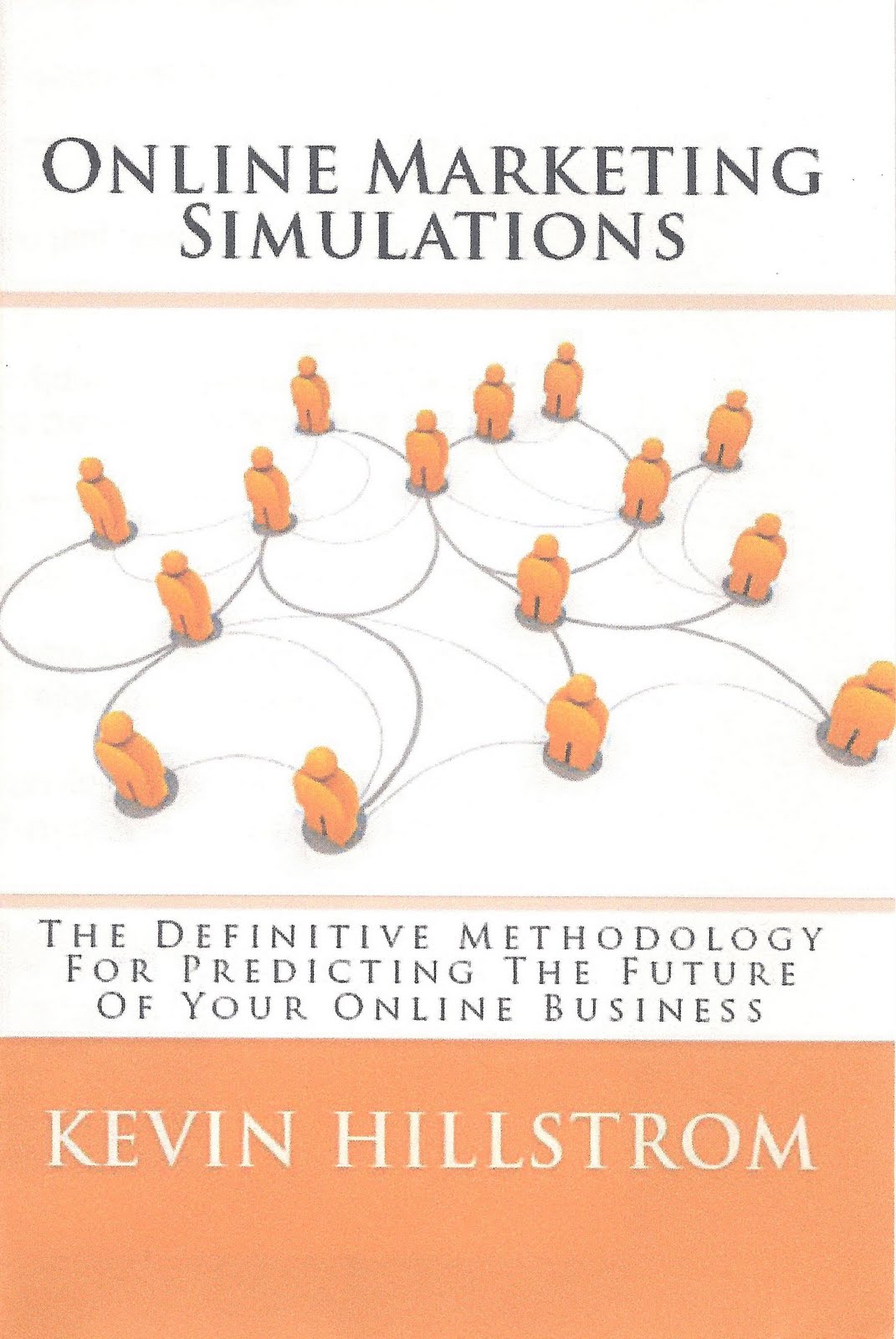 Time for everybody to pull out their sample OMS worksheets for an exercise (e-mail me for a copy)! And if you haven't secured your copy of Online Marketing Simulations (the book is a perfect Holiday stocking stuffer), you can buy the book via three sources:
Now, back to our regularly scheduled discussion. Open up your copy of the spreadsheet, and take a look at cells C18 - G18. What do you observe?
The average price that a customer is paying, per item, is decreasing over time. In fact, during the next five years, the average price trend is forecast to decrease by about 9%. This accounts for half of the reason why sales are dropping like a rock.
Look at cells C16 - G16. Even though prices are dropping, customers are not ordering more often. One might intuitively think that as prices drop, customers would become more "loyal", right?
Look at cells C17 - G17. Even though prices are dropping, customers are not ordering more items per order. One might intuitively think that as prices drop, customers would be willing to buy more items.
These are simple concepts ... prices, items, orders. And yet, combining simple concepts with Online Marketing Simulations allow you to see a forth-coming catastrophe.
So, I ask you the following question. Can you use Omniture, Coremetrics, Webtrends, Google Analytics, or any other software application to provide you with a five-year view of where your business is heading? If not, give me a holler!
December 01, 2009
Analyst Spotlight: Timing and Listening
Dear Analysts:
These days, the analytics and vendor community communicate to us how important it is to have integrated data, great software, dashboards filled with robust KPIs, and an outstanding testing infrastructure.
Add "timing" to the list.
"Timing" represents your ability to sense when Executives are receptive to key issues. Honestly, there are times when Executives need to hear your message, there are times when Executives want to hear your message, and there's the 80% of the time when Executives are not in a position to listen to or respond to your message.
In order to sense if the timing is right for your message, you need to become good at "listening". Oh, I know you don't want to hear this, your analytics message should be self-evident, it is the Executive that is the Luddite who "doesn't get it". For good for for bad, if you aren't willing to listen, you are not likely to be heard.
Back in the early 1990s, I executed a myriad of multivariate tests. I wrote summarizations of the tests, full of valuable KPIs that thoroughly explained how customers interacted with brands. The documents were circulated to every VP/Director at Lands' End.
For two years, essentially nothing came of my tests or write-ups.
And then, I became aware of a meeting that was going to happen on a Thursday, where Executives were going to talk about how customers interacted with brands. I became aware that very little of my information was going to be used.
I got busy.
I couldn't just get myself (a lowly manager) invited to a meeting with Executives. So I did the next best thing. I worked all weekend, creating an 85 page Powerpoint presentation, summarizing everything I had learned across all of the tests I had analyzed over the past three years. I set up a meeting with the leaders of the Direct Marketing department, hosting the meeting one day prior to the big Executive meeting. At that meeting, I shared my "re-packaged" results.
At the end of that meeting, our department head asked me to present my slides to the Executive team at the Executive meeting the next day.
Now, mind you, for the previous 2-3 years, I had done everything that the analytics vendor community tells you to do. We had an integrated database, we had business intelligence software, we executed multivariate tests designed to optimize the business, we had dashboards and reports and KPIs, we circulated everything to every Executive.
What was missing was timing. By listening to business leaders, I could tell that I had a brief window to "re-package" my information.
I tried the exact same strategy at Eddie Bauer, in 1997, with one notable exception ... I failed to listen to leadership. I created about 60 slides that explained how customers interacted with our brands and channels, set up a big meeting, invited marketing leadership ... and almost nobody showed up. I didn't listen to the various ways that Executives at Eddie Bauer worked. As a result, my timing (which was good) was wasted because I didn't listen.
There are so many ways that timing and listening are combined to yield success. At Nordstrom, our leadership team held quarterly conference calls with the investment community. About three weeks before these calls, I listened carefully to what our leadership team was talking about, then asked my team to query the database for answers to questions that were not being directly asked of my team. About a week before the conference call, I shared my findings with our investor relations director (and my boss). And then I'd listen to the conference call. About 40% of the time, I'd hear a metric that my team generated mentioned in the call.
You can listen all of the time. This is a skill you must become good at. If you listen long enough, you'll develop an intuition for what is important, and this skill will inform the timing that makes magic happen.
These days, the analytics and vendor community communicate to us how important it is to have integrated data, great software, dashboards filled with robust KPIs, and an outstanding testing infrastructure.
Add "timing" to the list.
"Timing" represents your ability to sense when Executives are receptive to key issues. Honestly, there are times when Executives need to hear your message, there are times when Executives want to hear your message, and there's the 80% of the time when Executives are not in a position to listen to or respond to your message.
In order to sense if the timing is right for your message, you need to become good at "listening". Oh, I know you don't want to hear this, your analytics message should be self-evident, it is the Executive that is the Luddite who "doesn't get it". For good for for bad, if you aren't willing to listen, you are not likely to be heard.
Back in the early 1990s, I executed a myriad of multivariate tests. I wrote summarizations of the tests, full of valuable KPIs that thoroughly explained how customers interacted with brands. The documents were circulated to every VP/Director at Lands' End.
For two years, essentially nothing came of my tests or write-ups.
And then, I became aware of a meeting that was going to happen on a Thursday, where Executives were going to talk about how customers interacted with brands. I became aware that very little of my information was going to be used.
I got busy.
I couldn't just get myself (a lowly manager) invited to a meeting with Executives. So I did the next best thing. I worked all weekend, creating an 85 page Powerpoint presentation, summarizing everything I had learned across all of the tests I had analyzed over the past three years. I set up a meeting with the leaders of the Direct Marketing department, hosting the meeting one day prior to the big Executive meeting. At that meeting, I shared my "re-packaged" results.
At the end of that meeting, our department head asked me to present my slides to the Executive team at the Executive meeting the next day.
Now, mind you, for the previous 2-3 years, I had done everything that the analytics vendor community tells you to do. We had an integrated database, we had business intelligence software, we executed multivariate tests designed to optimize the business, we had dashboards and reports and KPIs, we circulated everything to every Executive.
What was missing was timing. By listening to business leaders, I could tell that I had a brief window to "re-package" my information.
I tried the exact same strategy at Eddie Bauer, in 1997, with one notable exception ... I failed to listen to leadership. I created about 60 slides that explained how customers interacted with our brands and channels, set up a big meeting, invited marketing leadership ... and almost nobody showed up. I didn't listen to the various ways that Executives at Eddie Bauer worked. As a result, my timing (which was good) was wasted because I didn't listen.
There are so many ways that timing and listening are combined to yield success. At Nordstrom, our leadership team held quarterly conference calls with the investment community. About three weeks before these calls, I listened carefully to what our leadership team was talking about, then asked my team to query the database for answers to questions that were not being directly asked of my team. About a week before the conference call, I shared my findings with our investor relations director (and my boss). And then I'd listen to the conference call. About 40% of the time, I'd hear a metric that my team generated mentioned in the call.
You can listen all of the time. This is a skill you must become good at. If you listen long enough, you'll develop an intuition for what is important, and this skill will inform the timing that makes magic happen.
Subscribe to:
Posts (Atom)
-
It is time to find a few smart individuals in the world of e-mail analytics and data mining! And honestly, what follows is a dataset that y...
-
It's the story of 2015 among catalogers. "Our housefile performance is reasonable, but our co-op customer acquisition efforts ar...
-
 The emails come in on a daily basis now ... " here's what I think I need, what should I purchase ?" So, today I write a Search...