December 30, 2021

End of the Year

Well, we made it.

Take a break this weekend.

Then come back to work on Monday recharged and ready to tackle the chaos that comes our way in 2022. You've proven yourselves capable of dealing with co-workers getting horribly ill, having to work from home, supply chain issues, print/paper vendors falling apart right in front of you, and the end of the omnichannel era.

And yet, here you are. You persevered. You are talented.

You're gonna have a really good 2022. It has to happen. You've earned it.

December 29, 2021

End of an Era

In the National Football League, you get toward the end of the season, and you face a reckoning. 14 of 32 teams advance to the playoffs, two more than previously advanced from 1990 - 2019 ($$$). This means that many, many teams have false hope. You can have a 7-8 record, and because a game has been added to the schedule this year ($$$) you could finish 9-8 and potentially make the playoffs. It's hard to do that, however, when you spent 3.5 months winning six games and are now required to spend 3 weeks winning 3 games.

It's painful when it is over. Maybe your are a Broncos fan, or a fan of the Washington Football Team, or Cleveland Browns. It's about over. Vikings / Saints / Falcons fans are on the brink. Only one in five of the Dolphins / Chargers / Raiders / Ravens / Steelers will move on to the playoffs.

Sometimes you face more than missing the playoffs ... you face the end of an era. Your Seattle Seahawks are there. It's possible everything changes there ... coach, management org structure, departure of the legendary quarterback, it's all up for grabs.

Yesterday I wrote about retail and the coming "financial manipulation" of retail brands. Spinning off e-commerce divisions, spinning off the off-price channels, it's the end of the omnichannel era, and it's like having a 5-10 record with two games left in a forgotten NFL season.

Always remember that the end of an era is usually paired with a new beginning. There is hope, there is optimism.

Catalog brands face the end of the print era ... sure, there will be catalogs in 2031, but there won't ever be trust of the paper industry again. Retailers face the end of the omnichannel era ... sure, businesses will be tightly integrated in 2031 but the pundit-fueled dream came to an end in 2021.

If you face the end of an era, get busy. Start anew, and be optimistic. Rebuild. Demonstrate some Leadership. Take care of your customers. You don't have to adhere to old standards.

December 28, 2021

Spinnin' 'em Off

You've likely read about Saks spinning off their e-commerce division in an effort to increase shareholder value. You're likely read about Macy's saying "gimme some of that" after hiring the same firm Saks used to explore options. You've likely read about Nordstrom thinking about spinning off their Rack division after a decade when, without Rack, Nordstrom would have had to spend more time answering why Full Line Stores weren't performing well.

Needless to say, the omnichannel punditocracy has little patience for this. "The customer wants a seamless, frictionless omnichannel experience and you can't have that if your e-commerce division isn't integrated with your stores. This is nothing more than greed and stupidity." That's a paraphrase of a quote I read last week. No need to out the author.

You either spin something off because it is a drag on the core business, or because the core business is dying and you want to allow the positive side of the business to generate more value for shareholders.

If the fabled omnichannel thesis actually worked, nobody would be talking about spinning anything off ... you'd see investors clamoring for more integration.

Right?

Investors aren't doing that, are they?

Fifteen years from now college students will spend $400,000 a year on tuition to question why retail brands obsessed about integrating everything between 2001 - 2021. They'll ask interesting questions like "why did a retail executive want a customer to visit a website five times, place merchandise in a shopping cart, abandon the cart, then get hounded while traversing the internet to go back to the cart, then get several emails telling the customer to take an additional 20% off to buy the stuff left in the cart - so the customer bought the merchandise and then asked to have the merchandise available at the store for pickup later that day, obtain the merchandise after taking a 20 minute drive, take the merchandise home, try on the merchandise, find out there is a problem and then be forced to go online and fill out a returns authorization form, package the item with the form, and then drive to a UPS store to drop off the item for a return ... they'll ask why this process was called 'frictionless commerce'?".

There's a reason the financial folks are demanding that retailers go in a different direction than we've been taught for the past twenty years. The thesis we've been told to adhere to for two decades did not deliver the financial goodness promised to us. So the financial folks are pushing retailers in another direction.

What should you do? You should do whatever is right for your business ... don't do what somebody else tells you to do.

December 27, 2021

But We Generate Profit From Our Loyalty Efforts

You probably do!

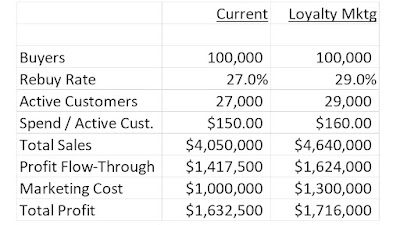
Let's assume your 12-month buyers have a 27% rebuy rate, and if they repurchase they spend $150 each. Let's assume you begin the year with 100,000 of 'em. Let's assume 35% of sales flow-through to profit. Let's assume that you spend $10 marketing to each customer during the year.

Now you ramp-up your retention/loyalty efforts ... you spend $300,000 to increase rebuy rates from 27% to 29% and to increase spend/repurchaser from $150 to $160. This, by the way, is TERRIBLY hard to do.

What does the story tell us?


Two really important points.

First, sales increased nicely (about 15%) resulting in a modest profit increase of about $83,000. So yeah, you generated profit from your loyalty efforts. They "worked". You likely paid for a chunk of your salary.

Now what happened to the customer file?

  • Old Scenario = 100,000 * 0.27 = 27,000 active customers.
  • New Scenario = 100,000 * 0.29 = 29,000 active customers.
You didn't materially change your future trajectory, did you? You still need to get the 73,000 new customers just to keep the bus moving.

This is why I keep imploring you to focus on new/reactivated customers. You need as many of 'em as you can get, because loyalty efforts generally don't move the total active customer needle.


December 26, 2021

Rebuy Rates

Almost twenty years ago I wrote a book that had nearly two-hundred pages of text talking about rebuy (repurchase) rates.

Rebuy rates are so darn important - and they are so darn easy to calculate.

Take every customer who bought during 2020 (100), then calculate the percentage who bought again in 2021 (27), then divide 2021 repurchasers by your 2020 inventory of customers (100) and you have your rebuy rate (27/100 = 27%).

Why do rebuy rates matter?

Rebuy rates matter because they indicate the type of business you manage. The rates are not reflective of success or failure (unless compared to prior years). The rates simply tell you what your marketing purpose is.

When overall rebuy rates are < 40%, your purpose as a marketer is to find as many new customers as possible at the lowest possible cost.

When overall rebuy rates are > 60%, your purpose as a marketer is to find as many ways as possible to increase the number of incremental purchases loyal customers place.

The biggest mistakes I see are when a company with a 27% rebuy rate tries to act like they have a 72% rebuy rate. The company invests all sorts of money on discounts and bribes to encourage customers to become "loyal". This tactic (push loyalty efforts to customers unlikely to repurchase) just doesn't work. Never has. Those who say it "works" are looking at incremental gains in sales/profit, which happen ... but the work the marketer performs does not fundamentally change the sales trajectory of the brand.

About 80% of my client base possess twelve-month buyers with rebuy rates < 40%.

This means 80% of my client base needs to be obsessed with customer acquisition.

Very few companies are obsessed with customer acquisition.


December 22, 2021

Merry Christmas

As has been tradition since Christmas 2006, have a Merry Christmas, dear readers!


P.S.: Seriously, have a wonderful Christmas. Ignore news. Ignore Facebook. Appreciate the people you know.


December 21, 2021

Customer Loyalty

I wrote a thread on Twitter over the weekend that was allegedly read by 120,000 souls. Who knows if that is true?

What was the thread about?

Customer Acquisition vs. Loyalty.

You already know that my view on the secret of business success is in low-cost customer acquisition programs. Programs, not campaigns. Eating, breathing, sleeping customer acquisition. Not just paying Google+Facebook money.

After Christmas, I am going to spend time modernizing a lot of the writing I did back in 2006-2007. We're at a point now where decades of vendor lies about retaining customers and nurturing loyal customers (spread primarily to foster purchases of vendor products that facilitate customer retention and loyalty) results in a gaping hole in the marketing landscape.

You will be the person who fills that hole.

We need to get back to understanding why a business grows and thrives. If you sell merchandise that a customer only needs 1-2 times per year, you might have loyal customers but you won't be able to use "loyalty marketing" to push that customer beyond what the customer naturally wants to do.

So that's what we are going to talk about after Christmas.


P.S.: You said you want a homework assignment over Christmas? Ok. I want you to write 500 words about why the phrase "It costs eight times as much to acquire a customer as it costs to retain a customer" is complete nonsense.

Content Creation

Here's the link . I realize many of you are stymied by creating content for your customers. Some of you would say the video above is poi...