August 10, 2017

They Don't Want To Change!

Several years back, I visited a client. This company possessed a 90% Organic Percentage ... high by any standards. Essentially the company could discontinue all catalog marketing activities and sales would decline by 10% and ad-to-sales would decrease by 30% and the whole business would be wildly profitable.

It's the best possible problem a company can have.

One problem.

The Chief Merchandising Officer.

This individual said something very interesting.
  • "If we discontinued the catalog, then what the heck do I do?"
I responded that his job would not change ... one bit. He would still be responsible for merchandising strategy. The individual stared at me and offered this tidbit.
  • "But how do I do my job if I don't have a catalog to merchandise?"
There you go.

I'm not convinced people "don't want to change".

I am convinced people (me included) don't know "how" to change.

If you offer your Executive Team an idea and you don't teach your Executive Team how to change, your Executive Team may not change.

Think of it this way ... if you were an analyst who used SAS for twenty years and then somebody demands that you use R and Python immediately, how would you respond, especially if the company keeps their SAS license? Be honest!

It isn't that people don't want to change ... people may not know "how" to change. Provide a roadmap for "how" somebody changes, and the likelihood of change may "change"!

August 09, 2017

Company Culture

The three large retailers I worked for had a fundamentally different Company Culture.
  • Lands' End = Align influential Executives around your idea.
  • Eddie Bauer = Align every employee in the company around your idea.
  • Nordstrom = Use good judgment.
Which culture do you think I enjoyed the most? You're right ... it was Nordstrom!

Which culture do you think gave me stomach cramps? You're right ... it was Eddie Bauer!

When you tell me that you cannot pursue concepts like the Organic Percentage, you seldom tell me that your Company Culture prevents you from pursing the concept.

Every company approaches solutions differently, based on the history of the company, the urgency of the challenges faced by the company, long-term employees, and the Executive Team.

If your ideas aren't going anywhere, which wall are your ideas bumping into?
  • History of the Company?
  • Urgency of the Challenges faced by your Company?
  • Long-Term Employees?
  • Your Executive Team?
It's bad enough you have to bump into one of these challenges, but frequently your ideas bump into 2-3 of the challenges. If you don't have 10-15 years of corporate experience, you haven't seen enough to know how to navigate these problems.

It's been my experience (especially in consulting) that Long-Term Employees are the biggest challenge to getting your ideas implemented. Long-Term Employees are protectors of the culture.

I was in a meeting a while back - and are you ready for this? The ANALYST was a long-term employee, and the ANALYST completely dictated the direction the company pursued. The Executive Team would come up with an idea, and the ANALYST would say "that has no chance of working, we tried that seven years ago and it did not work." Over and over and over this happened, to the point where nobody did anything different ... not only that, but nobody wanted to do anything different because nobody wanted the ANALYST to berate them. Only ideas that were guaranteed to work were pursued. How many of those exist?

There are a lot of moving parts to getting ideas implemented. Evaluate how your company culture (and your role in it) hurts your chances for implementation. 

August 08, 2017

Finding Cheese At The End Of The Maze

Sometimes I keep thinking I talk about the same topic over and over and over and don't get anywhere. Here's an example ... I wrote this about comp segment analytics ... in 2008 (click here). And yet, the very method that I use to illuminate nearly every problem I run across ... a method at least 20 years old ... that method is used by how many of you? Show of hands?!

But there's a reason that we have to say the same thing over and over and over again.

It's because people (people like you and I) have a hard time working together and agreeing upon things.

Allow me to provide an example.

I wanted to get rid of discounts/promotions at Eddie Bauer. We A/B tested discounts/promos for 6 months, and learned that customers spent $0.00 more over time when offered discounts/promotions. Pull 20% of gross margin dollars out of the equation, and you had a formula for disaster if discounts/promotions continued to be pursued.

I was a Director at the time (late 1998).

I had to convince my boss (DVP Marketing) that this was a good idea. That was easy - my boss was as kind and logical and rational a person as you'd ever find.

Next, I had to convince his boss (SVP Marketing) that this was a good idea. I met with him "before work" once a week, because he was busy during the work day. I shared test results with him. He didn't agree with the test results ... and he was a "data-driven" employee before being "data-driven" was deemed the way to go.

I could have quit there. I didn't quit there. I went to his boss (EVP of Global Brand Direction), who liked the idea of removing discounts/promotions because it was "good for the brand".

With his approval, I went back to my staff and told them to remove discounts/promotions.

An individual who reported to me didn't like my decision, so this individual went to the SVP of Marketing and told the SVP what I was doing. Then the individual (a data-driven Manager) waltzed into my office and said "We're not doing what you told me to do, because I went to the SVP and he said he told you not to execute your strategy." It's always nice to have your staff work against you ... that's probably what the SVP thought of me, too.

So my staff won't do what I want them to do, and the DVP will allow it and the SVP will not allow it and the EVP will allow it. What next?

I presented my findings to our Executive Team, unannounced (I'll bet the SVP liked that).

Guess what?

Our CEO didn't like my idea. 

Here's the scoreboard, for those of you keeping score at home.
  • My Staff = No.
  • Kevin = Yes.
  • DVP Marketing = Yes.
  • SVP Marketing = No.
  • EVP Global Brand Direction = Yes.
  • CEO = No.
What did I do?

I instructed my team to remove discounts/promotions to all customers who have purchased in the past "x" months ... I went halfway. I pleased everybody.

My data-driven Manager was again frustrated - he went to the SVP and complained again. This time the SVP backed me, because I didn't pull discounts/promotions from everybody. And that was all it took ... the Manager had to implement my tactic, and did implement the tactic.

A year later, we had the most profitable year in the history of the online/catalog division, a history spanning more than fifty years.

Nobody complained when we had the most profitable year in the history of the online/catalog division.

Why share this example?

Well, if you are a data-driven employee and you have great ideas and your Executive Team won't listen to you, you have options. You can fight the good fight, finding Executives who do agree with you and working hard with those individuals to evangelize your idea. You can find a way to get past "no". You can take a risk ... you can implement a tactic that your CEO specifically told you to not implement ... sure, you might lose your job, but you also might make your company a ton of profit.

This brings me back to the opening paragraph.

I've been telling many of you the same thing over and over and over again for a DECADE and you still don't implement what I'm sharing with you. I could quit. Or I could keep fighting, over and over and over again for a DECADE to teach you ideas that have been proven to work.

So how about you? Do you keep fighting for the ideas you believe in? Or do you blame the dumb Executive for not adhering to your data-driven strategy?

Please, keep fighting!

Ahead Of Time

When I worked at Lands' End, we had clear Goals and Objectives, issued before the fiscal year began. Our performance was measured against Goals and Objectives. We knew ahead of time what mattered.

When I worked at Eddie Bauer, we had clear Goals and Objectives, but we weren't held accountable for performance against the Goals and Objectives. So nobody really cared about Goals and Objectives.

When I worked at Nordstrom, we frequently began the fiscal year without Goals and Objectives. That's a problem, because by February 1 (the beginning of the fiscal year) we were already doing work that would impact the business in Fall. In other words, our Goals and Objectives only impacted the latter half of the year (unless they were written in a clever way).

This drove me nuts. So I gave my boss (the Chief Marketing Officer) Goals and Objectives for my team for the upcoming year ... in November or December of the prior year. I'd tell my boss that "this is what we're focusing on". By the time late February arrived and we didn't have Goals and Objectives, guess what? My Goals and Objectives became real Goals and Objectives. And you know what? We were already several months into implementing the work necessary to meet/exceed our Goals and Objectives.

This brings me to you ... you want to know why your Executive Team won't adopt your work?

Odds are your Executive Team has Goals and Objectives. They may have written them on their own, or the CEO may have written them. Regardless, they're working on fulfilling their Goals and Objectives. If your idea doesn't align with their Goals and Objectives, well, you know what might happen to your ideas, right?

Get out ahead of the issue. It's August. Start aligning the stars right now. Clearly communicate to Leadership what you'd like to accomplish in 2018 (or sooner). Ask your Leadership Team to write what you want to accomplish into your Goals and Objectives for 2018.

Ok?


August 07, 2017

Paper People

I'm walking through the lobby of a conference center, and a paper rep stops me. She has something she wants to tell me.
  1. "I guess I don't get to have a career anymore because of the things you say."
She then goes on to tell me what her incentive structure is.
  1. She earns a larger bonus when she gets my clients to spend more money annually on paper.
Do you think that the paper rep is going to evangelize the magic of the Organic Percentage to her client base?

Or do you think the paper rep is going to ask her client base (i.e. you) to spend more money, in spite of what is most profitable for your brand?

This reminds me of a sales rep from Forrester Research, back in 2006. He'd call me once a month and ask me to spend $35,000 on whatever it was he was selling. I'd say "no", that I didn't need his research to tell me what to do. He called and called and called. And I said "no" over and over and over.

Then he stopped calling. I was relieved, but only momentarily. One day I noticed he was in the office of the IT Executive (a person who had overlapping responsibilities to me). He actually got in the building! I told this person that we didn't need his nonsense.

A week later, he's in the office of my boss (Chief Marketing Officer). How'd he get there? I told my boss we didn't need his useless research telling us to promote an omnichannel future.

I thought I quelled the problem.

I was wrong.

The sales rep got to our online division, and got to our credit division. The sales rep got ten Executives in a room and DID NOT INVITE ME ... I got invited because my boss (the CMO) wanted me there because, and I quote, "I (Kevin) would have to implement what the sales rep and the Executives agreed to and I would pay for Forrester's data from my budget." #ohjoy

At this point, the Forrester Sales Rep spewed a ton of what a former boss called "Lizard Logic" - seductive language about omnichannel strategy that sounds right but is useless to the business and only gets the Sales Rep paid.

Why tell these stories?

Because the "sales reps" ... from your paper rep to your printer to your four co-ops to your list agency to your merge/purge vendor to your database vendor to your boutique catalog agency to the USPS ... they all have an incentive to get you to spend more, and they will meet with any Executive at your company until they find the weak Executive, and then they will dive in an exploit that relationship. They are paid to find the weak Executive.

I had a postal employee tell an audience at a conference I spoke at to "ignore what I said, because I didn't have actual research and he had survey research that proved that paper is valuable." Which is fascinating, because I have actual research ... actual data from more than a hundred catalog brands! But the postal employee lied in front of a large audience to get the audience to spend money so that the postal employee could get paid.

Remember this one (click here)? If you are an analyst trying to push a profitable agenda that uses less paper and you share facts with your Executive Team and they don't listen to you ... well ... maybe they are listening, but the paper rep is spending more time with your Executive Team than you are. Since I see this happen all the time, I just thought I'd pass it along, so that you can craft a strategy for getting your Executive Team to do what is right for your company as opposed to what is right for a paper rep.

August 06, 2017

I Can't Convince My Executive Team To Do Anything Different

For two weeks, I shared what I called "Catalog Theory" ... which really isn't theory but instead is a proven method for optimizing profit from print.

I received a positive comment or two - and as is typical, I received a standard array of "our Executive Team won't change" comments from readership. That's common when I post a series of articles about a specific topic, FYI.

Early in my career, I was rather harsh when it came to Executives ... when I worked at Lands' End I was so appalled by the growth in Executive positions that I renamed the "Company Pyramid" a "Rhomboid", a three-dimensional figure about to tip over from the weight of the disproportionate number of Executives recently hired.


Ha ha funny stuff and all ... until I got to Eddie Bauer and became a Director and noticed that I was one layer away from stock options and cars and parking spots and most important, fat bonuses. Then my opinion of Executives changed. I WANTED TO BE ONE!

When the dream became a reality (Nordstrom), I learned quickly that bonuses aren't just free money tossed in the direction of the Executive. Bonuses are EARNED. And you earn a bonus two different ways.
  1. Increase Sales.
  2. Increase Profit.
Here's the interesting thing about bonuses. Bonuses highlight conflict. When I was at Nordstrom, I ran into this problem in 2003. I had A/B test data that showed that we could reduce catalog mailings and be more profitable. Five problems.
  • If I cut back on the number of catalog mailings, sales declined. We couldn't have a decline in sales if we wanted to keep our jobs.
  • If sales declined, I'd have to liquidate merchandise we already planned to sell. You cannot let that happen - that's an unprofitable way to run a business.
  • I didn't have a proven replacement for the sales I'd lose via catalog mailings.
  • The profit component of my bonus was maxed, meaning that I could increase profit significantly and my bonus wouldn't grow - but I could grow sales and my bonus would increase. In other words, my personal financial incentives were opposite of what was best for the company.
  • There was a share of the employee base who were intrinsically motivated by anything "catalog" related. In other words, they could see catalog sales grow by 1% and online sales grow by 31% and they'd champion catalog sales growth of 1% because they "loved the catalog". Doing something opposite of what they wanted meant that those employees wouldn't do the things my team wanted to do - I'd alienate a lot of people by reducing the importance of their "passion".
If you want to understand why Executives do things that run contrary to the "right" thing to do, then spend time understanding how Executives get paid and understand what motivates an Executive.

Executives aren't dumb robots motivated by money and gut instinct, as is popularly discussed by some in the analytics community. There are many reasons why the "right" decision is avoided ... and the Executive isn't likely to share those reasons with employees.

Learn what motivates an Executive. Build relationships. Ask questions. Have your Executive Team spell out for you exactly what "success" looks like. This allows you to understand if your ideas have a chance of being implemented.


P.S.: I realize a lot of you don't want to hear this message. When I shared my post last Friday (click here), I received a series of "unsubscribes" from one specific company. It's obvious what I discussed was opposite of what that company wanted to hear. Or maybe the employees were tired of hearing the same message and then not getting anywhere. Whatever. We're at a point in time where we need to do something different ... and based on my observations, we're not great at collaborating with our co-workers. If something needs to change, then maybe we start by learning what motivates our co-workers?

August 03, 2017

Wrap-Up on Circulation Theory

I spend a lot of time reading ... and when you do that, you obtain a biased view of the world based on the content you read.

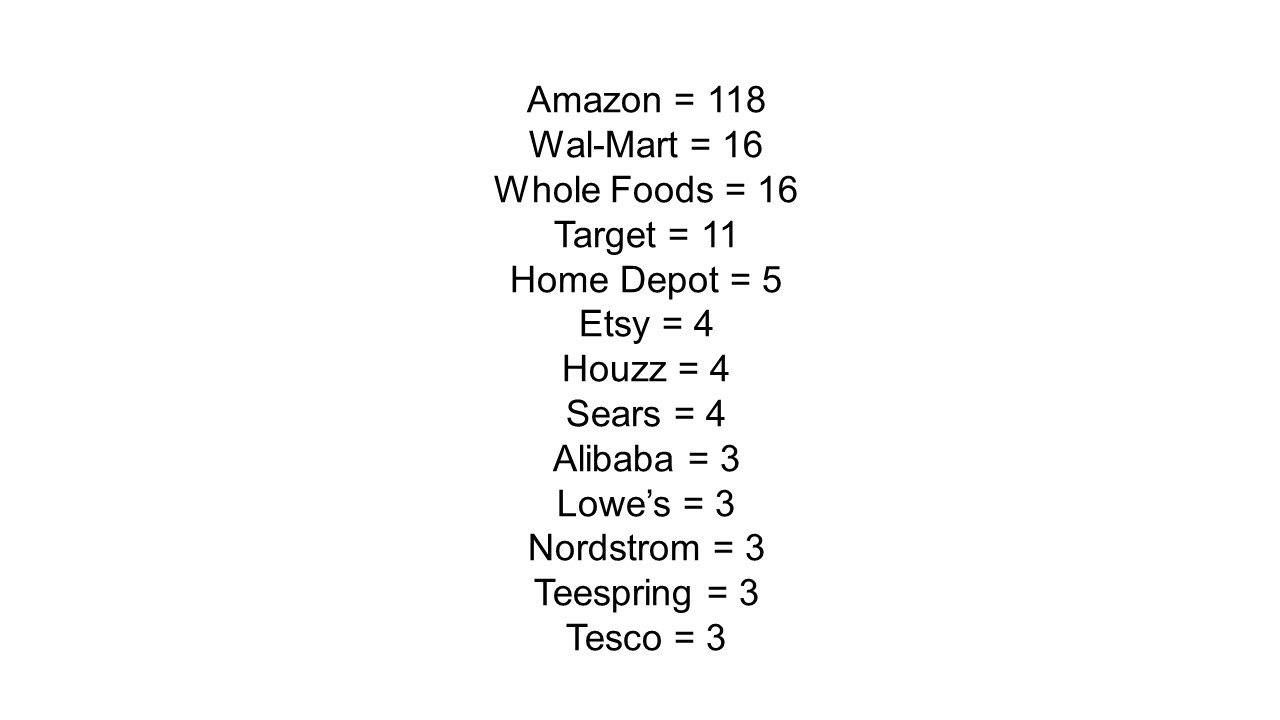
So I wanted to test my theory that what I read biases what I learn. For instance, I pay attention to Internet Retailer and listen to what they have to say. They like to talk about Amazon, don't they? And for good reason. So I counted the number of times they mentioned Amazon on original / non-vendor tweets (excluding retweets) between April 22, 2017 and July 21, 2017.

Here are the results.


Whole Foods got in there because they were purchased by Amazon. I recoded any mention of "Prime Day" as "Amazon", for good reason, boosting the Amazon total. But take those 40 tweets +/- out and the story isn't different.

If I pay attention to what I read, I'll make a ton of mistakes that hurt my client base. Internet Retailer has to talk about Amazon, because that enables Internet Retailer to get paid. We "get" to talk about Circulation Theory ... it gets you paid! You don't get paid when you ponder what Amazon is doing.

I spent two weeks discussing Circulation Theory because the secret to keep doing what catalogers love doing is embedded in the ten posts on the topic. If you've executed mail/holdout tests and page count tests, then every secret discussed in this Circulation Theory discussion is available to you.

Yes, you!

You get to be the person who charts a path to the future.

You get to be the person who generates disproportionate profit amounts compared to the marketers who managed your brand in the past.

You get to free up ad-dollars to spend online and in mobile, allowing your company to "keep up".

You will attract online/mobile customers who have different merchandise preferences. Your merchandising team will observe the results and, as a consequence, they'll offer more of what an online/mobile customer wants ... enabling your conversion rates to improve, allowing your company to move into the future must faster.

You get to do all of this.

Yes, you!

Analyze your test results ... structure them into the framework outlined in this series of ten posts. Then go make magic happen!

What questions do you have? Any? What should I discuss in a future week of Circulation Theory?

Need help? Contact me (kevinh@minethatdata.com) and we'll structure your information into this framework and see what it means to your business.


P.S.: I know, those of you who are Executives will tell me that your CEO/Board won't let you do anything different. And those of you who are Managers/Analysts will tell me that your Executive Team won't let you do anything different. It is TIME to do something different. I spent two weeks showing you how to make your company a fortune. If Leadership won't let you cut back on frequency, then cut back on pages ... go deep with a small page count as a test and see what happens. If Leadership won't let you cut back on pages or frequency, then make all of the changes you want with mobile-centric customers and just tell your Executive Team or CEO/Board that this is what you are doing, end-of-story. Or don't do that. But it is TIME to do something different. So do something different, ok?

Content Creation

Here's the link . I realize many of you are stymied by creating content for your customers. Some of you would say the video above is poi...