August 06, 2017

I Can't Convince My Executive Team To Do Anything Different

For two weeks, I shared what I called "Catalog Theory" ... which really isn't theory but instead is a proven method for optimizing profit from print.

I received a positive comment or two - and as is typical, I received a standard array of "our Executive Team won't change" comments from readership. That's common when I post a series of articles about a specific topic, FYI.

Early in my career, I was rather harsh when it came to Executives ... when I worked at Lands' End I was so appalled by the growth in Executive positions that I renamed the "Company Pyramid" a "Rhomboid", a three-dimensional figure about to tip over from the weight of the disproportionate number of Executives recently hired.


Ha ha funny stuff and all ... until I got to Eddie Bauer and became a Director and noticed that I was one layer away from stock options and cars and parking spots and most important, fat bonuses. Then my opinion of Executives changed. I WANTED TO BE ONE!

When the dream became a reality (Nordstrom), I learned quickly that bonuses aren't just free money tossed in the direction of the Executive. Bonuses are EARNED. And you earn a bonus two different ways.
  1. Increase Sales.
  2. Increase Profit.
Here's the interesting thing about bonuses. Bonuses highlight conflict. When I was at Nordstrom, I ran into this problem in 2003. I had A/B test data that showed that we could reduce catalog mailings and be more profitable. Five problems.
  • If I cut back on the number of catalog mailings, sales declined. We couldn't have a decline in sales if we wanted to keep our jobs.
  • If sales declined, I'd have to liquidate merchandise we already planned to sell. You cannot let that happen - that's an unprofitable way to run a business.
  • I didn't have a proven replacement for the sales I'd lose via catalog mailings.
  • The profit component of my bonus was maxed, meaning that I could increase profit significantly and my bonus wouldn't grow - but I could grow sales and my bonus would increase. In other words, my personal financial incentives were opposite of what was best for the company.
  • There was a share of the employee base who were intrinsically motivated by anything "catalog" related. In other words, they could see catalog sales grow by 1% and online sales grow by 31% and they'd champion catalog sales growth of 1% because they "loved the catalog". Doing something opposite of what they wanted meant that those employees wouldn't do the things my team wanted to do - I'd alienate a lot of people by reducing the importance of their "passion".
If you want to understand why Executives do things that run contrary to the "right" thing to do, then spend time understanding how Executives get paid and understand what motivates an Executive.

Executives aren't dumb robots motivated by money and gut instinct, as is popularly discussed by some in the analytics community. There are many reasons why the "right" decision is avoided ... and the Executive isn't likely to share those reasons with employees.

Learn what motivates an Executive. Build relationships. Ask questions. Have your Executive Team spell out for you exactly what "success" looks like. This allows you to understand if your ideas have a chance of being implemented.


P.S.: I realize a lot of you don't want to hear this message. When I shared my post last Friday (click here), I received a series of "unsubscribes" from one specific company. It's obvious what I discussed was opposite of what that company wanted to hear. Or maybe the employees were tired of hearing the same message and then not getting anywhere. Whatever. We're at a point in time where we need to do something different ... and based on my observations, we're not great at collaborating with our co-workers. If something needs to change, then maybe we start by learning what motivates our co-workers?

August 03, 2017

Wrap-Up on Circulation Theory

I spend a lot of time reading ... and when you do that, you obtain a biased view of the world based on the content you read.

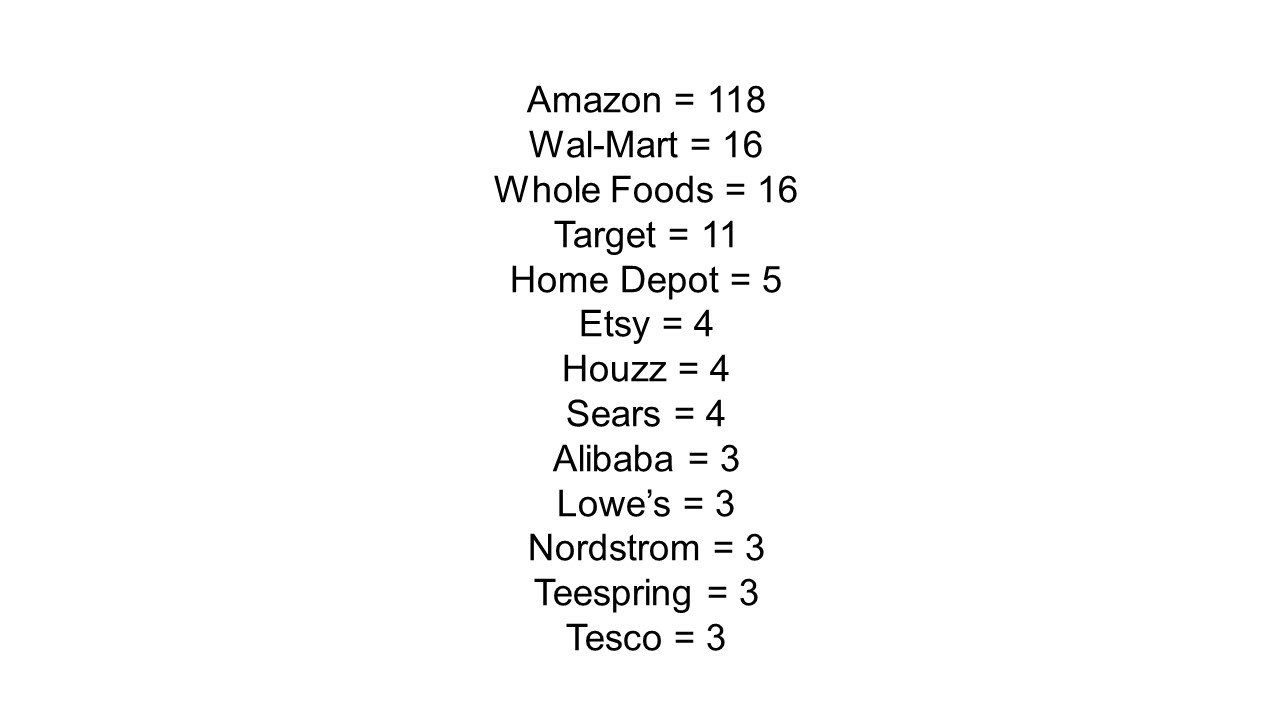
So I wanted to test my theory that what I read biases what I learn. For instance, I pay attention to Internet Retailer and listen to what they have to say. They like to talk about Amazon, don't they? And for good reason. So I counted the number of times they mentioned Amazon on original / non-vendor tweets (excluding retweets) between April 22, 2017 and July 21, 2017.

Here are the results.


Whole Foods got in there because they were purchased by Amazon. I recoded any mention of "Prime Day" as "Amazon", for good reason, boosting the Amazon total. But take those 40 tweets +/- out and the story isn't different.

If I pay attention to what I read, I'll make a ton of mistakes that hurt my client base. Internet Retailer has to talk about Amazon, because that enables Internet Retailer to get paid. We "get" to talk about Circulation Theory ... it gets you paid! You don't get paid when you ponder what Amazon is doing.

I spent two weeks discussing Circulation Theory because the secret to keep doing what catalogers love doing is embedded in the ten posts on the topic. If you've executed mail/holdout tests and page count tests, then every secret discussed in this Circulation Theory discussion is available to you.

Yes, you!

You get to be the person who charts a path to the future.

You get to be the person who generates disproportionate profit amounts compared to the marketers who managed your brand in the past.

You get to free up ad-dollars to spend online and in mobile, allowing your company to "keep up".

You will attract online/mobile customers who have different merchandise preferences. Your merchandising team will observe the results and, as a consequence, they'll offer more of what an online/mobile customer wants ... enabling your conversion rates to improve, allowing your company to move into the future must faster.

You get to do all of this.

Yes, you!

Analyze your test results ... structure them into the framework outlined in this series of ten posts. Then go make magic happen!

What questions do you have? Any? What should I discuss in a future week of Circulation Theory?

Need help? Contact me (kevinh@minethatdata.com) and we'll structure your information into this framework and see what it means to your business.


P.S.: I know, those of you who are Executives will tell me that your CEO/Board won't let you do anything different. And those of you who are Managers/Analysts will tell me that your Executive Team won't let you do anything different. It is TIME to do something different. I spent two weeks showing you how to make your company a fortune. If Leadership won't let you cut back on frequency, then cut back on pages ... go deep with a small page count as a test and see what happens. If Leadership won't let you cut back on pages or frequency, then make all of the changes you want with mobile-centric customers and just tell your Executive Team or CEO/Board that this is what you are doing, end-of-story. Or don't do that. But it is TIME to do something different. So do something different, ok?

August 02, 2017

Circulation Theory: Part 9

Remember our e-commerce customer from yesterday ... 50% organic, 50% catalog driven? We mail a catalog, and the $3.00 matchback outcome is actually not-so-great.
  • ($3.00 * 0.50) * 0.40 - $0.80 = ($0.20) ... a loss of twenty cents.
This is a place where 90% of us simply refuse to cut back. We can't cope with cutting back, because of what it means to our industry. So we don't cut back. We extend our "lifetime value" window by a year and say we're mailing to a loss because we'll make it up on lifetime value, never once questioning how many times we are willing to do this (10x/year) and what it does to lifetime value (it ruins it).

It doesn't have to be this way.

Last week, I talked about page counts. This is where page counts become really important.

Let's say we're mailing 128 pages. Let's say we cut back to 32 pages. We get 52% of the demand we'd expect, and our ad cost drops to $0.25 (yes, you'll say it drops to a different figure - fine - use your estimates from your printer, no worries).
  • ($3.00 * 0.50) * 0.52 * 0.40 - $0.25 = $0.06.
OMG!

Look at that.

Now we're generating profit.

Now you can continue to mail the e-commerce customer.

You get to keep doing what you love to do!

You just have to make two compromises.
  • You have to reduce pages.
  • You have to stuff the reduced page catalog with your absolute best merchandise in order to generate profit.
Some of you are going to do this. You will generate a ton of profit for your company. You'll run marketing someday, because of your disproportionate impact on company profit. Your CFO will respect you. Your co-op rep and paper rep and printer will love you because you are keeping them in business.

Just do it. I wouldn't share this if I haven't seen this work to the tune of millions of dollars of profit. When it hasn't worked, it failed because creative sabotaged the effort (we need new creative) or the merchandising team did not put best items in (let's experiment with new items that signal the future of our brand) ... notice the word "new" in both comments?? Just follow the prescription to the letter. Best product, best creative, few pages.

Follow the prescription.

Please tell me ... what stops you from doing this? Be honest (kevinh@minethatdata.com).

Tomorrow, we wrap up our discussion. I hope you took notes, because the information shared over two weeks comprises the very essence of Circulation Theory ... it's stuff you have the tools to master!!

August 01, 2017

Circulation Theory: Part 8

Let's assume that we have three customers, of equal customer quality.
  1. The first customer is a call-center customer ... s/he receives catalogs and buys over the phone. 20% of what this customer spends is organic, 80% is catalog-driven.
  2. The second customer is an e-commerce customer ... 50% of demand is catalog-driven, 50% is organic.
  3. The third customer is a mobile customer ... 20% of demand is catalog driven, 80% is organic.
We mail a catalog to each customer, and each customer generates (via matchback algorithms) $3.00 because of the catalog. 40% of demand flows-through to profit, and the catalog costs $0.80.

If you believe your matchback reporting, each segment is profitable ... $3.00 * 0.40 - $0.80 = $0.40 profit.

So you'll keep mailing each customer.

And that's not the right thing to do.

Customer #1:
  • 20% is organic, 80% is catalog driven.
  • ($3.00 * 0.80) * 0.40 - $0.80 = $0.16 profit.
Customer #2:
  • 50% is organic, 50% is catalog driven.
  • ($3.00 * 0.50) * 0.40 - $0.80 = ($0.20) ... a loss.
Customer #3:
  • 80% is organic, 20% is catalog driven.
  • ($3.00 * 0.20) * 0.40 - $0.80 = ($0.56) ... a loss.
Clearly, Customer #2 and Customer #3 are not generating profit. 

But we keep mailing Customer #2 and Customer #3.

This is why our ad-to-sales ratios have skyrocketed.

This is why we don't have enough money to invest in anything else.

This is why our brands keep being gobbled up by catalog holding companies.

Tomorrow, I'll talk about what can be done, especially with Customer #2.

July 31, 2017

Circulation Theory: Part 7

The organic percentage is influenced by between-catalog cannibalization.

More important, the organic percentage is influenced by your online and mobile channels.

When you execute your mail / holdout tests (you execute these, right?), you learn four things.
  1. Most of the demand captured at your call center is generated by catalogs - without the catalogs, you don't generate the demand. Usually 20% +/- of call center demand is organic - and 80% is caused by catalog mailings.
  2. E-commerce demand (excluding email marketing) is about 50% organic and 50% caused by catalog marketing. This is the mystery of our time ... few people actually measure this and fewer people understand what it means when half of online demand happens without catalogs. This means freedom ... it means your business has a path forward, and you can save a ton of ad cost and reinvested it elsewhere (or pocket it and make your CFO happy).
  3. Mobile demand is often 80% organic and 20% catalog driven. As the customer gets younger and/or the customer is two channels removed from catalog marketing, the customer exhibits different behaviors, behaviors that are not influenced by catalogs. Again, this means freedom ... it means your business has a path forward, and you can save a ton of ad cost and reinvest it elsewhere (or pocket it and make your CFO happy).
  4. Email Marketing demand is often 95% organic and 5% catalog driven. Why does your catalog matter when you send the customer a daily email marketing message? Get rid of your catalogs (via tests) and watch carefully how the customer shifts to email marketing. It doesn't happen overnight. But six months later or nine months later, the shift is clear. Again, this means freedom ... it means your business has a path forward, and you can save a ton of ad cost and reinvest it elsewhere (or pocket it and make your CFO happy).
I spent more than a decade communicating these facts to you. The facts represent an important part of circulation theory. Much of what I'm sharing with you was learned not in catalog marketing, but in sorghum tests I analyzed at the Garst Seed Company ... in 1989. The same concepts applied to the ways that sorghum hybrids grew, and were measured via reasonably simple tests - the same kinds of tests that you measure today.

I've shared these facts with you for more than a decade, for free. I've given you a path to the future. How many of you have taken advantage of free advice?

Tomorrow I'll show you why the organic percentage is so darn important, ok?

July 30, 2017

Circulation Theory: Part 6

One more week of Circulation Theory ... if you find this stuff to be too "circa-1991", then why not watch this video about shipping as a competitive advantage (click here).


We have an industry that doesn't want to understand the very thing that allows the industry to be much more profitable and, therefore, able to invest in the future.

What am I talking about? The organic percentage, of course.

The organic percentage is the share of demand that still happens when you stop mailing catalogs.

Every one of you measures your organic percentage (especially if you stopped all email campaigns if you are an e-commerce wizard), right?

Right?

There are two pieces to the organic percentage.

The first piece is inter-catalog cannibalization. Here's how this works. You have three catalogs, mailed April 1, April 22, and May 14. You execute a test - you cut out the April 22 in-home date and measure what happens when you have catalogs mailed on April 1 and May 14 vs. mailing three catalogs.

Let's assume that each catalog costs $0.80 and 40% of sales flow through to profit.

The mail group performs like this:
  • 4/1 = $5.00.
  • 4/22 = $5.00.
  • 5/14 = $5.00.
  • Total Sales = $15.00.
  • Total Profit = $15.00*0.4 - $0.80*3 = $3.60.
The holdout group performs like this:
  • 4/1 = $6.75.
  • 4/22 = $0.00.
  • 5/14 = $6.75.
  • Total Sales = $13.50.
  • Total Profit = $13.50*0.4 - $0.80*2 = $3.80.
Which group generates more profit?

The group mailed two catalogs generates more profit.

And yet, 9 in 10 readers prefer the outcome that is less profitable ... "WE GENERATE MORE SALES IF WE MAIL MORE CATALOGS!!". 

In this case, (6.75 - 5.00 + 6.75 - 5.00) / 5.00 = 70% of the value of the second mailing is organic ... it will happen if that mailing does not exist.

70% of the demand will happen if that catalog is not mailed.

You measure that metric, right?

Tomorrow, we'll talk about the second component of the organic percentage.

July 27, 2017

Circulation Theory, Part 5

Here was our profit table from yesterday.

My homework assignment was this ... what is the right strategy for this in-home date?

It should be difficult to answer this question, for obvious reasons.

What is the best strategy for Segment 1?  160 pages.

What is the best strategy for Segment 2?  128 pages.

What is the best strategy for Segment 3?  128 pages.

What is the best strategy for Segment 4?  96 pages.

What is the best strategy for Segments 5-10?  32 pages.

What is the best strategy for this company?

If you talk to somebody from Xerox, they'll tell you to create every version of the catalog, paginated based on customer merchandise preferences ... creating thousands of different versions. And they would be right.

But you're not going to do that, because you want to accurately forecast demand at an item-level so that your inventory buys are appropriate (even though you can forecast accurately online where you have no control over what the customer looks at).

And you are unlikely to create multiple versions of a catalog, even though the data is telling you that's exactly what you must do - because that creates added complexity and you don't have the staff to handle added complexity.

Your paper rep and your printer are going to tell you to go with a large page count because of various vendor discounts/incentives.

Your co-op rep, however, should be strenuously screaming at you to go with a small page count because you will mail many more prospects and the co-op will make a ton of money in the process.

Yes - your paper/printer partners and your co-op partners are at complete odds ... when one partner wins, the other partner potentially loses. This is a secret I'm not even certain the co-ops understand ... but if they were smart, they'd be running circulation grids for you and they'd be screaming at you to go with low page counts.

As an industry, catalogers tend to align with their paper partners - the USPS and various Printers tell you that you are "saving" money by going with larger page counts.

But the table above clearly indicates that by "saving" money you reduce circulation.

What happens when you reduce circulation?
  • You reactivate fewer customers.
  • You acquire fewer customers.
What is the most important aspect of marketing a catalog brand?
  • Reactivating customers and Acquiring customers.
So now we have a bunch of conflicting factors at play.
  • Your paper partners give incentives to have large page counts, but are fine with small page counts mailed to many people.
  • The USPS gives incentives to have large page counts.
  • Your co-op and list partners profit when you have small page counts.
  • Xerox wants you to have 80,000 versions of a catalog.
  • Your staff can only handle one or at most two versions of a catalog.
  • Your best customers want many pages.
  • Your marginal customers and prospects are unprofitable at large page counts.
  • Your CFO is yelling at you to increase demand and increase profit, which is impossible with only one version of a catalog.
What do you do?

As an industry, we're being pushed toward lower page counts - this is unavoidable. We're competing against digital strategies executed in real-time - you cannot compete by tossing large page counts out there that require six months of planning. Those days are over. Your online customers cannot support large page counts (as their organic percentage is high, thereby pushing them into Segments 7-10 in our example above). And as the table shows us, large page counts ruin prospecting efforts ... the most important part of being a cataloger (prospecting) is sub-optimized by a lust for large page counts.

So we have no choice but to move to smaller page counts.

But what about the meaty levels of profit generated at large page counts by best customers?

Here's how you work around this issue. You alternate strategies.
  • In-Home #1 = Large Page Counts, mailed only to best customers. This catalog has your full assortment of new merchandise. Your best customers pay for sub-optimal new items. By sending this only to your best customers, you avoid all of the losses that happen with marginal customers who don't spend enough on marginal merchandise to generate profit.
  • In-Home #2 = Small Page Counts, mailed as deep as you can humanly mail the small catalog. The catalog is absolutely stuffed with only winning items - with callouts to look at new/marginal items online. This is where you do all of your prospecting and reactivation work.
If you do this, you get a lot of benefit with minimal compromise.
  • Your paper partners are happy because you mail a large page count book shallow and a small page count book deep.
  • Your co-op and list partners are happy because you spend a ton with them on alternating prospect-heavy mailings.
  • Your CFO is happy because you generate a ton of profit from your best customers on large page counts and you increase prospecting efforts which generate a ton of profit for you next year.
  • Your staff is happy because they don't have to come up with inventory plans for 80,000 personalized versions of a catalog.
  • You are happy because you ran the simulations and you know what the right thing to do is.
This doesn't have to be difficult. Alternate your strategies. Large mailings sent only to best customers chocked full of new merchandise ... and then very small mailings sent deep into your file (and to prospects) stuffed with winning products and winning creative (to push productivity as high as possible to push circulation as deep as possible).

Need help figuring out what is right for your business? Email me (kevinh@minethatdata.com) and we'll figure it out together.


The Worst Long-Term Customers to Acquire

From tomorrow (November 25) to December 5 ... it might be the easiest eleven days to acquire a customer. You'll give away everything ima...