September 09, 2013

Cyber Monday Tip #1

I know, you're pushing your chips all-in on Cyber Monday. You "have" to, in order to remain competitive. Or so you tell me. And the press love it - you give away 35% plus free shipping, they make ad dollars by yelling about it.

So let's take some time to share a few tips with you.

First, I want you to analyze how business shifts over time. Compare 2008 to 2012, and look at three time periods:
  • Month of November Demand, Excluding Cyber Monday.
  • Cyber Monday Demand.
  • Month of December Demand, Excluding Cyber Monday.
Here's an example I witness, often:
  • 2008 November = $10,000,000.
  • 2008 Cyber Monday = $1,000,000.
  • 2008 December = $9,000,000.
  • 2008 Seasonal Totals = $20,000,000.
So far, so good. Now let's look at 2012:
  • 2012 November = $9,000,000.
  • 2012 Cyber Monday = $2,500,000.
  • 2012 December = $9,000,000.
  • 2012 Seasonal Totals = $20,500,000.
What do you observe?

If all things are equal, then Cyber Monday grew from $1,000,000 to $2,500,000 ... but the total business grew by $500,000.

This tells us that $500,000 / $1,500,000 = 33% of Cyber Monday business is truly incremental, and new to the business.

In other words, you gave away the farm (i.e. 30% off plus free shipping) to gain $1,500,000 of business, when $1,000,000 of it would have happened anyway.

Your profit and loss statement is likely to look like a catastrophe, assuming you give free shipping away in Nov/Dec - assuming the 30% off is due to Cyber Monday.
  • Incremental Demand = $500,000.
  • Discounts on Gain of $1,500,000 = $450,000.
  • Gross Margin = 50% = $250,000.
  • Net Contribution = $500,000 - $450,000 - $250,000 = ($200,000).
So - Tip #1 is an easy one ... quantify how much of Cyber Monday is incremental, is truly new business. Run a profit and loss statement (the one above is terribly simplistic, for illustrative purposes), and measure if you are actually helping your business.

Contact me (kevinh@minethatdata.com) for your own Cyber Monday analysis.

September 08, 2013

Dear Catalog CEOs: Really, Really Big Catalogs

Dear Catalog CEOs:

Yes, this is the kind of feedback I get:
  • "I recently received a five pound catalog from Restoration Hardware. No, really, it was five pounds. I weighed it. Restoration Hardware wouldn't send out a five pound catalog if it didn't work. Should we move into really, really big catalogs? Is that the future of cataloging?"
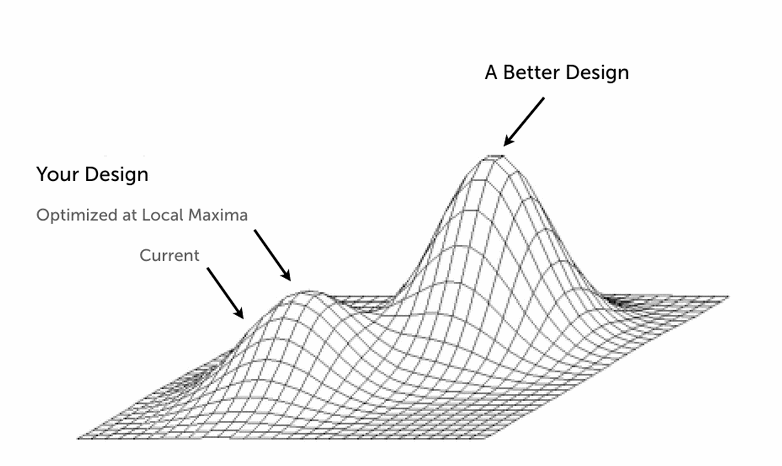
In calculus, there's a concept called a "local maxima". Go read this article (click here). That article is the source of this image:
A 500 page catalog is an example of a local maxima, especially in B2B. It's a peak that may appear to be the most profitable and most prudent decision. It may even be a better tactic than the catalog tactic you're currently employing.

Matchbacks almost demand that a retail brand, or a B2B brand, mail really, really big catalogs. We all know how horribly flawed Matchbacks are, yet catalogers use them religiously, simply because they overstate how effective catalogs are. Matchbacks are the magic that allows the catalog leader to continue to embrace cataloging.

In a retail environment, the majority of sales happen at retail. And at retail, a majority of sales happen if all marketing is discontinued. The Matchback simply and erroneously takes credit for sales that would happen anyway.

So, let's pretend that you have a 500 page monster catalog, and you're, say, Pottery Barn (who doesn't mail a 500 page catalog, but we'll use them for illustrative purposes). You mail it. Then you get the results. You apply your erroneously overstated Matchback to the results. Here's what you see after 90 days:
  • Total Sales, Online = $5.00.
  • Total Sales, Retail Store = $20.00.
  • Total Sales = $25.00.
  • Profit Factor = 35%.
  • Contribution Before Mailing Cost = $8.75.
  • Mailing Cost = $5.00.
  • Total Profit = $3.75.
It works! It works! A 500 page catalog is a great idea. Thank goodness we have Matchbacks!

Except for one little problem.
  • 50% of all online sales would still happen if the catalog is discontinued.
  • 90% of all retail sales would still happen if the catalog is discontinued.
You know this, of course, because you execute mail/holdout testing.

Now look at what your profit and loss statement looks like:
  • Total Sales, Online = $5.00 * (1 - 0.50) = $2.50.
  • Total Sales, Retail Store = $20.00 * (1 - 0.90) = $2.00.
  • Total Sales = $4.50.
  • Profit Factor = 35%.
  • Contribution Before Mailing Cost = $1.58.
  • Mailing Cost = $5.00.
  • Total Profit = ($3.42).
Oh oh.

In the real world, the catalog actually generated an enormous, embarrassing, humbling loss of $3.42 per customer.

This is where somebody in the creative department would say "Hold on, Kevin, hold on, you simply cannot measure the branding impact of a vehicle that sits on the coffee table for a year, I have a friend who displays it right next to a bowl of nuts, and picks it up repeatedly. That's some sweet branding, Kevin, and you and your cold numbers cannot account for the impact of branding".

There are three possible outcomes.
  1. Really, really big catalogs work.
  2. Really, really big catalogs don't work, they accomplish a local maxima that prevents a business from finding the true peak of marketing performance.
  3. Really, really big catalogs don't work, but we measure performance via Matchbacks, which make them appear to work so that we can keep executing them.
The last point is the sad reality of most catalog marketing measurement, especially in B2C marketing.

The middle point is the dangerous reality of most marketing tactics. In B2B marketing, big catalogs are common, and no amount of measurement proof will stop people from creating them. B2B marketers crave the local maxima, and will use the "I saw the big catalog sitting at the Jiffy Lube" argument as proof that visual confirmation equates to sales increases.

The data suggests, on the surface, that really, really big catalogs work.

Slightly advanced techniques (mail / holdout tests) show that really big catalogs usually don't work.

This leaves you in a very interesting situation.

You can believe in the fairy dust known as matchback, where everything works.

You can believe in the realm of testing, where almost nothing works.

Or you can invent the future.

September 05, 2013

I Just Want The Data

A while back, I'm meeting with the CEO of a startup. We're talking about his product. And he said something so opposite of what I expected that it literally took me a year to digest the comment.
  • "I don't care about the product, Kevin. I only care about what I can do with the data that the product creates."
At the time, I thought to myself, "well, wouldn't a great product create more/better data?"

But ever since the Great Recession, we elected to prioritize data over merchandise/product. A generation of experts believe strongly in the power of data. This is what the whole omnichannel movement is about - use data to provide the same homogenized experience across the board. Go a step further, and you have BIG DATA, which was really popular until ordinary folks realized that you can link phone numbers and social media data together to paint an accurate picture of individual activities ... then it wasn't so popular!

Here's the thing, folks. Maybe you just want the data. But you can't have the data unless you have something that creates data.

You need merchandise. Or product. Or software. Or something.

Maybe it's time to focus on the vehicle that creates the data, and give that priority?

September 04, 2013

#Omnichannel vs. Algorithms

Yup - fall is just around the corner.

As the Northern Hemisphere tilts away from the Sun, temperatures cool, bringing about a season of change. Think about what you do for recreation in Fall, how does it compare with what you do for recreation in Spring? It's different, isn't it?

In other words, the simple tilting of the axis causes us to enjoy different activities, to behave differently, even though everything else is constant. We behave opposite of an omnichannel framework (where everything would be the same, regardless of season).

In the omnichannel world, everything is the same. The customer does everything, all year, every day. We have to emulate the exact same experience across all devices and channels. Right?

In the real world, channels are exploding, but the opposite is happening - customers are rapidly sprinting to their preferred niche.

Don't believe me? Take a look at the merchandise that sells via email marketing. Lower price points, free shipping, or lower price points plus free shipping. The channel is fundamentally different than the rest of the business, thanks to 15 years of incessant promotions designed to stimulate response. The customers who buy because of email marketing (buying is different than being on a list) are fundamentally different than everybody else.

If you have retail stores, look at your top 500 best selling items in stores vs. online. Sure, there are similarities. But there are major differences - at least in the data I get to see there are major differences.

If mobile is responsible for more than 5% of annual sales, then compare the top 500 best selling mobile items ... they're different than the top 500 best selling e-commerce items. Some are the same, some are fundamentally difference ... suited for a tiny screen away from home.

So customers are running off into their own, personalized niches, even within your business. Just go analyze merchandise performance, and see this for yourself.

Omnichannel experts demand that we patch things back together - creating integrated campaigns that all reflect the brand the same way - same merchandise - same promotions - same same same same same.

And the data suggests otherwise - niche niche niche niche niche.

Algorithms are only going to exacerbate this issue.

Don't believe me?

Perform a search on Google on your computer - then perform a search on Google on a different computer.  Or visit a news site - and look at the ads that you get - compare them to the ads that your spouse receives. Or visit Amazon on two different computers, they've been mixin' in up for close to a decade - doing the opposite of Omnichannel.

This level of difference ... called "targeting" by some, called "relevancy" by others, called "personalization" by another camp, is coming to every website, to all email programs (of smaller companies - big companies have been tailoring merchandise in email campaigns for 15 years), and especially to mobile. Sure, we've been told about this for decades, but it's unavoidable. And via machine learning / neural networks, we're not going to understand "why" an algorithm is doing what it is doing ... the neural network will self-learn, faster than we can understand what is happening - freaking folks out!

In other words, you'll merchandise your home page and landing pages dynamically (big companies already do this and have done this for a long time), you'll merchandise your email campaigns dynamically, and you'll merchandise your content marketing strategy dynamically. This strategy will appeal to different customer segments. This strategy will further push customers into personalized niches.

Niches are not congruent with omnichannel strategy. Niches are the opposite of omnichannel strategy.

We already see the result of niche activities in catalog marketing. Catalogers, using algorithms from the co-ops, have dramatically accelerated the age of their audience to 55+ rural customers, completely separating catalog brands from mainstream customer behavior. This is what algorithms do to omnichannel businesses - algorithms accelerate niche behavior.

Algorithms accelerate niche behavior.

Omnichannel eviscerates niche behavior.

Algorithms hate equality - algorithms demand efficiency. Omnichannel is all about equality - same merchandise and pricing and promotions and look and feel in all channels.

In the next few years, there will be a battle - the battle between controlling the experience for the masses vs. using algorithms to tailor the experience for the niches.

I'm betting that the latter strategy wins. It's more efficient, and therefore, more profitable.

What do you think?

September 03, 2013

Best Buy

Several months ago, Best Buy published their 2nd quarter results (click here to review them).

A few tidbits:
  • Domestic sales are down 9% vs. last year (largely because of one fewer week of sales in the reporting period).
  • E-Commerce is +16% vs. last year.
  • Comp Store sales were -1.3%, on top of a -5.2% last year (hint - that's not good).
  • Gross Profit was down from 24.9% to 23.1%.
  • Consumer Electronics = -8% comp.
  • Entertainment = -17% comp.
  • Computing and Mobile Phones = +4%.
Those last three bullet points are interesting, don't you think? That's the essence of the Merchandise Forensics work you do - Best Buy is telling you that their business is going through a fundamental transformation.

A couple of questions for you, the loyal reader.
  1. You have a huge box, and many of your merchandise categories are dying. Tell me what you do?
  2. Even if you match prices with all of your competitors, describe why the customer should get in the car and purchase from Best Buy when comparable merchandise can be purchased almost anywhere, at the same price, without sales tax, with faster shipping? Discuss.
  3. Management notes that they are working on improving the Net Promoter Score, a key metric in their opinion. Where would you prioritize customer satisfaction vs. merchandising strategies? Discuss.
Mind you, I'm not criticizing Best Buy in this post. I'm asking you to think like this was your business. What would you do, and how would you demonstrate that your ideas are better than what they are currently doing? I'm asking you to think. Discuss.

September 02, 2013

Cyber Monday Customer Behavior - And An Offer For You

I know, it's coming ... CYBER MONDAY.

You already know this, but it needs to be said.


  1. You earn profit when customers pay full price for merchandise they have to have.
  2. Trade journalists get paid when people click on sensational articles, causing "traffic" to increase, attracting advertisers.
Which article title is more likely to generate clicks and page views?
  1. J. Crew generates a five percent increase in sales in late November by selling stuff at full price.
  2. J. Crew's 30% off plus free shipping promotion generates a whopping 224% increase in Cyber Monday website traffic, according to Quantcast.
The very behavior that is most profitable for a trade journal is likely to not be profitable for the company the trade journalist writes about.

Here's the problem, folks.
  • Cyber Monday promotions, often, do not result in incremental purchases. The promotions cause customers to shift full-price purchases out of other timeframes (say early November), into Cyber Monday.
  • Almost no analytical tools (especially Google Analytics and the Web Analytics family of software) produce standard reports that clearly illustrate how sales shift out of one timeframe, into another.
As a result, all of the standard software tools hide destructive behavior, and illustrate non-profitable behavior as being highly beneficial to the business.

Want to learn if you have a Cyber Monday problem? Want to learn if your customers are simply shifting behavior out of profitable timeframes into the promotion-laden Cyber Monday window? Good! Let's try something.
  • The first five businesses to respond to this request (contact me - kevinh@minethatdata.com) get an opportunity to have a one-time, $6,000 Cyber Monday analysis conducted.  Click here to see the file layouts necessary to have this analysis conducted. I will show you if Cyber Monday behavior is profitable for your business, if it brings in new customers, or if your existing customers are just shifting behavior out of profitable timeframes into Cyber Monday.
I'll run this special analysis for the first five responders - get your answers now, so that you are ready to deal with this year's Cyber Monday madness.

September 01, 2013

Dear Catalog CEOs: The Mountain

Dear Catalog CEOs:

In Seattle, a long-time radio icon disappeared over the weekend ... 103.7 FM ("The Mountain"), which had already (and subtly) changed format more than a year ago, is gone.

Have you ever noticed how radio stations are not afraid to kill whatever they are doing, in search of ratings?

In Seattle alone, 98.9 changed from Smooth Jazz to "Click 98.9". 102.9 changed from Sports Radio to "Now Hits".

How often have you fundamentally changed your merchandise assortment? In radio, there's a big difference between The Eagles and Eagle Eye Cherry. But in cataloging, how often do we stray from our core merchandise assortment? How often are we willing to literally kill what we're doing, and start over, from scratch?

Radio stations are willing to blow things up, start over from scratch, and acquire new listeners, one at a time.

It's something worth thinking about, as you begin your post-Labor-Day path to Cyber Monday.

Curiosity and Contempt

Early in my tenure at Lands' End, I worked for a department head that had a level of business curiosity that was nearly unmatched over t...