December 23, 2012

Dear Catalog CEOs: Boxing Week

Dear Catalog CEOs:

Outside of offering deep discounts on merchandise that your customers didn't want, what are you planning on doing over the next two weeks, with half of your employees out of the office?

Maybe, in the spirit of Boxing Day (click here), it's time to think differently.  Give this a try.
  • Work with the brightest five employees you have under the age of 30.
  • Give them a task - if they were to reinvent your business, what would their version of reinvention look like?  Merchandising strategy?  Marketing strategy?
Give them a deadline of January 4.  That's two weeks.  See what this team of over-achieving professionals can create.  I'll bet it is fundamentally different than your plan for 2013.

What have you go to lose?  Give it a try.

December 19, 2012

Tablet Commerce

The catalog industry seems to really like the potential of tablet commerce via 3rd party apps.


Can you blame a cataloger for loving tablet commerce via 3rd party apps?  The merchant and creative executive get to replicate the same process (creating spreads / stories) that they've been replicating since the 1980s.  This is in stark contrast to e-commerce, which old school merchants and creative leaders find blatantly algorithmic and unfeeling.

How about the customer?  Does the customer love tablet commerce via 3rd party apps?  Overwhelmingly, to date, the answer is no.  Count how many customers listen to Pandora on a tablet, read a book on a Kindle app on a tablet, or play games on a tablet.  Now count the number of customers who purchase via the most popular tablet commerce apps.  For almost all catalogers, less than 1% of annual sales come via tablet commerce 3rd party apps.

Does this mean that tablet commerce is destined to fail?  Absolutely not.

Why, then, aren't customers flocking to tablet commerce via 3rd party apps?
  • Judy:  She loves the physical catalog.  If she owns a tablet, it's hard to improve upon the paper-based experience she's grown to love over 35 to 45 years, right?
  • Jennifer:  She choose e-commerce over catalogs.  She hunts for the best deal, having six tabs open at a time, comparing prices across the internet.  Today's tablet commerce apps make that style of shopping way too difficult for her - she's forced into a walled garden.  Jennifer doesn't want to be forced into anything, she's in charge.
  • Jasmine:  We don't know enough about her habits, yet, do we?  But we do know enough to know that she's heading in interesting, new directions.
What mistake did catalogers make when moving to tablet commerce via 3rd party apps?  

Well, we replicated the catalog experience.  By doing that, we didn't solve a genuine customer problem.

We are not solving a customer problem when we plop a 96 page catalog onto a tablet.  If anything, we create more problems!  For Judy, it's hard to read.  For Jennifer, it's hard to comparison shop.  For Jasmine, it's inherently unsocial.

Tablet commerce apps have the potential to take off, to change the world.

But we're going to have to re-think the merchandising and creative strategy behind tablet commerce apps.

For instance, if you are "brand x", why not create a 16 page mini-catalog of best sellers, low-density (1 item or 2 items per page), with easy-to-read copy?  You don't need to smash 128 pages at 12 products per spread onto an iPad Mini --- there is simply no rule out there requiring you to do this.  Or why not produce mini-catalogs twice a week, once on Monday, once on Thursday?  You already do this (it's called email), so just change the creative strategy to one congruent with the strengths of tablet commerce 3rd party apps?

Until we start executing tablet commerce in a way that aligns with the strengths of the channel, we'll fail to realize the potential of the channel.  We need experimentation in tablet commerce, not the simple dumping of a catalog into a tablet commerce app.

And, yes, I realize this doesn't align with what catalog merchants and catalog creative experts love doing.

It's time to rethink this tablet commerce concept via 3rd party apps.

December 18, 2012

Triggers: Weighting Transactions

From time to time, I work on projects where the goal is to set up various triggers.  This can be a complicated problem, because customers might perform competing activities.

I run regressions against various purchase, visitation, and social activities.  My goal is to identify when an activity should trigger a marketing tactic.  You learn some interesting things when you do this (your mileage will vary):
  1. Old-School Catalog orders have a half-life of maybe 24 months.
  2. E-Commerce orders have a half-life of maybe 20 months.
  3. In-Store retail purchases have a half-life of maybe 16 months.
  4. A click through an email campaign may have a half-life of 2 months.
  5. A visit to a website may have a half-life of 2 weeks.
  6. A social media action may have a half-life of 2 days.
Again, your mileage will vary.  But it's your job to know the half-life of all activities!  If a customer visits your website on December 13, but purchased in a retail store on December 1, it is quite likely that the retail transaction will carry more weight ... any triggers you plan are focused more on the retail transaction than the website visit.

Know the half-life of all customer activities.

December 17, 2012

The Fiscal Cliff

How do you know if your business is heading off the fiscal cliff?

Certainly free cash flow and profitability matter.  Those are the easy ones.

There are three metrics that I look at.  All three are telling:
  1. An unplanned drop in new customer acquisition.
  2. An unplanned drop in the annual repurchase rate among 1x buyers last year (not loyal buyers, but those with only 1 purchase last year).
  3. A planned increase in Average Order Value that is achieved.
I saw all three at Nordstrom, back in late 2006 and early 2007.  Not a soul would listen to me, of course, because we were posting +5% comps.  All three were harbingers of the impending collapse of the global economy.

Be wary when you hear Management talk about planned strategies to increase Average Order Values.  The parallel in the fiscal cliff debate is raising taxes on those who can afford it ... regardless whether you believe that is right or wrong, all organizations facing a cash crisis look to "squeeze more out of the lemon", as an Executive recently told me.  It's logical to try to get more out of those who can seemingly afford it.  In e-commerce, that's what increasing AOV is all about, among your best customers.

Run your own queries, and see if any/all of these three things are happening:
  1. An unplanned drop in new customer acquisition.
  2. An unplanned drop in the annual repurchase rate among 1x buyers last year (not loyal buyers, but those with only 1 purchase last year).
  3. A planned increase in Average Order Value that is achieved.
If all three of these things are happening simultaneously, your company may be on the verge of going over the fiscal cliff.

December 16, 2012

Dear Catalog CEOs: The End of Call Center Buyer Migration

Dear Catalog CEOs:

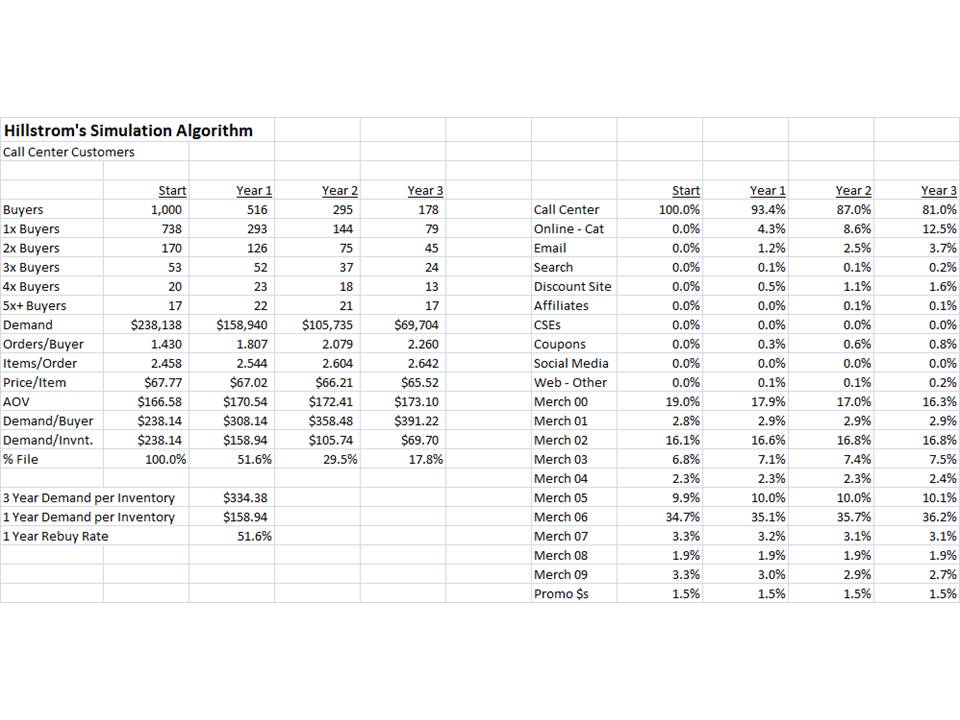
Take a look at the image below - this is from a recent simulation I ran - we're analyzing the migration of 1,000 call center buyers.
In three years, 81% of the demand from call center customer demand will still be sourced from the call center.

Back in 2006, 81% of call center customers would have migrated online within three years.

I can't over-state the importance of this trend, my friends.

Simply put, the transition of customers from old-school channels to e-commerce is over.  

Yes, sure, customers are still migrating.  But more important, the vast majority have completed their migration.  This has huge ramifications for the businesses we manage.

Ramification #1:  The catalog is changing.  Call center buyers (unless you're buying a $500 item that requires human contact to complete the transaction) are largely Judy or June ... in other words, age 55+.  These customers have very different needs than Jennifer or Jasmine.  There is nothing wrong with creating separate business units that target June / Judy ... the 55+ call center buyer.  This will be a lucrative niche, one that may have a 20 year shelf life of profitable opportunities.  Tell me what is wrong with that?  You do not have to serve all customers age 18-98.

Ramification #2:  The catalog has some meaning to Jennifer, minimal or no meaning to Jasmine.  Back in 2006, online buyers happily shifted back to the call center (and vice versa), leading to multi-channel nirvana.  But once the customer is fully trained to use e-commerce and online channels (especially email), the catalog becomes a secondary demand driver.  There's huge cost savings to be had here.  In fact, you can pay for free shipping with hurdle promotional program (all year) by taking advantage of the cost savings here.  Surprisingly, not many catalogers want to take advantage of this opportunity, because if "feels" wrong to not mail catalogs to customers.  In 2013 and 2014, catalogers have an opportunity to shift dollars from unproductive catalog mailings to productive shipping tactics.

Ramification #3:  The shift from e-commerce to mobile is coming.  Outside of e-commerce, it's already happening.  Maybe this won't be on a phone, but it will be somewhere between a 4" display, a 7" display, or a 10" display, +/-.  We've been experiencing channel migration for forty years ... we went from mailing in checks to call centers with credit cards (that was a huge transition) ... we went from call centers with credit cards to e-commerce ... now we're going from e-commerce to an intermediate device (maybe tablets).  By the way, this doesn't guarantee that tablet commerce is the next step.  Lots of people are going to try lots of different ways to get customers to shop on intermediate devices ... the customer is going to choose the "right" device / experience combination.  Regardless, customers are always migrating from older channels to newer channels ... it's been happening for decades (or longer).  E-commerce experts keep bragging about posting +10s and +20s year after year after year ... strongly benefiting from the shift from call centers to e-commerce.  The same dynamic is going to haunt e-commerce experts when mobile arrives upon a preferred method of demand capture with customers.

Ramification #4:  Channel migration business skills will be VERY important.  There will be leaders who know how to manage transitions between channels ... these leaders know the inflection points where/when the organization must pivot.  With the call center to e-commerce transition complete, there will be opportunities for business leaders with knowledge of this transition to apply leadership skills to the mobile device transition.  Quite possibly, these skills will be ignored by the younger generation of mobile experts (increasingly, extensive old-school skills are ignored in favor of new-channel experimentation) , but that doesn't mean that the skills aren't valuable.

Ramification #5:  Nothing is directly attributable anymore (and it's been this way for awhile).  Measurement gurus will strongly disagree with me, and that's fine.  In the old days, you put a key code on the back of a catalog, and you tracked the demand associated with that code to the catalog that caused the order.  Sure, there were problems with this methodology, but the problems were in the +/- 15% magnitude.  Today, everything is measurable, and yet nothing is definitive.  It's a paradox.  And it's ok.  You have a marketing budget, you kind of know in total what you're marketing efforts are generating.  Leadership needs to, believe it or not, leverage gut instinct, when managing the transition from older channels to newer channels.

Ramification #6:  Simulations will become important.  When nothing is directly attributable, it becomes very hard to understand "what to do" or "when to do it".  Simulations will allow business leaders to make decisions in a safe environment, playing "what-if" games.

Ok, time for your thoughts.  Please offer them in the comments section of this post.

December 12, 2012

The Evolution of the Search Buyer

When you run simulations, you get an opportunity to see how specific customers evolve over time.

Take a look at a search buyer.


In this simulation, the majority of search-only buyers purchased just one time via search last year.  Now look at how these customers evolve over time ... next year, 54% of their dollars are in search ... two years from now it is 28% ... and three years from now it is 14%.  In other words, this customer doesn't stay as a search customer, the customer migrates to and uses other channels (in this case, 64% of year three demand is generated via catalogs).

Look at the merchandise preferences of the customer ... I list each merchandise category (00 to 09, ten in total) ... notice how the customer evolves out of merchandise category 00 and moves into merchandise category 06.  Think about this when figuring out what to market to the "search" customer in the future.

Ready for your own simulation?  Click here to contact me now!

December 11, 2012

Omnichannel

I get a fair amount of feedback about my stance against anything that is "omnichannel".

I'm not against omnichannel strategies.  I simply struggle with the defense of "omnichannel" on the basis of lizard logic like this ... "omnichannel customers are 294 times more valuable than other customers".

The logic is largely hokum.  Maybe even bunkum.

I recently ran a simulation, evaluating four segments within my algorithm:
  • 2x Buyers Last Year, Single Channel = $236 demand value next twelve months.
  • 2x Buyers Last Year, Omnichannel = $242 demand value next twelve months.
  • 3x Buyers Last Year, Single Channel = $367 demand value next twelve months.
  • 3x Buyers Last Year, Omnichannel = $379 demand value next twelve months.
In fact, across the four simulations, omnichannel customers were only 3% more valuable.

You probably don't need a simulation to see this ... just run a query, freezing customers at the end of 2011, equalizing them by RFM factors, then measuring the difference in 2012 spend between omnichannel customers and all other customers (after equalization).

Being "omnichannel" isn't the solution.  Focus on products that customers crave (yes, I realize that's hard to do).

Run the query above, or run your own simulation ... let us know what you learn!

Content Creation

Here's the link . I realize many of you are stymied by creating content for your customers. Some of you would say the video above is poi...