October 26, 2009

The Pre-Release of Online Marketing Simulations!!!

I am so excited!!

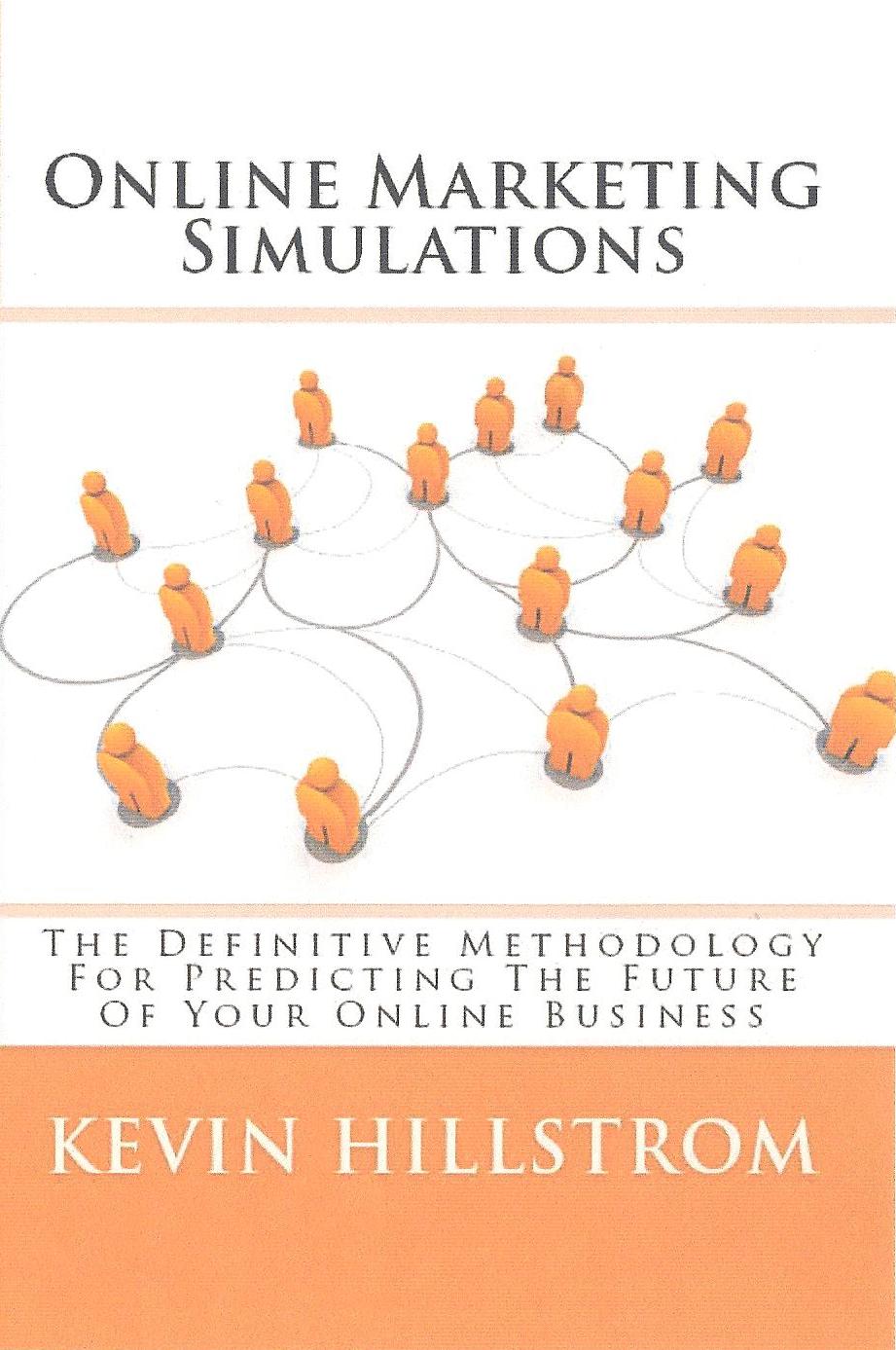
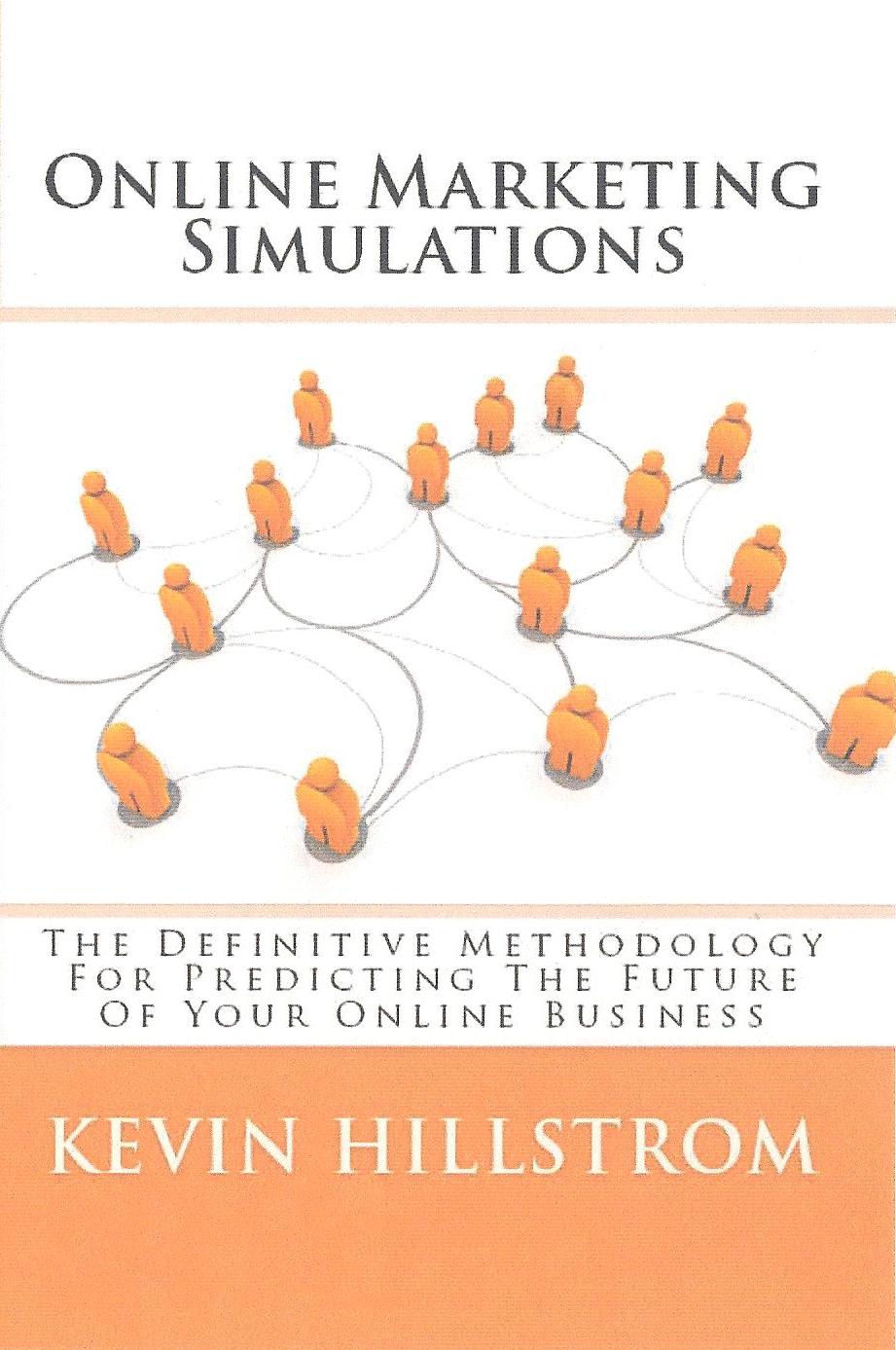
Click here to purchase my new book, Online Marketing Simulations. The book is being pre-released via my publishing platform --- so if you are dying to have the book, you can buy it today via Createspace for the same $19.95 fee that you'll be able to purchase it for on Amazon.com in two weeks, plus a shipping/handling fee.

Because you are a loyal blog reader, you get access to the content two weeks before the general public!

About fifteen years of intense customer research have gone into the creation of this industry-leading methodology.

This handbook walks you through an e-commerce online marketing simulation. You'll get to explore the ways that customers of different levels of quality, merchandise preference, and online advertising micro-channels (Affiliates, Offline Ads, E-Mail, Social Media, Print Ads, Search, No Attributed Source) all interact with each other. You will clearly see the "MVP", or "Most Valuable Path" that a customer takes as the customer migrates from first purchase to loyal shopper.

Most important, you will learn how to optimize your online business for long-term success. Current web analytics software applications fail to provide you with a five year sales forecast by advertising micro-channel / merchandise division. The Online Marketing Simulation allows you to play "what-if" games, identifying the optimal strategy for long-term success.

And if you don't think you'll be in your job 24 months from now, then Online Marketing Simulations allow you to optimize your business for the next twelve months, so that you can earn a nice bonus!

Here's what you get when you purchase this book. There are plenty of geeky details, and plenty of high-level strategy appropriate for a CEO, CMO, or CFO.

  • 106 pages of examples that illustrate how to execute Online Marketing Simulations.
  • A companion spreadsheet to work through examples and use in your projects.
  • 51 examples and accompanying tables.
  • More than 50 pages of programming code, so that you can populate your own spreadsheet.
  • 162 pages, total.

Who should buy this book?

  • CEOs looking to predict where e-commerce sales are headed over the next five years.
  • CMOs trying to allocate marketing dollars across advertising channels.
  • Vendors looking to add important functionality to their software suite.
  • Online Marketing Executives trying to demonstrate the value of each advertising channel.
  • Web Analytics Experts, especially those looking to obtain skills necessary to analyze the entire business, not just the online channel.
  • Business Intelligence mavens with an interest in simulating future activity.

I'm so excited that it is finally available!!!!!!! Help spread the word!

Coremetrics Offer Exclusively For Omniture Users

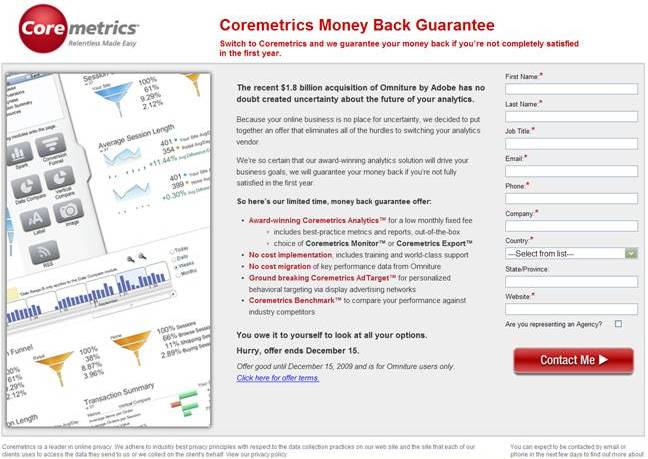
Coremetrics and Omniture are leading web analytics providers. Omniture was recently acquired by Adobe, creating quite a buzz in the business intelligence and web analytics arena.

Today, I received the following offer from Coremetrics and Chief Marketer. Here is a link to the offer in the e-mail message. You can click on the image above to see the offer as well.

Since you are all marketers or analytics experts, think about how you would answer the following questions, as they relate to your business.

Question #1: Chief Marketer did not rent my e-mail address, sending the message on behalf of Coremetrics because of a previous opt-in / opt-out preference of mine. Is this an e-mail marketing strategy that is appropriate for your business? Describe why it is or is not appropriate.

Question #2: I am not an Omniture customer. The offer in the e-mail marketing message only applies to Omniture customers. In your opinion, what benefits are obtained by the recipient in an instance where the offer cannot be redeemed by the recipient?

October 25, 2009

Dear Catalog CEOs: Much Smaller Catalogs

Dear Catalog CEOs,

Some of you ask me to do a unique analysis, one I call a "filtering" analysis.

Others might refer to this analysis "segmentation" or "persona development". The objective, honestly, is the same.

And for catalogers, it has never been more important.

I'm not talking about traditional RFM segmentation. Instead, I am talking about creating a series of "strategic segments", segments with unique characteristics.

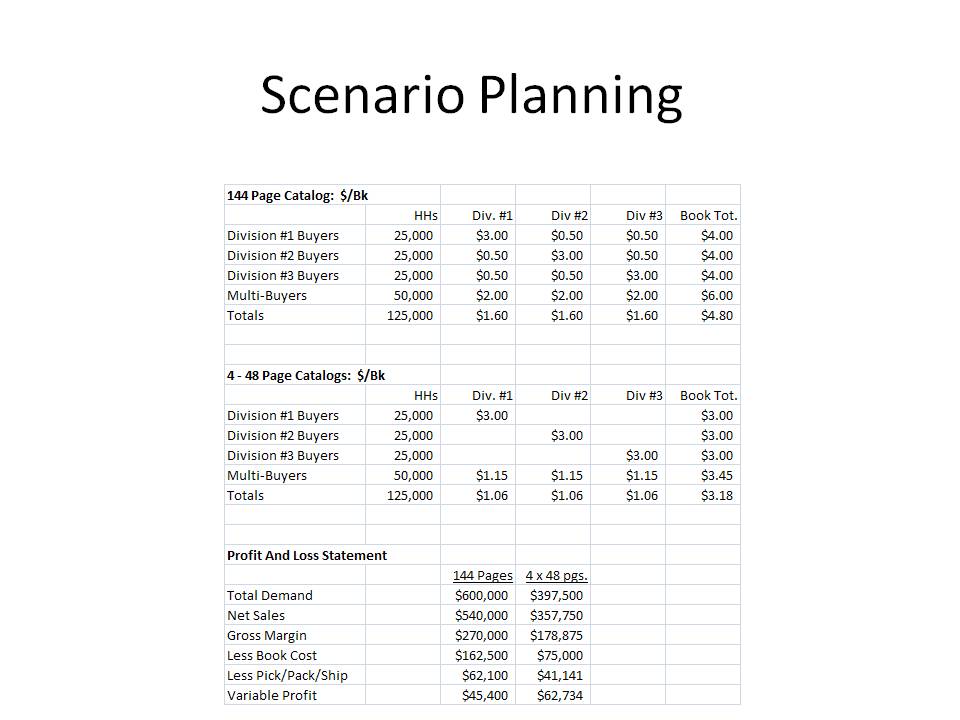
In the example I have here (click to enlarge the image), there are three merchandise divisions. This catalog company sends a 144 page catalog to each customer, with equal page counts attributed to each merchandise division. In this case, about 60% of the customer file only buys from one merchandise division.

So instead of sending a 144 page general merchandise catalog, let's create four small versions. Each version has 48 pages instead of 144. Version #1 only has merchandise from division #1. Version #2 only has merchandise from division #2. Version #3 only has merchandise from division #3. Version #4 is small, and has a sampling of each merchandise division for customers who buy from multiple merchandise divisions.

We target each smaller version to the audience that enjoys it. Your job is to create each 48 page version just like you normally would.

Take a look at the profit and loss statement in the image above. Clearly, customers spend less because they are receiving fewer pages. But even if the smaller catalogs cost $0.60 each (vs. $1.30 each for a large catalog in the example), it is more profitable to send the four smaller versions, one version per customer, than to send the general catalog to each customer.

Honestly, it is easier to send the general catalog to each customer. It will always be easier. The inertia within your organization will demand the easier solution.

But we're in a position where profit dollars are what are needed, right?

So when you're looking for new strategies for the second half of 2010, give this strategy a try, as a test, and see what happens!

Thanks,
Kevin

October 22, 2009

Gliebers Dresses: A Panel Discussion

This week, we take a peek at a panel discussion at a popular direct marketing conference. The panel discussion is hosted by Chip Cayman, a popular industry marketing consultant. The room is filled with maybe 300 online and catalog marketers. Here we go.


Chip Cayman (Moderator, A Popular Industry Marketing Consultant): "Welcome everybody to the 10:25am session titled 'Best Practices in Customer Engagement'. Today we have four industry experts who will offer bold insights into the future of customer relationships. First up, we have Glenn Glieber, Owner of Gliebers Dresses, a New England based purveyor of fashion apparel. Next, we have Dolly Pickens, CEO of Zuppie, a customer evangelism consultancy. To Dolly's left we have Greg Markham, Online Marketing Director at Boosky.com, and finally, we have Sarah Wheldon, Chief Marketing Officer at Anna Carter, a fashion dress brand. Ok, let's get started. Dolly, the first question is for you. How has the consumer changed over the past two years?"

Dolly Pickens (CEO of Zuppie): "Great question, Chip. The customer has literally been transformed. You all remember how Motrin angered their audience, right? Well, 'Motrin Moms', as they were known, fought back using social media. The repercussions reverberated through the Executive team at Motrin. Brands simply have to understand that an engaged customer is a loyal customer. I like to look at what Booksy.com is doing, they are using social media to foster deep relationships with brand advocates. And then you factor in the economy. Families are hurting. Brands that foster deep relationships will have a competitive advantage for decades to come."

Chip Cayman: "Glenn, how about you? How has your customer changed?"

Glenn Glieber (Owner, Gliebers Dresses): "Like everybody else, we saw a spending sea change happen last fall. This is the 'new normal', as I like to call it. We responded by re-vamping our catalog contact strategy, and by adding a new loyalty program --- buy four dresses, and get free shipping for the rest of the year."

Chip Cayman: "Fascinating. Greg, how does Boosky.com respond to changes in customer behavior?"

Greg Markham (Online Marketing Director, Boosky.com): "We really focus on the customer experience. We did a multivariate test, comparing Microsoft Sans Serif to Verdana to Times New Roman as the preferred font on our homepage, and found that Verdana increased conversion rates by 8.4%. We're always looking for ways to leverage improvements in campaign response."
Chip Cayman: "Did you catch that one, folks? Write that down. Verdana improved conversion rates by 8.4%. Your conference fees have already been reimbursed with that tidbit alone! Ok, Sarah, how has Anna Carter responded to changes in customer behavior?"

Sarah Wheldon (Chief Marketing Officer, Anna Carter): "First of all, Chip, thanks for asking me to be on this panel! As you may already know, we are discontinuing our catalog marketing program on January 1, 2010. We have found that catalog mailings are bad for the planet, and we learned that prospects don't want their mailboxes spammed with catalogs they didn't ask to receive. We received a lot of feedback via social media, and we learned that customers hate to have their names rented to other companies. So we're going in a different direction. We listened to our customers, and going forward, we will provide them with the best possible online shopping experience."

Dolly Pickens: "Sarah, are you saying that catalog companies actually rent names and addresses? That's a terrible customer experience, terrible. For shame, catalogers. You rape the planet with your misguided use of old growth forests, and you violate consumer rights by forcing them to receive catalogs in the mail. My goodness. No wonder the catalog industry is fighting for survival."

Sarah Wheldon: "Yes Dolly, catalogers have actively practiced list rental strategies for decades."

Dolly Pickens: "Glenn, is that something you do?"

Glenn Glieber: "I think the broader question we're asking is, how do you get your brand out in front of a million or two million prospects if you don't rent names from your competitors? Does anybody on the panel have any solutions to this issue?"

Dolly Pickens: "Oh Glenn. Look at what Boosky.com does. They use social media to advocate on behalf of their brand, they use paid search to acquire new customers, and they have maybe the biggest affiliate marketing program on the planet, second only to Amazon. You don't need to rent 2,000,000 names every month if you create a great customer experience."

Glenn Glieber: "Greg, how exactly do you get your brand out in front of several million prospects, over and over and over again?"

Dolly Pickens: "I can take that one. Greg's team partnered with my team on a social media brand advocacy campaign that increased Twitter followers by 32%. And then Boosky.com created an iPhone app that resulted in 1.4% of total net sales coming from mobile marketing programs."

Chip Cayman: "WOW! Did you get that one, folks? Boosky.com leveraged a social media brand advocacy campaign that increased Twitter followers by 32%. And now a significant minority of sales are being generated by mobile marketing. That's fantastic!"

Glenn Glieber: "But how many Twitter followers did you have, before and after the program?"

Dolly Pickens: "I'll take that one. I think Boosky.com had 20,000 before the program, and about 26,400 after."

Greg Markham: "And during the campaign, the conversion rate from customers coming from Twitter improved from 9.3% to 9.8%."

Chip Cayman: "OUTSTANDING! Did you write that one down, folks? By using a social media brand advocacy strategy, Boosky.com improved the conversion rate of Twitter followers from 9.3% to 9.8%. You guys are really leveraging new media to improve brand relevancy, aren't you?"

Dolly Pickens: "Well, it is all about being there for the customer during these trying economic times, isn't it?"

Sarah Wheldon: "That's so true, isn't it, Dolly? I mean, you want to provide a great experience for the customer, like we do at Anna Carter. We don't use promotional gimmicks, and starting January 1, we're not going to spam the customer with unwanted catalogs anymore. We will treat our customer with honesty and integrity. You won't see any phony loyalty programs from Anna Carter. We trust that if we treat the customer right, we will be paid back down the road."

Glenn Glieber: "Let me ask a question. Sarah, how do you plan on making up for the sales you will lose when you stop mailing catalogs to customers?"

Dolly Pickens: "Who cares? I'll bet Anna Carter, with such a strong brand name, has loyal customers who will keep shopping. I'd support a forward thinking brand like Anna Carter. And the positive buzz around the brand should more than make up for the loss in sales."

Glenn Glieber: "But that's not a real answer. I want a real answer. Sarah, would you be willing to share with this audience how you plan on recouping the sales that you will lose when you stop mailing catalogs? And what about all of the employees who supported catalog marketing for decades? Will they even have a job? Do you have any loyalty to those individuals, the very folks who helped make your brand what it is?"

Greg Markham: "At Boosky.com, we found that global website conversion increased from 6.13% to 6.34% when we downsized customer service reps, and replaced them with information technology experts who could improve the performance of the website. So maybe Anna Carter will also go through a similar transition."

Chip Cayman: "AMAZING! Did you get that one, folks? Website conversion at Boosky.com improved from 6.13% to 6.34% by transitioning staff from a customer service model to one where the information technology team is better staffed. Folks, write these things down, what we're learning here is important."

Glenn Glieber: "Sarah, I still don't have an answer to my question. I'm going to guess that you will lose $50,000,000 in sales by not having a catalog. How will you meet merchandise/inventory minimums with such a sales loss? Will you generate enough profit to cover your fixed costs? What are you going to do to recoup the sales you lose, send more e-mail campaigns, that won't work. And you can never spend enough money in search to reach a critical mass that enables your business to thrive. So, Sarah, would you be willing to answer my question?"

Greg Markham: "At Boosky.com, we learned that using the phrase 'Trust Us' in paid search copy caused paid search conversion rates to improve from 5.44% to 5.62%, and increased traffic from clicks by 37%."

Dolly Pickens: "See you don't need to rent names to have success. Use technology, and real, genuine, authentic customer relationships. The rest will take care of itself."

Chip Cayman: "You folks at Boosky.com are just amazing!"

Glenn Glieber: "Does anybody in the audience want to see my question answered by Ms. Wheldon?"

Sarah Wheldon: "Glenn, you know I cannot publicly answer that question, that's proprietary knowledge. But rest assured, we've analyzed the issue thoroughly, we understand the consequences, and we believe the knowledge we've gained gives us a competitive advantage over other dress purveyors."

Dolly Pickens: "And you won't be violating customer rights like you do when you rent names. That's what really matters, here."

Glenn Glieber: "What really matters here is how you create traffic and interest. Anna Carter is essentially eliminating the primary vehicle for creating traffic and interest."

Sarah Wheldon: "That's wrong, our primary vehicle for creating traffic and interest is our website. Glenn, you go ahead and keep generating traffic and interest with your catalogs. You spend the money to rent a name and to put a catalog in the hand of the prospect. The prospect goes to Google, does a search, and because we at Anna Carter execute online marketing well, we'll intercept the demand you generate. That's one way to make up sales, and quite honestly, I'm thankful there are other marketers out there willing to use offline marketing to create demand that I can intercept and convert on my website. You represent free marketing for my business."

Glenn Glieber: "I love free marketing! But what you just said sounds unethical."

Sarah Wheldon: "It's not unethical. It's competitive. You spend money on offline marketing. You create demand. The liberated customer that Dolly celebrates goes to Google, and Google does the damage ... Google decides the websites that the customer sees, not me. If you have an issue, take up your issue with Google. In the meantime, I am going to intercept your customers via Google, and re-direct their demand from Gliebers Dresses to Anna Carter. Keep mailing catalogs, Glenn! We at Anna Carter applaud your efforts!"

(the audience roars with laughter).

Dolly Pickens: "This is exactly why you must have a personal, authentic, warm, one-to-one relationship with every customer. If you are Gliebers Dresses, you don't want your customers to go to Google and then be re-directed to Anna Carter. I'd be worrying about that, Glenn, I really would. Google will doom you."

Glenn Glieber: "Do you know what I worry about when I wake up in the morning? I worry about how to keep 250 people employed. I know every one of my 250 employees, by name. I know their kids. I know that my catalog sent kids to college, in fact, my scholarships paid for the education of close to 100 students. I know that my catalog created Doctors, and Lawyers, and County Clerks, and Electricians. My business generated a profit in 39 out of 42 years. I know that my catalog was successful enough to pay close to $12,000,000 in federal taxes. The federal tax contributions, caused by outstanding production on behalf of my employees protect third-party opt-out services like Catalog Select, businesses structured as .org's from paying any taxes, funding their ability to publicly bash me and my business practices. I can look at I-93 and realize that my employees and I paid for the concrete that allows people to go up to Lake Winnipesaukee for an extended vacation."

Chip Cayman: "Ok, Glenn, why don't we ..."

Glenn Glieber: "What I don't understand is the lack of respect, folks. Look at this panel today. I thought we were here to talk about best practices in customer engagement. Instead, we have panelists who decide to criticize me and my business model. When did that become acceptable? Dolly, you talk about being a customer advocate. And yet, you criticize Motrin, you did it here again today, and in my hand I have the output from every blog article and tweet that you ever wrote about Motrin, because Google remembers, Dolly. If you say enough bad things, Google will doom you, too. It is so easy to criticize people when they aren't standing in front of you, when they cannot defend themselves. By criticizing Motrin, you violate your own social media best practices. Why would Motrin ever want to hire you? Isn't Motrin a potential customer of yours? You offended your own potential customer. Do you think I would ever hire you? Why would I ever hire somebody who purposely criticizes others in an effort to build their own brand portfolio? If that is what social media and customer advocacy is all about, I don't want to have anything to do with it. I'd rather stick to my old fashioned business model, one that truly cares about customers, one that puts kids through college, gives men and women the money to make a living or to lift themselves from the lower class to the middle class, one that gives Ms. Wheldon the opportunty to have a different viewpoint than mine. Dolly, have you ever been in your distribution center? Have you ever watched 55 employees working hard at 2:00am on December 22, just so you can get a package delivered to your home on the 24th? I'd rather sink with those people than swim with those who have a platform to criticize the rest of us. I'd rather sink with those people than use Google as a weapon to destroy my competition. Maybe that will result in the death of my business. But at least I'll be able to sleep at night."

Greg Markham: "We learned that customers who visit our site from competing websites have conversion rates that are 27% greater than the average customer."

Chip Cayman: "We're going to have to end our panel discussion right there, with yet another amazing tidbit courtesy of Greg Markham at Boosky.com. Panelists, thank you for your time, I sincerely appreciate all of your points of view. Next up is the 11:05am session, titled 'Twenty-Nine Reasons Why E-Mail Marketing Will Still Be Relevant In 2029."

October 21, 2009

OMS: Compound Interest

Please send me an e-mail message if you'd like a copy of the spreadsheet to follow along with.

Old-school direct marketers like to explore the concept of Lifetime Value.

In online marketing, however, the focus is generally on conversion rate, on getting customers to purchase something today, now!

So go ahead and obtain every single conversion you can. You can't argue that it generates sales today!

Now that you have a bunch of new customers, let's try something. Enter "0.00" in cells D6 - G6. Then enter "0.00" in cells B101 - B340. In this situation, you are acquiring new customers in year one, and then you're following them (and only them) for the next four years.

What did you learn?

Well, these customers generated $13.3 million in the year you acquired the customer.

But now take a look at the compound interest you earned ... $6.7 million in year two, $5.9 million in year three, $4.8 million in year four, and $3.9 million in year five.

You could roll this out into infinity if you wanted to.

In the subsequent four years, these customers generated $21.3 million.

Customers acquired in one year don't act like compound interest. But when you keep acquiring new customers, year after year after year, the result is like compound interest.

You think about your conversion activities differently when you realize that the customers you acquire today will spend 1.6 times as much over the next four years. By balancing short-term and long-term profit, you optimize your online business for long-term success.

October 20, 2009

This Week In Business: Integration

There are two directions that the world is heading in.

The first direction is being taken by the customer. Twenty years ago, she was one of a million similar customers. Today, she is going in a million different directions, using search and mobile and traditional media and social media to do whatever she wants, whenever she wants.

The second direction is being taken by the vendor community. The vendor community is telling us that we need to take a million customers moving in a million different directions, and herd them in a brand-friendly direction with integrated data from all sources.

This message is coming from a lot of different disciplines, and the message is typically prescribed to us when a disruptive technology displaces an incumbant technology. Long-time blog readers know that the catalog industry went through this in the first half of the decade, as e-commerce displaced catalog marketing.

Now we see e-mail being displaced by social media, we see Web Analytics and Business Intelligence racing to the middle ground of multichannel database support and analytics, and we see online folks promoting mobile marketing as part of an integrated e-commerce strategy.

In 2015, e-commerce gurus will tell us how e-commerce is a vital part of a multichannel hologram marketing strategy. It's simply the way that humans deal with technological transformation.

The challenge, of course, is to go beyond the message.


We need to find a middle ground, one of data integration and customer understanding, one that does not necessarily support campaign integration that does not yield increased profit or increased annual retention rates.


Of course, knowledge about integrated data existed since the days of Snedecor and Cochrane, if not earlier. Statisticians have always used a measure called "R-Squared" to explain how much of the variability in a dataset is explained by different combinations of variables.

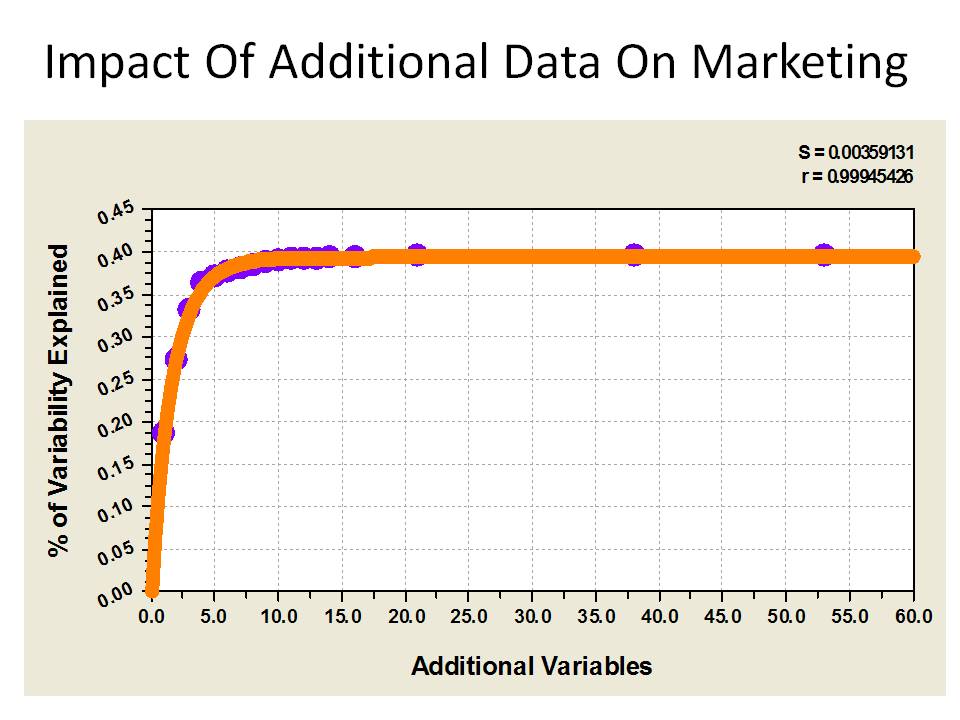
The graph at the top of this post is the result of a model that ranks customers from best to worst, based on integrated data across channels. The x-axis represents each variable added to the model, the y-axis represents the percentage of variability explained by the variables in the model. This model was built off of actual multi-channel customer data.

Notice that when you add the first piece of data, you make a huge leap. Then you add a second piece of data, and you make a smaller leap.

After adding the fifth piece of data (i.e. channel), you stop making significant improvements. In other words, you're just as well off with five pieces of customer information as you are with fifty pieces of customer information. This concept is known as "parsimony", or "less is better".

This is the piece of the puzzle that isn't always explained.

The reality is that, by having a few key data points from each channel, you get 98% of the benefit from 10% of the work.

Focus on getting a few key data points from each of your channels, and focus on how your organization can make decisions on a small number of customer attributes. You'll find it is a lot harder to get people to work together than it is to integrate data ... and you'll find that nobody has a solution for getting people to work together!

October 19, 2009

The New OMS Book: One Week Away!

We're closing in on the release of my new book on OMS, aptly titled 'Online Marketing Simulations'!

This book is written for CEOs, CMOs, Online Marketing Directors, Online Marketing Managers, and Web Analytics Experts looking to understand how to optimize the long-term health of a business.

This book is paired with a companion spreadsheet (the url for the spreadsheet is listed in the book). The spreadsheet outlines an online business with the following advertising micro-channels:
  • Affiliates.
  • Offline Advertisements.
  • E-Mail Campaigns.
  • Social Media.
  • Print Ads.
  • Search.
  • No Attributed Source.

The spreadsheet also contains five merchandise divisions. Think of these as being similar to the tabs running across the top of an e-commerce website. In total, there are five customer grades (A, B, C, D, and F) with eight online advertising micro-channels (all channels + multiple channels) and six merchandising divisions (five + multiple merchandise divisions) yielding 240 segment combinations.

Most important, you will get to see how you can identify a "MVP", or "Most Valuable Path", the route that customers take from acquisition to loyalty. It is my opinion that identification of the "MVP" is more important to the long-term health of your business than is optimization of conversion rate.

The book walks you through an analysis of a business, helping you understand what steps you can take to make sure that, in five years, your business is growing at the rate you want for it to grow. If you are a CEO or CMO, you need to know how your actions impact the future of your business.

If you are an SPSS/SAS programmer, or you use another programming language, then you'll appreciate the 50+ pages of programming code in the appendix. With this information and the spreadsheet, you will be able to create your own Online Marketing Simulation.

I am self-publishing this book via Amazon, and am offering the book at a reasonable $19.95 price point. The book is clean and simple, no fancy colors or fonts or graphics, it simply offers a soup-to-nuts approach to conducting an Online Marketing Simulation.

I sincerely believe that Online Marketing Simulations should be part of any web analytics software package. After you purchase the book (or read the posts on this blog), if you feel the same way, let our web analytics software provider know that you want to see Online Marketing Simulations incorporated in their software offering.

OMS projects and Multichannel Forensics work will be the focus of my consulting work over the course of the next year --- these are things that CEOs are asking me to do for them. So give the book a chance when it becomes available next week!

Content Creation

Here's the link . I realize many of you are stymied by creating content for your customers. Some of you would say the video above is poi...