July 31, 2019

Making Small Page Counts Work

In the simulation from the start of the week, we noticed that more pages per contact was more profitable than fewer pages per contact.

This is where merchandise personalization comes into play.

When crafting a 32 page catalog, you dynamically insert merchandise that aligns with what the customer previously purchased. This causes the 32 page catalog to perform 20% to 30% better, and as a consequence it changes the math in the simulation. The math then favors small page counts. And you want small page counts, because you'll contact the customer more often. CONTACTS > PAGES.

This is why the future is all about dynamic content populating frequent/small contacts.

Your printer loves this.

Your favorite catalog agency loves this.

And you'll love this, because you're going to invent something new and interesting within the catalog industry.

I'm not aware of a lot of circumstances that benefit printers, agencies, and you.

Run your Optimal Mailing Strategy Simulation, see what it tells you, and then move in a new and interesting direction.

You can do this!!!!

July 29, 2019

What Does An OMSS Show For Great Customers With High Organic Percentages?

When a great customer has moved on from catalog marketing, the optimal contact strategy changes ... significantly!!

In this example, the brand is mailing a dozen 80 page catalogs to the great customer who is no longer a shopper due to catalog marketing.

And that, dear readers, is a mistake.

The brand should mail this customer six 32 page catalogs, or three 80 page catalogs (not 12), or two 160 page catalogs.

This is how the world has changed ... this is Bifurcation in action.
  • Great Catalog Customer = 1,800ish pages per year.
  • Great Brand Customer = 240ish pages per year.
  • Current Strategy = 960ish pages per year.
It's time to change strategy, isn't it?

It's time to start thinking about the future.

July 28, 2019

What Are The Simulations Showing?

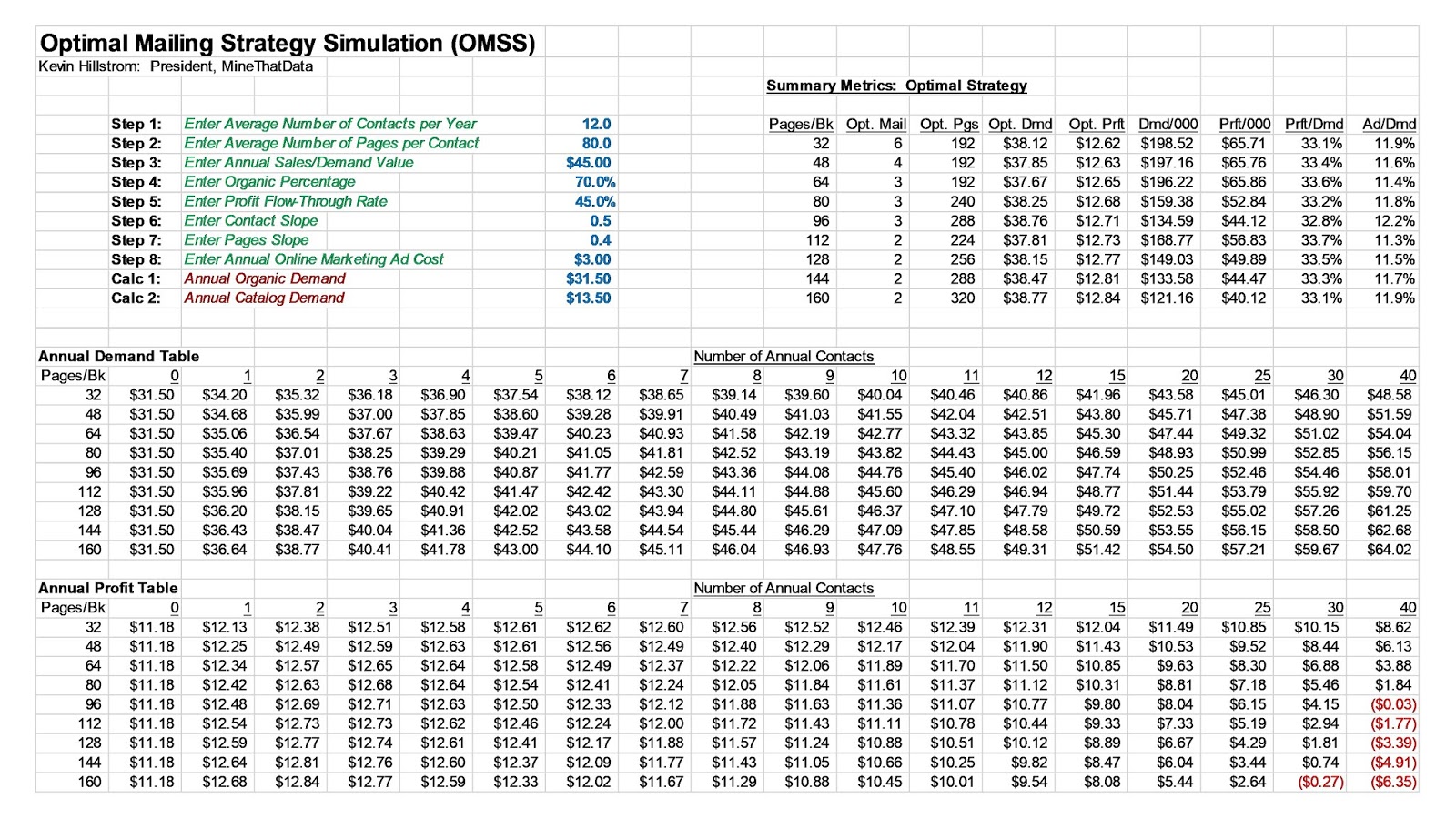
This table illustrates the results of an Optimal Mailing Strategy Simulation (OMSS).

We enter customer metrics in the upper left portion of the simulation, and the spreadsheet calculates the optimal strategy at each page count.

The results are summarized in the upper right portion of the table. Go ahead, click on the table and take a peek, I'll wait for you, ok?

Welcome back!

This simulation demonstrates what happens when you figure out the optimal strategy for a customer that is responsive to catalogs (organic percentage = 20%). Look at the summary portion of the table. The customer could receive 40 contacts at 32 pages each, or the customer could receive 15 contacts at 160 pages each. Neither solution is being employed by this brand (12 contacts at 80 pages each). The best customer can be mailed MORE often. Yes, MORE often. Either more pages, or more contacts.

And in this case, more pages results in more profit because ad costs are steep at 32 pages and are efficient at higher page counts. Your mileage will vary ... CONSIDERABLY!!!!!

But the result of the simulation is MORE ... across the board.

This is the story that simulations repeatedly demonstrate across my project work.

Ask your favorite vendor to produce Optimal Mailing Strategy Simulations (OMSS) for you. They're smart people, and they can easily assemble the simulations at your request. Or ask me and I'll do it ... either way, you win, and if you ask your favorite vendor to do it they win. Or build it in-house ... challenge your analyst to do something fun!!!

Regardless, you need to produce Optimal Mailing Strategy Simulations (OMSS).

July 24, 2019

Frequency > Pages

One of the outcomes of a catalog simulation environment is this ...

... Four 32 Page Contacts > One 96 Page Contact.

In the future, you'll have many more contacts for the shrinking portion of the file that is still catalog-centric. 

These customers will generate more response by receiving many small page count mailings than fewer large page count mailings. Your simulations will verify this finding.

Same thing with infrequent non-catalog buyers ... why mail them once a year at 96 pages when you could mail them four times a year at 32 pages each??

And you'll stuff those 32 page mailings full of two things.
  1. The merchandise the customer prefers.
  2. Winning items.
Frequency > Pages. All of these trends are coming to a catalog marketer near you. Get ready for the future, ok?


July 22, 2019

Your Agency Should Be Able To Help You

Most of the time, you want your vendor partners to help you with circulation decisions. 80% of my work used to be in this realm. But now you love working with your existing catalog marketing agency. I know this because y'all tell me you have your favorites.

Well, your favorite catalog marketing agency should easily be able to produce a simulation environment for you that tells you, for every single customer on your customer file, how many mailings a customer should receive annually and how many pages each catalog should be comprised of.

It's so easy to do this.

You use the following:
  1. Your Organic Percentage, by Customer.
  2. Your Frequency Testing Results - Obtain Your Elasticity Curve And Give It To Your Favorite Agency.
  3. Your Page Count Analytics And/Or Testing - Obtain Your Elasticity Curve And Give It To Your Favorite Agency.
With these three pieces, your agency can easily create a simulation for you, by customer, showing the optimal strategy. Here's a classic example of one of my simple simulations.


Go to your favorite catalog agency RIGHT NOW (Cohere One or Belardi/Wong come to mind) and ask them to put the simulation environment together for you. They're fully capable of doing this, and the outcome is going to give them and your printer a lot more business to manage.

Your sales increase. Their sales increase. What's not to like?

Go to them right now and ask them to create the simulation environment for you.

Right now!

July 21, 2019

It's Coming

In my catalog-centric presentations this year, there is one theme that, when shared, leaves folks flummoxed.

The theme is "bifurcation". In catalog marketing, it's the splitting of the file into two pieces ... one (old school catalog buyer) requires +/- 40 catalogs per year. The other, and much larger fraction of the file, is the "brand buyer" ... they buy because they like your merchandise and they couldn't care less about your catalog. These customers need three catalogs a year.

Did you digest what I said?

  • Your catalog-centric portion of the file is shrinking, and as it shrinks it needs more mailings.
  • Your brand-centric portion of the file is growing, and as it grows it needs fewer mailings.
It's the "40 catalogs" message that leaves folks flummoxed.

They can't conceive a world with 40 contacts. The questions/comments reflect their thoughts.
  • "Could I go from 18 to 19 mailings by adding a remail?"
  • "We don't have the kind of creative team that can put 40 catalogs a year together, so we're not going to pursue such an odd idea."
  • "We can't forecast inventory properly if we have to dynamically merchandise and personalize catalogs to get to 40 per year."
You can't afford NOT to get to 40 per year for your best customers. And these are going to be small mailings, with a personalized merchandise assortment based on prior buying behavior.

Bifurcation is here, and the future is coming. It's time to start thinking about how you adapt to bifurcation.

July 17, 2019

The Problem With Retail

We've got three types of traffic in retail.

  1. EARNED:  This is traffic we earn, via customer loyalty or word-of-mouth or free uses of social media or email marketing.  We somewhat control this via our successes or failures.
  2. PAID:  This is traffic we pay for. Google, Facebook, Display Ads, TV Ads, Billboards, Radio, and countless other channels/tactics. We control this source of marketing via our marketing budget. The traffic flow generally is generally variable, following some form of a a^x function, where "a" is the marketing investment and "x" is the efficiency slope of marketing success.
  3. SHARED:  This is traffic we share with our peers. It's the traffic that Macy's brings into a mall, traffic that buys an old-school Bose Wave Radio. If Macy's closes or loses traffic, Bose loses business. That's bad for Bose.
The secret to fixing retail is understanding how much of your sales come from EARNED, PAID, and SHARED sources.

Let's say that you are a brilliant synergistic customer experience channel-less frictionless marketer. This area of marketing generally falls under the EARNED banner. If you do a great job, you increase your EARNED traffic.

Pretend that your traffic comes from the following sources:
  • EARNED = 30%.
  • PAID = 20%.
  • SHARED = 50%.
Now pretend that your synergistic customer experience channel-less frictionless entertainment-centric strategy results in a 10% increase in EARNED traffic (that would be really, really awesome ... and really, really hard to do).

And let's say that you boost PAID traffic by 5% via a 10% increase in marketing spend.

Finally, let's say that your SHARED traffic drops by 17% because all of your peers in your mall-based stores are not doing well.

Next Year's Traffic = 0.30*1.10 + 0.20*1.05 + 0.50*0.83 = 0.955.

You worked terribly hard to grow what you control by 10% and your total traffic drops by at least 4%.

Now you know what needs to be solved.

To be successful in retail, you have to come up with a solution for the SHARED traffic problem.

SHARED traffic will continue to be a challenge, so retailers have no choice but to increase EARNED/PAID traffic faster than SHARED traffic decreases. The problem, of course, is that if you spend money to grow EARNED/PAID traffic you de-leverage the p&l. If you don't spend money, traffic decreases and sales decrease as well.

In other words, retailers have to become really CREATIVE. That's going to be one of the key ways that we get through the SHARED traffic problem.

If your favorite retail guru doesn't have a plan for the following equation, your retail guru has some work to do:
  • x*EARNED + y*PAID > z*SHARED

The Ecommerce Middle Class

Not "middle class" in terms of income. "Middle Class" in terms of value to a client of mine. If we go back twenty years,...