December 08, 2015

Graduating To New Competition

That's Joey Chestnut. Every July 4, for eight years, he won the Nathans Hot Dog Eating Contest. And then, in 2015, new competition arrived. Matt "Megatoad" Stonie ate 62 hot dogs.

"Megatoad" won.

We like to think that Amazon is our "Megatoad". 

Amazon is not our "Megatoad". They (Amazon) have been lying there, in plain sight, for twenty years. Twenty years!!!! They won nearly a decade years ago. That battle is over. We cannot stop 40% of customers from beginning product searches on Amazon, and we cannot stop most of the rest of the prospect audience from beginning their product search on Google. 

Can I show you something?

We ordered a new dining room table. The first table arrived, damaged. Eight weeks lost. We sent the table back. Here's how the second table looked upon arrival:


Imagine what happens when you screw the leg in to that bolt? You have a leg that rests at a 17 degree angle!

Fortunately, we didn't have a leg that rested at a 17 degree angle. Do you know why? Because the legs were missing! 

Another eight weeks of waiting.

Say you purchase a table via an omnichannel strategy at Pottery Barn. Is the table going to look like this table? Highly unlikely. They've got their stuff put together (#pun), they know how to execute.

And yet, I chose this brand over Pottery Barn (because of merchandise selection - hint hint). 

Honestly, how hard can it be for Pottery Barn to run this company into bankruptcy? This company is growing 5x faster than Pottery Barn, at a time when Pottery Barn should stamp it out of existence.

Pottery Barn cannot run this company out of business by integrating channels.

We've graduated to new competition. In case you haven't noticed, online brands are moving offline at epic rates ... you were told you had to be digital, but while you worked on being digital, digital brands quietly moved offline. They execute creative marketing strategies, and creative means "clever" in this instance. When we moved into the digital realm, we didn't do anything clever. We stuck a bent bolt into a faulty table and called it good.

It's time to get creative.

December 07, 2015

Lands' End

Click here to go to the page that outlines financial filings ... read the 10-Q published on December 3, 2015.

Then, take a sad nap.
  • Creative changes.
  • Merchandise productivity declines.
  • Reduced circulation.
  • Reduced promotional activity.
  • Reduced sales.
  • Reduced profit.
It's hard to convert a Mercury Topaz into a Lincoln MKZ while the car is moving at 70mph on US 18 / US 151.

Team Chemistry

My hypothesis on how business works continually evolves, as should yours.

It is obvious that Merchandise Productivity is critically important. We all know this to be true. You won't read about the topic anywhere, because it is hard for vendors to make money selling solutions when your business is working better because customers like your merchandise.

It is obvious that companies that do not have to pay for advertising to generate orders outperform those who must advertise to generate orders. Macy's spends $1.6 billion a year on advertising. When I worked at Nordstrom, we spent less than $0.2 billion. Needless to say, Nordstrom prints money, Macy's doesn't. The secret to any successful business is to find ways to get customers to love merchandise without having to advertise.

An ongoing theme on this blog is Customer Acquisition. It's the story of 2016-2020 ... and you agree, based on the fact that more than 4,200 views of my draft presentation in March have been generated (click here).

In the next week, you will learn about the importance of rapidly moving a customer from 1x to 2x to 3x+ status ... that's where a ton of profit volume is generated.

But when does anybody talk about teamwork/chemistry?

When I worked at Nordstrom, there was a staffer in the information technology department. This person didn't think much of the work my team did. This person acted like an in-house consultant, actively seeking project work outside of the typical information technology job description. This person was fully supported by the department head. Needless to say, my team did not respond kindly when they had to clean up the mess created by a person not equipped to do advanced analytical work. Worse, my team would chew me out ... "MAKE SURE THAT PERSON STOPS DOING OUR WORK, YOU ARE A VP, YOU SHOULD BE ABLE TO TAKE THAT PERSON OUT TO THE WOODSHED!" But there wasn't a thing I could do to stop this. If the individual and the department head wanted to constantly step into our swim lane, they were going to constantly step into our swim lane, period.

The result was terrible team chemistry. My team did not trust the information technology team. The information technology team clearly thought my team were comprised of a band of idiots. Few conversations happened outside of joint meetings. Nobody went out to lunch together. Nobody went out on Friday night together. In fact, on one lonely afternoon, one member of my team and one member of the information technology team nearly came to blows in my office - screaming unkind words at each other in my office.

I rarely run across a company that has great team chemistry. Here's what is common:

  • Analysts don't like other analysts.
  • Executives compete against each other for promotional and/or leadership opportunities.
  • Directors beat up other Directors.
  • Online folks think catalog folks are idiots.
  • Catalog folks disrespect online folks.
  • Retail folks have different work processes than online team members.
  • Merchants dislike marketers.
  • Finance leaders dislike marketers and creatives.
  • Creatives dislike marketers.
  • Information technology folks dislike marketers.
  • Marketers don't like bean counting financial leaders.
  • Operations staffers who feel like they can do every job better than the folks who do the actual work.
  • Inventory staffers who have contempt for merchandising, creative, and marketing, and vice versa!
I can think of one (1) company that I have worked, one company where team chemistry was high. One. Team chemistry starts at the top at this company. Employees are given disproportionate responsibility, given their experience levels. The end result is unfettered business success.

If you had to evaluate your company on a scale of 1-10, where 1 = employees who want to punch each other, and 10 = true team chemistry, what score would you give your company?

There are four key areas that my research suggests lead to business success.
  • Customer Acquisition Strategy.
  • Minimal Tolls (low ad-cost).
  • Merchandise Productivity.
  • Team Chemistry.

December 06, 2015

We Graduated! What Next?

Here's what the data indicates.

(1) For both catalogers and retail brands, the e-commerce experience was sub-optimal. This goes back to maybe 2007, +/-.

(2) We had to work hard to fix the e-commerce experience.

(3) Catalogers chose not to fix the e-commerce experience. Instead, catalogers aligned the website with the catalog (fixing the business #multichannel), and in doing so, cataloger websites fell far behind e-commerce websites. The catalog, fueled by co-op buyers, skewed old, and the merchandise offered in catalogs and online aligned with the 60 year old customer. Catalog consultancies will tell you that this is fine (while having cozy relationships with the very co-ops that send you old customers, so of course the merchandise and age of your customer is fine). It may be fine, if you have always catered to a 60 year old customer. It is not fine if your customer was 50 years old in 2005. There are consequences for being obedient to industry experts.

(4) Retailers chose to fix the e-commerce problem, and succeeded wildly. The online experience was so much better that in-store visits were skipped, resulting instead in online visits. Stores are closing, and foot traffic is down. Retail consultants will tell you that this is fine, as long as your mall is on the A-list or your customer shops at H&M (#innovate #disrupt). There are consequences for being obedient to industry experts.

The end result of (3) and (4) is comparable to graduating from obedience training. Both industries did what they were told to do by industry experts. Both parties were obedient. Both graduated to a land of tepid growth and comments like "can we fix this problem with social ads?"

What next?

You remember what it was like when you graduated from high school, and then spent your first year at college, right? It was a night-and-day difference. The competition was so much fiercer. You had far fewer people telling you what to do. Given the freedom to make your own decisions, you made your own decisions. Some decisions were good. Some not so good. But, overall, things worked out, or you wouldn't be reading this.

Catalogers graduated from multi-channel alignment - retailers graduated from omnichannel alignment. Now it is time to apply new skills to new problems. Your own, custom, tailor-made solutions. Merchandise/Entertainment. New Merchandise Low Cost Customer Acquisition. This is your future. Almost nobody is talking about this, because those who talk to you want you to take their Graduate program on retargeting or catalog circulation planning or social ads or responsive design. They can't make money when you focus on your merchandise, when you focus on entertaining your customer, or when you focus on low cost customer acquisition.

Our future is Entertainment, New Merchandise, and Low Cost Customer Acquisition. The latter is most important, and is dependent upon the first two topics.


December 03, 2015

Cyber Monday, Peak Desktop/Laptop, and Your Career

It's hard to know specifically what happened on Cyber Monday. Every number conflicts with another number. Every number is wrong. Every number is based on a small and biased sample of information.

So we have to make some assumptions. Most important, however, is to put context around information we see.

Let's make three assumptions, based on everything we've learned this week.

  1. Let's assume that Cyber Monday grew by 10%, this year vs. last year, to $3.1 billion.
  2. Let's assume that Mobile represented 30% of this year's sales total.
  3. Let's assume that Mobile grew by 50%.
You may disagree with the assumptions ... but your disagreements won't make much difference, when analyzing this table:


Regardless what assumptions you make, Desktop/Laptop demand is peaking ... and is on the verge of no longer growing.

Do you understand what this means?

Catalogers went through this, between 2001 - 2005. Phone (call center) demand stopped growing. Everything about how the business was managed changed.

The e-commerce folks are about to go through the same thing, between 2016 - 2020. Resources will go away from desktop/laptop - they'll move to mobile. Tactical approaches will change, a "mobile first" mindset will pervade meetings. This means that a different set of employees ... younger employees ... will be given much more responsibility. When this happens, those currently holding the keys (traditional e-commerce leaders) will seek to "integrate" processes, much in the way that old-school catalog pros tried to hold on to the business back in 2001 - 2005.

From 1986 - 1990, credit cards transformed how we shopped, and changed how direct-to-consumer businesses were managed.

From 2001 - 2005, e-commerce transformed how we shopped, changing how direct-to-consumer businesses were managed.

From 2016 - 2020, mobile will transform how we shop, changing how direct-to-consumer businesses will be managed.

In other words, there are generational changes that simply happen. We're about to enter a new phase, one that impacts a new generation of shoppers. This will lead to a new generation of professional leaders. It's about to begin.

Much is gained, and much is lost, when businesses transition to new channels.

Proactively manage your career now, so that you are not caught unprepared when change hits your organization.

December 02, 2015

Customer Acquisition Means Everything: ESPN

Let's look at cable/satellite television. You have ESPN. They pull in $6.00 +/- per customer per month from cable/satellite. Say that is $72 a year (I know, #math).

If you are ESPN, and you have 100,000,000 subscribers at $72 a year, you have $7.2 billion in revenue, each year.

So there are three ways to grow revenue from subscribers. First, you charge Comcast and DirecTV more when your carriage deals end. That gets you more money, right? Second, you have to "retain" your existing audience. It's quite possible that 5% of the audience churns per year ... reduce that, and you have something (which is, of course, impossible). Third, you have to find new customers ... new cable/satellite subscribers.

When you hear about young people cutting the cord, what you are really hearing about is a customer acquisition problem. Instead of spending $125 a month ($6 for ESPN), a 24 year old chooses less expensive options, especially those with better technology. ESPN does not get a new customer.

Now, computer guy up there ignores this fact in 2009 - 2013 ... computer guy just sees 100,000,000 subscribers at $5.50 each per month ... and then 100,000,000 subscribers at $6.00 each per month ... and then 100,000,000 subscribers at $6.50 per month. Then, expenses are planned against seven billion in annual revenue ... then eight billion in annual revenue. You spend more.

But customer acquisition eventually haunts you. Because younger folks don't subscribe to cable/satellite, ESPN doesn't get new customers. Because 5% of subscribers, +/- drop each year, ESPN doesn't retain everybody. Eventually, 100,000,000 subscribers becomes 92,000,000 subscribers. You either charge the remaining 92,000,000 subscribers more (and risk losing even more), or you find a way to be relevant to the 8,000,000 subscribers you would have had but no longer have ... how do you generate revenue from those folks?

Maybe you don't generate revenue from those folks. Then what?

Now you, sitting on the train reading this on the way to work, you can look at ESPN and you can see that long-term, they are doomed. When 92,000,000 subscribers becomes 80,000,000 subscribers in seven years, with fixed costs increasing, the business model implodes. It doesn't die, but it implodes and then fundamentally changes. You can see this. You can see the future. You are smart.

Now how about your business?

If you are a retailer, odds are you are like ESPN. ESPN got customers to pay (and pay more) for multiple TV channels and multiple physical channels (magazines, website, 538, Grantland, ESPN3) from 2009 to 2013. ESPN followed an "omnichannel" strategy, just like most retailers did. When omnichannel only appealed to existing customers did the strategy become a problem. The world changed. Retailers lost the battle to young customers ... to "cord cutters" if you will ... with "cord cutters" shifting to fast fashion and online brands and new retail concepts.

If you are a cataloger, odds are you are like ESPN, but you are 10 years down a path that ESPN is just 1 year down. You know exactly what happens. Your customer is 62 years old (for 75% to 80% of catalogers - those without kids/party/home products). For you, the "cord" was cut back in 2003-2004, back when Catalog Age became Multichannel Merchant.

Customer acquisition means everything. You are always going to lose customers. How you manage new customer acquisition means everything. Use cases like ESPN to think about your own business. What would you do if you were ESPN? You will be able to give an answer to that question. Now draw the parallel to your business. What would you do with your business? How should your customer acquisition programs appeal to those who have "cut the cord" with your business?

December 01, 2015

Style Differences In E-Commerce Impact New Customer Acquisition

The biggest challenge, across retail / e-commerce / cataloging is the new customer challenge. Specifically, it has become really, really hard to find new customers. Expensive, too.

The thing that is most interesting to me is traffic ... there's plenty of (online) traffic ... not nearly enough retail foot traffic of course, but online, there's enough. We don't convert much of it, of course, but we try to ignore that fact, don't we?

Our creative approach to e-commerce sends a strong message to the first-time visitor who we are and what we stand for.

Take a look at this image.


Bakers has a younger-than-average customer base. When you look at the creative presentation of brand with younger-than-average customer bases, you find sparse copy and sparse product density.

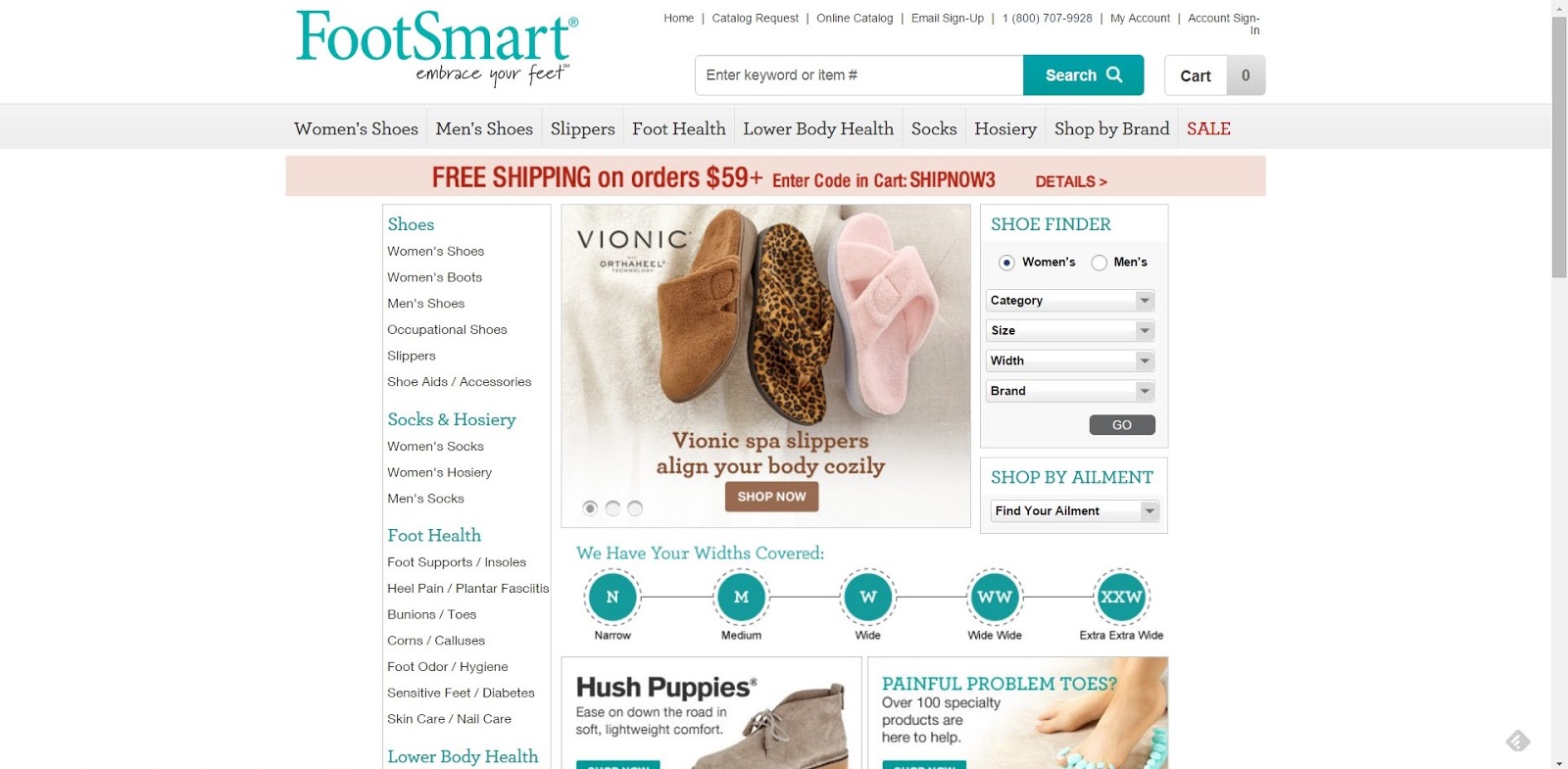
How about FootSmart?


FootSmart has an older-than-average customer base. When brands have older-than-average customer bases, you observe increases in the following:
  • Increased Copy.
  • Increased Offers.
  • Increased Product Density.
  • Customer-Relevant Copy (heel pain, toe pain, bunions, corns).
Now, if you don't believe me, do the research yourself. Grab yourself a copy of the IR500 or IR Next 500, look at the demographic profiles of the brands presented, and then use your preferred device to look at the creative presentation used on the website. You'll see the same trends.
  • Young = Sparse.
  • Young = Imagery.
  • Older = Text.
  • Older = Offers.
  • Older = Dense.
You pick your customer on the basis of a combination of tactics.
  1. Marketing tactics (catalogs skew older, mobile skews younger).
  2. Merchandise (FootSmart Bunion Relief = older, for instance).
  3. Creative (dense/text = older, images = younger).
Remember, customer acquisition is the story of 2016-2020:

Life of an Item

In case you are wondering why I'm talking about items / merchandise more often, this is a process that happens every 3-5 years. Business...